Pre-Code Cinema (1930–1934): The Lost World
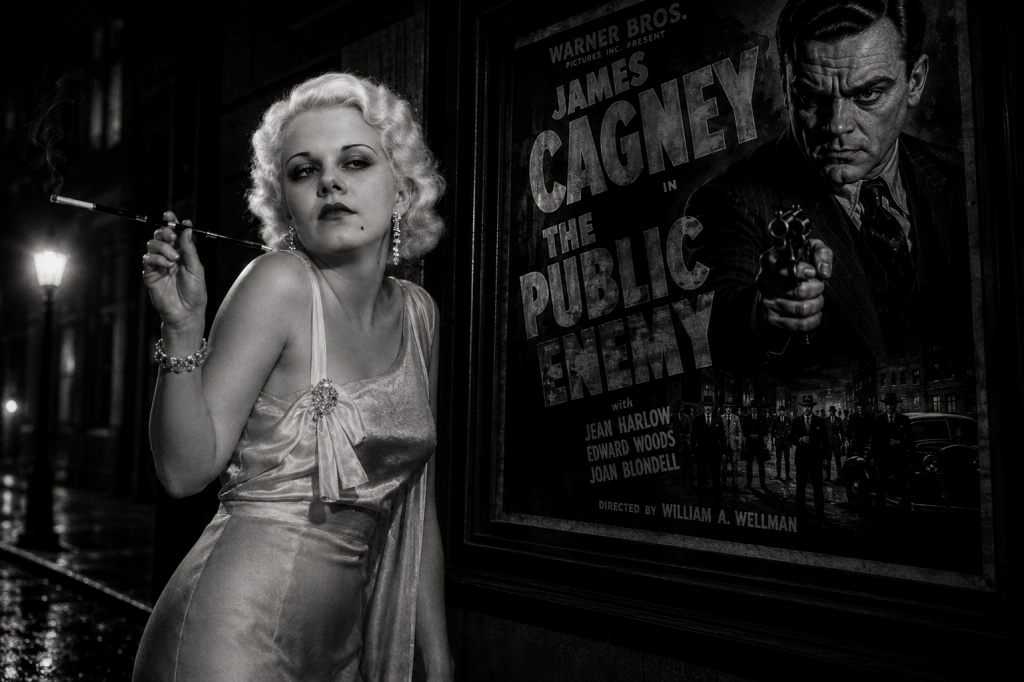
By Kiya Laurent
Estimated reading time: 25–35 minutes
From gangsters and femme fatales to horror, censorship, and artistic freedom, the brief Pre-Code era produced some of Hollywood’s boldest films before history changed course in 1934.
There is a moment in Baby Face when Lily Powers, played by Barbara Stanwyck, looks toward the towering New York office building she is about to enter. The camera begins at street level and travels upward, following the building floor by floor. As Lily rises through the company, the film returns to the exterior, climbing higher each time. The metaphor is hardly concealed. She is using the men on each floor to reach the one above it.
What remains startling is not merely the suggestion of sex. It is the film’s refusal to pretend that Lily has many honest opportunities from which to choose.
She has grown up in the back room of her father’s speakeasy, where powerful men have treated access to her as another privilege of doing business. When her father dies, Lily leaves town with her friend Chico and heads for New York. She has learned what men want, and she decides to convert that knowledge into power.
The film does not present her ascent as a harmless fantasy. It is calculating, bitter, funny, uncomfortable, and rooted in a world in which nearly everything—including affection, labor, marriage, loyalty, and the human body—can become a form of currency.
Released in 1933, Baby Face belongs to a brief and extraordinary period in American filmmaking now known as pre-Code cinema. The term generally describes the years between the widespread arrival of synchronized sound at the end of the 1920s and the strict enforcement of the Motion Picture Production Code in the summer of 1934. The Code had existed in written form since 1930, but for several years its authority remained inconsistent. Studios negotiated, evaded, compromised, ignored, and occasionally defied its restrictions.
The result was not a completely uncensored Hollywood. Local censorship boards could still demand cuts. Studio executives still feared public controversy. Films were shaped by commercial pressures, racial prejudice, gender conventions, and the political limitations of their time.
Yet something unusual happened during those few unstable years.
American movies spoke with an openness they would soon lose.
They acknowledged sex outside marriage, prostitution, homosexuality, addiction, abortion, racial injustice, corrupt capitalism, abusive authority, criminal ambition, religious hypocrisy, and the economic desperation of the Great Depression. Women pursued pleasure and independence without always expressing regret. Criminals became charismatic protagonists. Ministers could be frauds. Businessmen could be predators. The police could be cruel. Marriage could be a transaction rather than a sacred conclusion. A character could behave badly, survive, and occasionally prosper.
Pre-Code films did not invent adult subject matter. Silent cinema had already explored many of these themes, and European filmmakers were often more daring. What distinguished the early sound era was the collision of modern dialogue, economic crisis, urban culture, new stars, aggressive studio production, and uncertain censorship.
For several years, Hollywood seemed unsure of where its boundaries were.
That uncertainty created a lost world.
Before the Code
The popular name “Hays Code” comes from Will H. Hays, a former Republican Party chairman and United States postmaster general who became president of the Motion Picture Producers and Distributors of America in 1922.
Hays was hired during a period when Hollywood faced scandal, political hostility, and growing demands for federal censorship. The film industry wanted to reassure the public that it could regulate itself. Self-regulation was not only a moral argument; it was a strategy for protecting the studios’ control over their product.
The threat was already real. State and municipal censorship boards could prohibit films or order individual scenes removed. Standards varied from one jurisdiction to another. A film accepted in one city might be altered in another. For vertically integrated studios producing and distributing movies across the country, this patchwork was expensive and unpredictable.
In 1927, the industry adopted a list commonly known as the “Don’ts and Be Carefuls.” The subjects to be avoided or treated cautiously included profanity, nudity, illegal drug trafficking, sexual “perversion,” interracial relationships, childbirth, ridicule of religion, and certain depictions of crime.
The more comprehensive Motion Picture Production Code followed in 1930. Written principally by Catholic layman Martin Quigley and Jesuit priest Daniel A. Lord, the document was more than a list of forbidden images. It expressed an entire philosophy of mass entertainment.
Motion pictures, the Code argued, were uniquely powerful because they reached enormous audiences and created vivid emotional impressions. Therefore, filmmakers were expected to uphold what its authors considered correct moral standards.
Its governing principles declared that no picture should lower the moral standards of those who saw it. The sympathy of the audience should not be directed toward crime, wrongdoing, evil, or sin. Law—whether natural, human, or divine—should not be ridiculed. Wrongdoing could be depicted, but it could not be made so attractive that viewers might admire or imitate it.
These ideas would profoundly shape American movies once they became enforceable. During the early 1930s, however, the Code had a serious weakness: the organization interpreting it could object, negotiate, and recommend, but it lacked sufficient power to prevent a studio from releasing a film.
Hollywood possessed rules without an effective court.
That distinction matters. The term “pre-Code” can imply that the Code did not yet exist. It did. The films of the period were being made in its presence. Their freedom came from the gap between written morality and industrial enforcement.
In that gap, filmmakers found room to maneuver.
A Nation in Crisis
Pre-Code cinema cannot be separated from the Great Depression.
The stock-market crash of 1929 did not instantly transform every aspect of American life, but the economic collapse that followed reached into nearly every community. Banks failed. Businesses closed. Families lost their homes. Unemployment spread on a scale that made traditional assurances about hard work and respectability feel increasingly hollow.
Movies remained an essential form of escape, but they also absorbed the anger and anxiety surrounding them.
Warner Bros. became especially associated with tough, urban stories about gangsters, prison labor, political corruption, newspaper offices, factories, and working-class survival. Its films moved quickly. Dialogue arrived like gunfire. Characters spoke in slang, interrupted one another, lied without ceremony, and understood that respectable institutions were often operating rackets of their own.
In The Public Enemy (1931), James Cagney’s Tom Powers rises through the Chicago underworld during Prohibition. The film does not hide the brutality of his world, but neither does it deny his vitality. Cagney moves with such speed and confidence that Tom becomes difficult to dismiss as a simple cautionary symbol.
He is funny, vicious, magnetic, and emotionally stunted. His criminal life is not presented as the invasion of evil into an otherwise healthy society. It grows out of the neighborhood, the family, Prohibition, poverty, masculine codes, and the opportunities created by corruption.
The film’s famous violence retains its shock because it often arrives without operatic preparation. A horse is killed after throwing and injuring one of Tom’s partners. A man disappears behind a closed door before gunshots reveal his fate. Tom shoves half a grapefruit into his girlfriend’s face at breakfast, turning an ordinary domestic moment into an eruption of humiliation.
At the conclusion, his bandaged body is delivered to his family’s doorstep. He falls forward into the house like a package returned to its sender.
The Public Enemy condemns criminality, but it does not restore moral order comfortably. Its world has already produced Tom Powers. Removing him does not remove the conditions that formed him.
The Library of Congress describes the film as a raw and brutal crime saga and identifies Cagney’s performance as his star-making role. That brutality was central to the gangster cycle’s impact. These films were not merely stories about lawbreaking; they were stories about ambition in a society where legitimate paths to advancement appeared blocked. (The Library of Congress)
Howard Hawks’s Scarface (1932), produced by Howard Hughes, pushed the gangster film toward something even more feverish. Paul Muni’s Tony Camonte does not simply want money. He wants expansion. He treats the city like territory awaiting conquest.
A sign visible outside his apartment declares, “The World Is Yours.” It functions as an advertisement, a promise, and an accusation.
Tony’s violence is childish in its excitement and industrial in its efficiency. The machine gun becomes both weapon and modern object—a tool suited to mass production. The film connects organized crime with the language of business: competition, territory, acquisition, elimination.
The censors objected intensely to Scarface, and its release was delayed while Hughes battled over cuts and alterations. The film appeared with the subtitle The Shame of a Nation, and moralizing material was added to place responsibility on government and the public. Yet these gestures could not neutralize Tony’s energy.
The movie’s true horror is not that he is entirely alien to American values. It is that he pursues recognizable American promises through naked violence.
He wants the world because the world has told him it belongs to whoever can take it.
Women Without Permission
One of pre-Code cinema’s most distinctive qualities is the range of women who occupy its stories.
They are secretaries, performers, criminals, socialites, prostitutes, wives, laborers, journalists, nightclub singers, department-store employees, and professional opportunists. They make compromises, pursue careers, manipulate men, reject marriage, desire money, enjoy sex, and attempt to survive structures designed to exploit them.
These films are not uniformly progressive. Many were created by men and still depend upon stereotypes, voyeurism, and punishment. But their women are frequently allowed a degree of knowledge later movies would struggle to accommodate.
They understand the price placed upon them.
In Baby Face, Lily’s sexuality is not portrayed as an innocent force she barely comprehends. It is a form of leverage she consciously uses after years of being exploited by men. The original version of the film was considered so provocative that Warner Bros. revised it, changing dialogue and reshaping its moral emphasis. The uncensored version was rediscovered decades later and eventually preserved by the Library of Congress.
The film’s most radical element may be the friendship between Lily and Chico, played by Theresa Harris. Chico is a Black woman who leaves the industrial town with Lily and remains beside her as Lily advances. The relationship is unequal in ways the film does not fully confront—Chico is often positioned as Lily’s maid—but their bond possesses an emotional steadiness absent from Lily’s relationships with men.
They leave together. They travel together. Chico witnesses the cost of Lily’s reinvention.
Race in pre-Code Hollywood remains a field of contradictions. Black performers could appear with a visibility and vitality that later became constrained in different ways, yet they were usually denied equal narrative power and restricted to stereotyped roles. The period’s daring in one area did not erase the industry’s racism.
Still, performers such as Harris could create presence beyond the limitations of the screenplay. Chico’s voice, patience, and observation complicate the film. She is not simply part of Lily’s rise; she is evidence of who has been required to stand quietly while that rise occurs.
Jean Harlow’s films offer another vision of female modernity. In Red-Headed Woman (1932), she plays Lil Andrews, who seduces her married employer and refuses to accept the social boundaries imposed upon her. Lil is selfish, disruptive, and shamelessly determined. The film does not pretend she is misunderstood goodness. Its audacity comes from allowing her to remain energetically herself.
She pursues wealth, status, pleasure, and revenge. When one plan collapses, she creates another. The conclusion suggests that she has not been purified or destroyed. She has simply relocated her campaign.
A later Code-era version of such a character would generally require clearer punishment, repentance, or containment. Lil slips through the moral machinery.
Harlow’s screen presence was essential to this effect. Her comedy is physical and unsentimental. She does not ask the audience’s permission to occupy the frame. Her sexuality is paired with impatience, wit, and an almost cheerful recognition that respectable society is held together by appetites it refuses to name.
Mae West went further by making the act of naming those appetites central to her art.
West arrived in Hollywood as an established stage performer, playwright, and public scandal. She understood censorship not simply as an obstacle but as a creative opponent. Her dialogue advanced through implication, reversal, rhythm, and double meaning. What could not be stated directly could be made unmistakable through timing.
In She Done Him Wrong (1933), adapted from her stage play Diamond Lil, West plays nightclub singer Lady Lou, a woman surrounded by criminals, admirers, diamonds, and danger. She controls the room not through innocence but through complete self-possession.
Cary Grant’s young missionary character may appear morally respectable, but West’s presence reorganizes the film around her own authority. She evaluates men as openly as male characters traditionally evaluated women.
The film’s success helped make West one of Paramount’s most valuable stars. It also made her a conspicuous target. The Library of Congress notes that severe Code enforcement arrived roughly sixteen months after the film’s release and sharply restricted what West could do on-screen. (The Library of Congress)
The shift was not merely a reduction in exposed skin or suggestive dialogue. It narrowed the forms of female personality Hollywood could present without correction.
MoMA has observed that the early talkies produced a variety of women stars whose styles were particularly suited to Depression-era stories and that enforcement of the Code reduced the demand for many of those characters. Working women who displayed common sense, self-preservation, weariness, aggression, or sexual confidence no longer fit as easily within the approved moral frame. (The Museum of Modern Art)
The lost world was populated not only by famous rebels such as West, Stanwyck, Harlow, Marlene Dietrich, and Miriam Hopkins, but by actresses whose careers and screen types faded as Hollywood’s boundaries tightened.
Censorship does not only remove scenes.
It can remove entire kinds of people.
Desire in Disguise—and Without It
Later Hollywood cinema became extraordinarily skilled at suggestion. Filmmakers working under the Code learned to communicate desire through glances, shadows, closing doors, cigarettes, trains entering tunnels, and dialogue constructed to pass one meaning to the censors while offering another to the audience.
Pre-Code cinema often possesses that elegance, but it does not always require the disguise.
In Ernst Lubitsch’s Trouble in Paradise (1932), romance and theft become almost indistinguishable. Herbert Marshall and Miriam Hopkins play Gaston and Lily, sophisticated criminals who recognize one another while attempting to steal from each other.
Their courtship is an exchange of recovered property.
A wallet appears. A watch is returned. A garter is produced. Each revelation becomes an erotic gesture because both characters understand the game. They fall in love through mutual recognition—not despite being thieves, but because each has finally encountered someone capable of appreciating the other’s craft.
When Gaston later becomes involved with wealthy perfume executive Mariette Colet, played by Kay Francis, the film refuses to arrange its relationships into simple virtue and vice. Desire travels alongside class, money, deception, and admiration.
Lubitsch’s world is artificial in the most elegant sense. Doors open and close with musical precision. Objects speak. Time passes through suggestion. Yet beneath the polish lies a destabilizing idea: morality may be less attractive than style, and lawful society may be no more honest than the thieves attempting to rob it.
Trouble in Paradise was difficult to reissue once the Code was firmly enforced. Its attitude could not easily be repaired by removing a line or shortening an embrace. The problem was structural. The criminals were charming, sex existed beyond marriage, and respectability never acquired moral superiority.
The Code could censor actions, but it was especially suspicious of atmosphere.
An atmosphere can persuade without arguing.
Design for Living (1933), directed by Lubitsch and adapted very freely from Noël Coward’s play, presented another problem. Miriam Hopkins, Fredric March, and Gary Cooper form a romantic triangle whose proposed solution is not that the woman choose between the two men. Instead, the three attempt to build a life together under a private agreement.
Their arrangement is comic, unstable, and never described with modern terminology. Yet the premise challenges the assumption that a respectable romantic story must narrow desire into an approved pair.
The film does not offer a manifesto. It offers pleasure in refusing the expected ending.
Marlene Dietrich’s films with director Josef von Sternberg created their own world of shifting identity. In Morocco (1930), Dietrich appears in a tuxedo and top hat, performs before a nightclub audience, and kisses a woman on the mouth before taking a flower from her hair and giving it to Gary Cooper.
The sequence lasts only a moment, but its imagery has endured because it makes gender itself appear theatrical. Dietrich does not borrow masculine clothing in order to disappear. The tuxedo intensifies her presence.
Pre-Code cinema’s treatment of queer identity was rarely free from caricature. Effeminate men were often used as jokes, coded figures, or background decoration. Yet such figures could appear openly enough to register as part of urban life. After enforcement, the Code’s prohibition against what it called “sex perversion” drove homosexuality into more concealed forms.
The screen did not become free of queerness.
It became fluent in shadows.
Horror Before the Door Closed
The early 1930s transformed American horror.
Universal’s Dracula and Frankenstein, both released in 1931, established images that would become inseparable from their literary sources. Bela Lugosi’s deliberate speech, cape, and hypnotic stillness shaped the popular Dracula. Boris Karloff’s flat-topped Monster, created with makeup artist Jack Pierce, became one of cinema’s most recognizable faces.
These films are sometimes remembered as stately classics, safely distant from modern horror. Seen closely, they remain charged with transgression.
Frankenstein is about forbidden creation, violated bodies, scientific ambition, parental abandonment, and a society that responds to fear with collective violence. Henry Frankenstein enters graveyards and gallows to assemble life from the dead. The Monster awakens not as pure evil but as consciousness without guidance.
One of the film’s most disturbing scenes occurs when the Monster encounters a young girl beside a lake. She welcomes him without fear. Together they throw flowers into the water and watch them float. When the flowers are gone, the Monster throws the child into the water, apparently believing she will float as well.
The scene’s horror comes from innocence rather than malice.
It was removed from many prints and remained difficult to see for years. Without it, the discovery of the girl’s body is more mysterious. With it restored, the Monster becomes more tragic and frightening at once.
The film’s original opening also included actor Edward Van Sloan stepping before a curtain to warn the audience that the story might horrify them. Horror was not yet treated as an ordinary product category. It arrived as an event requiring a threshold.
Pre-Code horror repeatedly crosses thresholds.
In Dr. Jekyll and Mr. Hyde (1931), Fredric March’s transformation is not only physical. Hyde embodies appetite released from social performance. His abuse of Ivy, played by Miriam Hopkins, gives the film a sexual cruelty that remains difficult to watch. Jekyll does not merely become another being; he creates permission for desires already within him.
Island of Lost Souls (1932), adapted from H. G. Wells’s The Island of Doctor Moreau, enters an even darker territory. Charles Laughton’s Doctor Moreau transforms animals into humanlike beings through surgical experimentation. His island is governed by pain, ritual, and the repeated question, “What is the law?”
The film’s horror is scientific, colonial, religious, and bodily. Moreau acts as creator, dictator, and sadist. His creatures have been forced into unstable identities and commanded to deny their animal nature. The Law gives language to their oppression while disguising it as civilization.
When they finally turn upon Moreau, the punishment is not administered by a morally restored institution. His own creations carry him toward the operating room.
The violence he called progress returns as judgment.
Tod Browning’s Freaks (1932) remains perhaps the period’s most complicated horror film. Browning, who had worked in circus and carnival environments, cast performers with disabilities and physical differences as members of a traveling sideshow community.
The plot concerns a trapeze artist, Cleopatra, who conspires with the strongman Hercules to marry and murder Hans, a little person who has inherited money. The sideshow performers accept Cleopatra into their community during a wedding feast, chanting their promise that she is “one of us.” She recoils in disgust and humiliates them.
The film’s final movement turns toward revenge, storm, mud, blades, and transformation. It is this ending that secured Freaks its reputation as a nightmare.
Yet the film’s moral structure places its sympathy largely with the people whom Cleopatra and Hercules treat as less than human. The so-called normal characters become the monsters because of their cruelty.
That reversal was too disturbing for many audiences and exhibitors. MGM cut the film significantly. It was banned in the United Kingdom for decades and disappeared from ordinary circulation before being rediscovered as a cult work. The Library of Congress notes that its unusual cast, subject, and nontraditional moral sympathy contributed both to its troubled release and its later following. (The Library of Congress)
Freaks is not beyond criticism. The revenge sequence can turn bodily difference back into spectacle, and the film’s advertising often exploited the very performers its story asks viewers to respect.
That contradiction is part of its history.
Pre-Code cinema could expose prejudice while still participating in it. It could create space for marginalized figures without surrendering the commercial instincts of the sideshow.
The lost world was never innocent.
It was revealing.
The Business of Respectability
The conflict over film content was intensified by the economic structure of Hollywood.
The major studios controlled production, distribution, and large theater chains. They manufactured films on organized schedules, moved stars between projects, and relied upon constant exhibition. A censorship controversy could be useful publicity, but widespread boycotts or coordinated political pressure threatened the entire system.
During the early 1930s, religious organizations became increasingly effective at mobilizing opposition to screen content. Catholic leaders helped organize the Legion of Decency in 1934, asking members to pledge resistance to films considered morally objectionable.
The studios were no longer facing scattered criticism alone. They were facing an organized national campaign capable of affecting ticket sales.
Joseph I. Breen, a powerful Catholic layman and longtime industry censor, became head of the newly strengthened Production Code Administration. Beginning in July 1934, films released by member studios required a PCA seal of approval. Companies that distributed unapproved pictures could face substantial fines. The Library of Congress identifies July 15, 1934, as the point when this approval requirement became binding for MPPDA members. (The Library of Congress)
The machinery now had teeth.
The change did not occur because a single shocking film suddenly corrupted the nation. Nor can it be reduced entirely to one religious organization, one censor, or one studio decision. It emerged from years of conflict involving local boards, reform groups, industry fears, political pressure, economic vulnerability, and competing ideas about the social power of movies.
The Code offered the studios a bargain.
They would surrender certain kinds of expression in exchange for greater industrial stability. A centrally administered seal could reduce the chaos of regional censorship and protect the industry from more direct government intervention.
Morality and business became partners.
After 1934, screenplays were reviewed before production. Objections could be raised while stories were still being developed. Negotiation moved earlier into the creative process. This mattered because censorship became architectural rather than merely surgical.
Instead of cutting an offending scene after a film was completed, the system could prevent the scene from being conceived, financed, written, or photographed in the first place.
The most effective censorship leaves no scar because the missing thing was never allowed to exist.
What the Code Changed
The Code did not make all American films dull, childish, or artistically dishonest.
Some of the greatest movies ever produced in Hollywood were created during the decades of strict enforcement. Directors, writers, performers, cinematographers, designers, and editors learned to work through implication. Limitations inspired indirection, metaphor, visual wit, and narrative ingenuity.
Film noir grew in part from a world of shadows, compromised desire, and coded corruption. Screwball comedy turned conflict between the sexes into speed, disguise, and verbal combat. Horror relocated forbidden material into monsters, laboratories, dreams, and uncanny houses. Alfred Hitchcock became a master at designing images whose psychological meaning exceeded what could be spoken.
The Code did not end adult cinema.
It changed its language.
But the cost of that change should not be romanticized.
The Code required crime to be treated carefully and discouraged films from making criminals appear heroic. Adultery could not be presented as attractive or justified. Sexual relationships outside marriage faced restriction. Queer identity was pushed into coding, implication, villainy, ridicule, or absence. Interracial romantic relationships were prohibited. Abortion could scarcely be named. Religious figures and institutions received protection. The “correct standards of life” were expected to prevail.
The idea of moral balance became inseparable from punishment.
A woman might desire independence, but the narrative often needed to demonstrate its cost. A criminal might fascinate the audience, but the conclusion had to close the account. A marriage might be miserable, but adultery could not become an uncomplicated path toward freedom. Authority could be questioned, but not so completely that the social order lost legitimacy.
This did not produce a single uniform cinema. Enforcement changed over time, and filmmakers continually tested the limits. Some films reached mature and complex conclusions despite the rules. Others exposed the hypocrisy of respectable life through implication.
Yet the range of permissible outcomes narrowed.
One way to understand the difference is to compare not only what characters do, but what a film is permitted to feel about them.
Pre-Code cinema can be surprisingly nonjudgmental. It may observe a character’s choices without supplying the audience with a formal moral verdict. It may allow contradiction to remain unresolved.
Code-era cinema often had to settle the meaning.
The Versions That Vanished
The enforcement of the Code affected films made before 1934 as well as those made afterward.
When studios sought to reissue earlier pictures, the films could be reviewed under the newer standards. Scenes once accepted were cut. Dialogue disappeared. Narratives were altered. In some cases, the surviving version known to generations of viewers was not the version originally released.
The Library of Congress has documented how a suggestive scene in the 1933 film State Fair was removed for a 1936 reissue because the newly enforced Code would not accept it. (The Library of Congress)
This process helps explain why pre-Code cinema can feel like an archaeological subject. The lost world is not only a metaphor. Parts of it were physically removed.
Film itself was fragile. Studios discarded prints, lost negatives, re-edited existing materials, and treated many movies as products with limited commercial lives. Some titles survived only in compromised copies. Others became difficult to see because they could not receive approval for rerelease.
A film can disappear without being officially banned.
It can be withheld, shortened, neglected, mislabeled, or forgotten.
Modern restorations have therefore changed our understanding of the period. When original footage is recovered, a familiar movie can regain its political meaning, erotic charge, emotional logic, or narrative clarity.
The restoration of Baby Face did more than add provocative material. It revealed how strongly the film understood Lily’s actions as a response to exploitation and economic philosophy. Advice she receives from an older cobbler, influenced by Nietzsche, encourages her to use men rather than allowing them to use her. The altered release version softened that idea and inserted a more conventional moral warning.
The difference is not decorative.
It changes who Lily is.
The Myth of Lawlessness
It is tempting to describe pre-Code Hollywood as a party that ended when the guardians arrived.
The reality is more interesting.
The period was not free of censorship, and its filmmakers were not united in a campaign for liberation. Studios wanted profitable films. Executives responded to public appetite. Stars were marketed through carefully constructed identities. Controversy was both feared and exploited.
Many pre-Code films uphold conservative ideas even while violating particular taboos. Some punish women more severely than men. Some rely upon racist caricature. Some turn queer people into jokes. Some treat poverty as atmosphere rather than injustice. Some use violence and sexuality as commercial attraction without examining either deeply.
The era was not a lost paradise.
It was a contested zone.
Its importance lies in the instability of its values. The rules had been written, but their authority was incomplete. Economic collapse had weakened public faith in respectable institutions. Sound had made movies feel immediate, urban, and confrontational. Broadway performers and writers brought new verbal energy. Studios were competing aggressively for audiences.
For a few years, contradiction remained visible.
A film could criticize sexual exploitation while selling an actress’s body.
It could condemn a gangster while inviting the audience to enjoy his rise.
It could sympathize with outsiders while advertising them as spectacle.
It could mock wealth while depending upon fantasy.
It could defend marriage while demonstrating that marriage was often economic theater.
That contradiction gives the films life.
They do not speak from a morally purified past. They expose the machinery of their moment because the machinery had not yet learned to conceal itself completely.
Why They Still Feel Modern
Watching a pre-Code film today can produce a strange interruption in our sense of history.
The clothing, speech, technology, and performance styles belong unmistakably to the early 1930s. Yet the attitudes can feel closer to modern independent cinema than to the polished studio films released only a few years later.
Characters live together without marriage. Women discuss the economic uses of sex. Employees recognize their bosses as predators. Prisoners are abused by institutions claiming to reform them. Religious authority is questioned. Wealth appears inseparable from corruption. Gender can become performance. Romantic relationships resist tidy definition.
The surprise reveals something about how cultural memory works.
We often imagine progress as a straight line: each generation sees more, says more, and becomes more honest than the one before it. Pre-Code cinema complicates that story. Freedom can expand and contract. A culture may speak openly, retreat into silence, and later rediscover what it had once been willing to admit.
History does not simply move forward.
Sometimes it closes a door.
The films also feel modern because the economic conditions shaping them have not entirely disappeared. Baby Face understands that labor, sexuality, and advancement exist within systems of unequal power. The Public Enemy understands that violence can become a form of entrepreneurship. Trouble in Paradise understands that the wealthy and the criminal may differ more in manners than in ethics. Freaks understands that a society calling people abnormal may be revealing its own cruelty.
These films do not always provide solutions. Their power often lies in recognition.
They know something is wrong.
The Faces of the Lost World
Every historical period eventually becomes a collection of famous images.
Cagney with the grapefruit.
Dietrich in the tuxedo.
Karloff beneath Jack Pierce’s makeup.
Mae West leaning backward as though the entire room exists for her amusement.
Stanwyck staring toward the next floor.
The rain-soaked figures crawling beneath the wagons in Freaks.
These images survive because they contain more than scandal. They preserve ways of being that the industry was preparing to regulate.
Pre-Code cinema’s stars frequently appear to know the audience is watching and to understand why. Their performances possess an unusual directness. They do not always seek identification through moral goodness. They invite fascination through intelligence, appetite, anger, humor, elegance, fatigue, or danger.
They can be difficult without becoming unknowable.
This may be Kiya Laurent’s lost world in its most human form: not a world without rules, but a cinema in which people had not yet been reduced to examples of correct behavior.
They could remain unresolved.
They could know too much.
They could want the wrong thing and explain why.
They could look directly at the structure surrounding them and decide to use it, escape it, rob it, seduce it, laugh at it, or burn within it.
After the Lost World
The Production Code remained a central force in American filmmaking for more than three decades, though its authority weakened significantly during the 1950s and 1960s. Social change, competition from television, foreign films, independent producers, court decisions, and filmmakers’ increasing challenges made the old system difficult to sustain.
In 1968, the Code was replaced by the modern ratings system.
By then, the pre-Code years had become distant. Many of their films were rarely shown, available only in incomplete versions, or remembered as curiosities. Television packages often favored movies that could fit later standards and broadcasting requirements. Scholars, archivists, programmers, collectors, repertory theaters, cable channels, and home-video releases gradually returned the period to public view.
What emerged was not simply a cabinet of forbidden scenes.
It was an alternative map of American cinema.
Pre-Code movies demonstrate that the classical studio system contained more possibilities than later cultural memory suggested. Hollywood could be cynical, sexually intelligent, politically angry, morally uncertain, and sympathetic toward people outside respectable society.
It could also be cruel, prejudiced, exploitative, and commercially opportunistic.
The value of the period comes from seeing those qualities together.
A lost world is often imagined as pure because it can no longer contradict us. Pre-Code cinema refuses that comfort. It is too restless to become innocent nostalgia.
Its women may be liberated in one scene and objectified in the next.
Its criminals may expose capitalism while reproducing its violence.
Its monsters may be victims and threats simultaneously.
Its elegance may conceal desperation.
Its humor may carry the sound of people realizing that the rules were never designed for them.
What Was Really Lost
What disappeared in 1934 was not sex.
Hollywood found ways to suggest sex.
It was not crime.
Gangsters, murderers, thieves, and corrupt officials remained essential to American movies.
It was not darkness.
Some of cinema’s darkest masterpieces were still to come.
What was lost was a particular kind of permission: the permission to present adult contradiction without reliably repairing it before the final reel.
The Code did not merely ask what could be shown. It asked where the audience’s sympathy was allowed to go.
That is the deeper question behind pre-Code cinema.
May we sympathize with the criminal?
May we understand the woman who uses the only power society has given her?
May we desire what the institution calls improper?
May the minister be fraudulent, the businessman predatory, the prison unjust, the family damaging, and the law morally inadequate?
May the monster be more human than the crowd?
For a few brief years, Hollywood’s answer was sometimes yes.
Not always bravely. Not always consciously. Not without prejudice or compromise. But often enough to leave behind a body of films that still feels dangerous—not because modern viewers are shocked by a dress, a kiss, or an innuendo, but because the films reveal how quickly a culture’s moral certainty can be manufactured.
The lost world was not destroyed in a single night. Its borders narrowed through memos, negotiations, altered endings, withheld seals, removed scenes, organized pressure, and decisions made before cameras began to turn.
Then, gradually, audiences forgot that another Hollywood had existed.
But the evidence remains.
It survives in Lily Powers entering the office building.
In Lady Lou surveying a room full of men.
In Dietrich adjusting her tuxedo.
In Tony Camonte looking toward the promise that the world belongs to him.
In Moreau’s creatures asking what the law is and who created it.
In the Monster reaching for the last flower.
These images return from the darkness carrying the unresolved questions of their time.
They do not ask us to mistake transgression for freedom.
They ask us to remember that freedom is temporary unless someone recognizes what is being taken away.
Pre-Code cinema was brief, compromised, unruly, and alive.
Its world was lost.
Its voice was not.
About the Author
Kiya Laurent is a contributing writer for DARKWAVE Magazine, where she explores the history of film, music, and the cultural movements that continue to shape them. Her work combines meticulous research with long-form storytelling, uncovering forgotten histories, overlooked artists, and the ideas that connect cinema, music, and visual culture across generations.
Selected Research References
Academy of Motion Picture Arts and Sciences, Margaret Herrick Library. Motion Picture Association of America Production Code Administration Records. The collection preserves production documents covering hundreds of films and identifies Will H. Hays’s introduction of the Code and Joseph Breen’s role in administering it beginning in 1934. (Arena)
Library of Congress. “When ‘Pre-’ Met ‘Code’—Eighty Years Ago Today.” The Library dates the binding approval requirement for MPPDA members to July 15, 1934, when films had to obtain PCA approval or expose their distributors to financial penalties. (The Library of Congress)
Library of Congress, National Film Preservation Board. National Film Registry descriptions and essays for Baby Face, The Public Enemy, Scarface, Freaks, Red Dust, She Done Him Wrong, and other works discussed in this article. (The Library of Congress)
Museum of Modern Art. “Dames, Janes, Dolls, and Canaries: Women Stars of Pre-Code Hollywood.” MoMA’s accompanying material examines the range of actresses and working-woman characters who flourished during the early sound years before Code enforcement narrowed their opportunities. (The Museum of Modern Art)
Museum of Modern Art. “Fleischer Cartoons: The Pre-Codes.” MoMA notes how enforcement changed Betty Boop’s image and restricted the sexual suggestion, violence, substance use, and urban humor common in the earlier cartoons. (The Museum of Modern Art)
Library of Congress. “On the Film Registry: State Fair (1933).” The essay documents the removal of a seduction scene when the film was prepared for reissue under the enforced Code in 1936. (The Library of Congress)