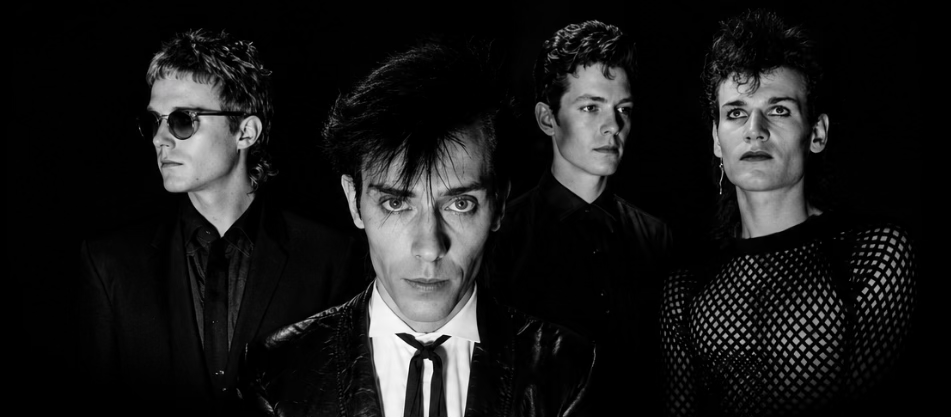
The landmark debut album that transformed post-punk into something darker, stranger, and entirely its own. Inside the creation of one of the most influential albums in gothic rock history—and the story of how four musicians from Northampton created a work that continues to inspire generations of artists, musicians, filmmakers, and outsiders more than four decades later.
Introduction
The Record That Opened Another Room
Some albums document a band. Others create a world. In the Flat Field, released by Bauhaus in 1980, belongs to the second category.
The album arrived during a period when post-punk was still wide open. Punk had broken the rules, but the most adventurous artists were beginning to ask what could happen after that rupture. Could a rock band use horror cinema, literature, dub, glam, theatre, art-school experimentation, and stark visual design without becoming trapped by any of them? Could darkness be intelligent, elegant, physical, and strange at the same time? Could a debut album feel less like a collection of songs and more like a doorway?
Bauhaus answered those questions by refusing to sound like anyone else.
Peter Murphy, Daniel Ash, David J, and Kevin Haskins did not simply make a gothic rock record. In fact, the genre vocabulary that would later surround them had not yet settled into place. What they made was more unstable and more interesting: a record built from tension, space, theatricality, rhythm, instinct, and atmosphere. Later generations would hear the foundations of gothic rock, darkwave, industrial music, alternative rock, and post-punk revivalism inside it. But the album itself still resists being reduced to any single label.
That resistance is part of its power.
In the Flat Field remains important because it does what lasting art often does. It creates its own weather. It does not simply ask to be heard. It asks the listener to enter.
Before Bauhaus
From Northampton to Post-Punk
Before Bauhaus became one of the defining names in gothic rock, they were four young artists emerging from Northampton, England, at the end of the 1970s. That timing matters. Punk had already proved that music could be urgent, independent, and self-directed. But by 1978 and 1979, many musicians wanted to move beyond punk’s first explosion. They wanted more space, more ambiguity, more rhythm, more art, more atmosphere, and more danger.
That restless period became post-punk.
Post-punk was never one single sound. It was a permission slip. Some artists explored funk and dub. Others pushed toward electronics, minimalism, noise, art rock, poetry, or experimental production. What united the best of them was not a shared formula, but a shared rejection of inherited rules.
Bauhaus used that freedom with unusual conviction.
Northampton also gave the band a particular emotional pressure. The feeling of ordinary surroundings, boredom, escape, and the desire to transform the everyday into something charged and theatrical runs through the album. The title In the Flat Field suggests that tension: the flatness of the ordinary world, and the imaginative force required to break out of it.
By the time the group formed, each member brought something different. Peter Murphy had presence, mystery, and a voice that could move from whisper to command. Daniel Ash treated the guitar as a source of texture and disturbance. David J gave the bass melodic authority. Kevin Haskins approached rhythm with discipline, space, and imagination.
The result was not merely a band looking for a scene. It was the beginning of an artistic language.
The Formation of Bauhaus
Four Artists, One Vision
Every influential band begins with a meeting of personalities, but Bauhaus emerged from something deeper than coincidence. Formed in Northampton in 1978, the group brought together four musicians whose approaches to music, art, and performance were remarkably different yet unexpectedly compatible. Peter Murphy, Daniel Ash, David J, and Kevin Haskins did not simply assemble a rock band. They created a creative partnership that would redefine the possibilities of post-punk and help lay the foundations of what would later be called gothic rock.
Unlike groups built around a single dominant songwriter, Bauhaus functioned as a genuine artistic collective. Songs evolved through collaboration, experimentation, and a shared willingness to ignore convention. Each member approached music from a different direction, and those contrasts became one of the band’s greatest strengths. Remove any one of the four, and Bauhaus immediately becomes something else.
Murphy quickly established himself as one of rock music’s most compelling frontmen. Tall, charismatic, and impossible to ignore, he possessed a commanding baritone capable of moving between whispers, chants, theatrical narration, and explosive projection. Comparisons to David Bowie followed him, but Murphy was never simply following Bowie’s path. He developed a distinctive identity rooted in symbolism, literature, emotional ambiguity, and total commitment to performance.
If Murphy became the visual and emotional focal point, Daniel Ash became Bauhaus’ great sonic architect. Few guitarists of the post-punk era expanded the vocabulary of the electric guitar as dramatically. Rather than relying on blues-derived riffs or conventional rock solos, Ash approached the instrument almost as a sound designer. Harmonics, controlled feedback, echo, scraping techniques, unusual chord shapes, and carefully layered textures became part of his language. At various moments his guitar resembles machinery, shattering glass, whispered voices, metallic percussion, or something moving in the walls.
David J rejected the traditional role of simply reinforcing chord changes beneath the guitar. His bass lines frequently function as independent melodies, weaving around Murphy’s vocals while locking into Kevin Haskins’ drums. Rather than remaining hidden beneath the mix, the bass often becomes one of the defining voices of a Bauhaus composition.
Haskins completed the foundation with a drumming style that was disciplined, imaginative, and unusually attentive to space. Drawing from punk, dub, glam, reggae, jazz, and experimental music, he searched for rhythmic ideas rather than familiar rock patterns. Hi-hat dynamics, tom accents, cymbal color, silence, and shifting emphasis gave the band an unmistakable pulse.
One of Bauhaus’ greatest achievements was their understanding of space. Ash’s guitar never overwhelmed David J’s bass. Haskins’ drums never crowded Murphy’s voice. Every instrument occupied its own place in the arrangement, allowing the music to breathe. That sense of balance remains one of the reasons the recordings still sound modern.
Together, the four musicians built a complete artistic universe. The music, photography, typography, fashion, stage presentation, album artwork, and performances all belonged to the same mysterious world. Nothing felt accidental. Every decision strengthened the identity of Bauhaus, inviting listeners into an atmosphere somewhere between punk, art rock, German Expressionism, literature, horror cinema, performance art, and pure imagination.
Perhaps that is why the band continues to fascinate new generations. Bauhaus never seemed interested in chasing commercial expectations. They pursued originality with conviction. In doing so, they created more than songs. They created an alternate reality. Once inside, many listeners never wanted to leave.
Bela Lugosi’s Dead
The Six-Hour Recording That Changed Everything
Before In the Flat Field, before Bauhaus became one of the defining names in gothic rock, and before an entire visual and musical language began forming around them, there was “Bela Lugosi’s Dead.”
Recorded in January 1979 and released later that year as Bauhaus’ debut single on Small Wonder Records, the song remains one of the most astonishing introductions any band has ever made. Most groups announce themselves with something concise, energetic, and immediately accessible. Bauhaus chose the opposite approach. They emerged with a composition lasting more than nine minutes — a slow-burning, hypnotic work that ignored virtually every commercial expectation of a debut single.
Nothing about it sounded conventional. Nothing about it sounded temporary. It felt as though it had always existed somewhere in the shadows, simply waiting to be discovered.
The recording has become legendary partly because of how quickly it came into existence. “Bela Lugosi’s Dead” was recorded during a single six-hour session at Beck Studios in Wellingborough. A song that would become one of the founding documents of gothic rock was not assembled over weeks of expensive refinement. It emerged almost fully formed while the band was still discovering its own identity.
Sometimes great art arrives through refinement. Sometimes it arrives through instinct. This recording belongs firmly in the second category.
The opening remains one of the most recognizable in post-punk history. Kevin Haskins begins almost alone, introducing a skeletal rhythm that feels less like the start of a rock song than the opening of a ritual. Every cymbal strike, rimshot, and pause contributes to anticipation rather than immediate release. Haskins understood that tension often comes from restraint.
David J then enters with one of the most unforgettable bass lines ever recorded. Rather than merely outlining chord changes, he constructs the architecture upon which the entire composition rests. The bass moves with hypnotic confidence, repeating enough to induce a trance while introducing subtle variations that reward attentive listening.
Then Daniel Ash appears. His entrance is almost ghostlike. Rather than playing conventional rhythm guitar, he uses echo, harmonics, scraping textures, controlled feedback, and sustained notes to create an atmosphere suspended between music and sound design. Every phrase seems to emerge from darkness before dissolving back into it.
Peter Murphy’s vocal does not simply begin. It materializes. His delivery immediately establishes one of Bauhaus’ defining characteristics: the voice as performance, invocation, image, and presence. The repeated phrase “Bela Lugosi’s dead” could have become novelty in less capable hands. Murphy turns it into something strangely timeless.
He is not merely announcing the death of the actor famous for portraying Dracula. He is invoking a mythology: early horror cinema, black-and-white shadows, old theatres, velvet curtains, cemetery romance, artificial night, and the strange glamour of the undead.
The genius of the recording is discipline. Nobody overplays. Haskins leaves space. David J patiently develops the bass figure. Ash paints around the edges. Murphy enters only when the atmosphere is prepared to receive him. The song trusts suspense more than activity.
That philosophy would become central to Bauhaus. They were never simply writing dark songs. They were constructing environments. “Bela Lugosi’s Dead” feels less like a single than a location: a deserted theatre after midnight, a corridor inside a forgotten castle, a dream where time moves differently. The listener does not simply hear it. The listener enters it.
It is also important to remember that “Bela Lugosi’s Dead” was not included on the original UK release of In the Flat Field. It existed independently, almost like a mysterious invitation into the world the album would later expand. By November 1980, audiences already understood that Bauhaus were creating something unlike anything else in post-punk.
Looking back today, the recording remains astonishingly modern. There are no fashionable production tricks tying it to 1979, no obvious attempt to chase radio, and no unnecessary ornamentation. Only atmosphere, patience, confidence, and imagination.
More than four decades later, “Bela Lugosi’s Dead” still feels suspended outside ordinary time. It did not simply introduce Bauhaus. It opened the door.
Gold Nugget: Listen to the song once without focusing on the vocal. Follow only David J’s bass and Kevin Haskins’ percussion. Then listen again for Daniel Ash’s guitar textures. The track becomes a lesson in negative space: the drama comes as much from what Bauhaus refuses to play as from what they actually perform.
In the Flat Field
Creating the Album
By the summer of 1980, Bauhaus had already established themselves as one of the most original bands to emerge from Britain’s post-punk movement. “Bela Lugosi’s Dead” had become an underground sensation, while “Dark Entries” and “Terror Couple Kill Colonel” demonstrated that the group had no intention of repeating themselves. Rather than attempting to recreate the success of those singles, Bauhaus approached their debut album with a broader ambition.
They wanted to build an entire world.
In the Flat Field would not simply become a collection of songs. It would become a complete artistic statement — one that united music, atmosphere, photography, typography, performance, literature, visual art, and experimentation into a single immersive experience.
Recorded between late 1979 and the summer of 1980, much of the album was completed at Southern Studios in London after the band had returned from an extensive thirty-date British tour. Unlike many young bands recording a debut album, Bauhaus chose to produce the record themselves. It was an unusually confident decision, but it proved essential to preserving their artistic vision.
Southern Studios became more than a recording facility. It became another instrument. Echo was treated as composition. Silence became arrangement. Stereo placement became storytelling. Rather than filling every available moment with sound, Bauhaus allowed the music to breathe. Instruments appear from unexpected places, drift across the stereo image, disappear into darkness, then return.
One of the album’s most fascinating stories involves “Double Dare.” Although Bauhaus recorded a studio version, they remained dissatisfied with it. They felt it lacked the urgency of the version captured earlier for John Peel’s BBC Radio 1 programme. Rather than settling for a cleaner recording, they insisted that the Peel Session version better represented the spirit of the song.
That decision delayed the album’s release. Permission from the BBC was slowed by Musicians’ Union regulations, forcing Bauhaus to wait more than a month before In the Flat Field could finally appear. Most bands would have compromised. Bauhaus refused. The choice reveals something fundamental about their philosophy: artistic honesty mattered more than convenience.
Throughout the album, each musician continued expanding the language begun on the early singles. Haskins rejected predictable rock drumming in favor of atmosphere, dynamics, and rhythmic tension. David J composed bass lines that often function as countermelodies. Ash explored harmonics, scraping, feedback, unusual chord voicings, and echo. Murphy blended spoken word, theatrical narration, chant, whisper, and dramatic projection.
The result remains difficult to categorize. Punk, glam, dub, expressionist cinema, horror, literature, art-school thinking, and avant-garde production all coexist naturally within the record. Yet the album never feels like a collection of influences. It feels like the birth of something new.
Few debut albums reveal themselves all at once. In the Flat Field invites repeated listening. A guitar harmonic appears. A bass movement changes the emotional direction of a phrase. A hi-hat accent reshapes a section. A vocal inflection opens another door. The album’s deepest rewards often arrive after the tenth or twentieth listen rather than the first.
Bauhaus did not merely record a debut album. They constructed an artistic universe that listeners continue entering more than four decades later.
Dark Entries
The Opening Statement
Although “Dark Entries” did not appear on the original 1980 UK release of In the Flat Field, it remains impossible to understand Bauhaus’ earliest creative period without it. Together with “Bela Lugosi’s Dead” and “Terror Couple Kill Colonel,” the single forms an essential bridge between the band’s first experiments and the world they would fully realize on the album.
Released in January 1980 on 4AD, “Dark Entries” immediately demonstrated that Bauhaus had no intention of becoming prisoners of their own success. After the slow, hypnotic atmosphere of “Bela Lugosi’s Dead,” many listeners might have expected another extended exercise in gothic minimalism. Instead, Bauhaus attacked from a completely different direction.
Fast. Urgent. Angular. Explosive.
Where “Bela Lugosi’s Dead” moved like a funeral procession, “Dark Entries” charges forward with restless energy. Yet despite the dramatic change in tempo, the song remains unmistakably Bauhaus. The band’s identity never depended upon repeating one style. It rested upon a commitment to originality.
Peter Murphy later connected the lyric to Oscar Wilde’s The Picture of Dorian Gray, one of his favorite works of literature. Rather than adapting the novel directly, Murphy absorbed its themes of vanity, hidden identity, corruption, desire, and psychological darkness, transforming them into fragments of poetic imagery. Literature would become one of Bauhaus’ defining characteristics: not as decoration, but as fuel.
Musically, “Dark Entries” showcases a band operating with remarkable confidence. Haskins drives the recording forward with disciplined urgency. David J’s bass refuses to remain hidden, conversing continuously with the drums and giving the track depth beneath its speed. Ash delivers one of his finest early guitar performances, combining punk attack with harmonics, scraping textures, fractured chords, and controlled feedback. Murphy matches the band with a vocal performance full of conviction and theatrical control.
The song possesses the urgency of punk, the theatricality of glam, the spacious thinking of dub, the intellectual curiosity of art school, and the visual imagination of German Expressionism. Yet the finished result sounds unlike any of those sources individually. It sounds like Bauhaus.
Although later editions of In the Flat Field would include “Dark Entries,” its original identity as a standalone single remains significant. It proved Bauhaus were not merely following post-punk. They were expanding it. Each release challenged assumptions created by the one before it.
More than four decades later, “Dark Entries” remains one of Bauhaus’ most exhilarating recordings — not because it established a formula, but because it proved they never intended to have one.
Gold Nugget: Read a short summary of *The Picture of Dorian Gray* before playing “Dark Entries.” Then listen for how Murphy turns literary influence into mood rather than plot. The song does not retell Wilde. It absorbs Wilde’s sense of beauty, corruption, performance, and hidden self.
Double Dare
Art Rock Meets Punk
If In the Flat Field marks the beginning of Bauhaus as an album, “Double Dare” marks the beginning of Bauhaus as an experience.
As the opening track on the original 1980 release, “Double Dare” wastes no time announcing that the listener has entered unfamiliar territory. There is no welcoming introduction, no comforting melody, and no attempt to ease the audience into the record. Bauhaus opens with tension, uncertainty, and controlled aggression.
The album does not simply begin. It confronts you.
The version used on In the Flat Field was not recorded during the main Southern Studios album sessions. Bauhaus had completed a studio recording but rejected it, believing it lacked the urgency and emotional electricity of the version captured for John Peel. Rather than choosing technical polish, they chose emotional truth.
The Peel Session recording became the album version.
That decision was bold for a young band preparing a debut album. Permission delays forced the release to be postponed, but the band held their ground. The performance still feels alive because it preserves the nervous energy of musicians playing together in real time. It does not sound unfinished. It sounds dangerous.
Haskins establishes that danger through drumming that avoids conventional rock patterns. He creates momentum through restraint, syncopation, and pressure. His hi-hat work deserves attention: small changes in articulation quietly alter the direction of the performance.
David J enters with a bass part that does more than support the song. It helps lead it. Melodic, muscular, and hypnotic, his playing moves independently beneath Ash’s guitar while remaining locked to Haskins’ drums.
Ash then destabilizes the sonic landscape. His guitar refuses to behave like a traditional rock instrument. Harmonics, feedback, scraping textures, ringing overtones, delay, and fractured chord voicings create an atmosphere that feels unstable in the best possible way. Sounds appear at the edge of the stereo image, vanish, and return from another direction.
Murphy completes the picture. His performance exists somewhere between singing, acting, and invocation. He projects authority from his first entrance, delivering the lyric with complete commitment while shifting between narration, confrontation, chant, and declaration. His voice does not simply sit on top of the arrangement. It changes the gravity of everything beneath it.
“Double Dare” balances apparent chaos with extraordinary discipline. The performance feels spontaneous, yet every musician leaves space for the others. The drums create tension without excess. The bass provides movement without clutter. The guitar paints atmosphere rather than dominating the mix. The vocal binds the whole into a single dramatic performance.
As the opening track, the song establishes the album’s rules: atmosphere over convention, curiosity over formula, space over excess, originality over imitation. Everything that follows grows from those principles.
“Double Dare” does not simply begin In the Flat Field. It throws open the door and dares the listener to step inside.
In the Flat Field
The Title Track
If “Double Dare” throws open the door, “In the Flat Field” reveals the world waiting on the other side.
As the title track, it serves as the philosophical center of the record. Every quality that defines the album — atmosphere, tension, theatricality, experimentation, and refusal to conform — can be heard within these few extraordinary minutes. The song is less interested in conventional songwriting than in creating an emotional landscape the listener gradually inhabits.
Murphy’s lyrics remain deliberately elusive, offering fragments of imagery rather than a straightforward narrative. Images appear, disappear, and transform. Rather than closing interpretive doors, he leaves them open. That openness has helped the song endure. Every generation discovers something different within it.
Musically, the track demonstrates how completely Bauhaus had developed their own language by 1980. Haskins approaches the drums as a sculptor of tension. David J’s melodic lines weave independently through the arrangement, sometimes supporting Murphy, sometimes answering Ash, sometimes quietly leading the emotional direction of the song. Ash’s guitar rarely functions as rhythm or lead in the conventional sense. It becomes atmosphere itself: harmonics, fractured chords, controlled feedback, and suspended resonance.
Murphy matches the band’s imagination with one of his most commanding performances on the album. His voice shifts between spoken phrasing, dramatic narration, ritualistic chant, and melodic projection. He does not explain the song. He invites us inside it.
One of the remarkable achievements of “In the Flat Field” is balance. No instrument dominates for long. Each voice enters, contributes, and steps aside. The result feels less like four musicians competing for attention than four artists constructing the same atmosphere from different directions.
The production reinforces that philosophy. Space becomes an instrument. Silence becomes rhythm. Echo becomes architecture. Nothing feels excessive. Nothing feels accidental.
The title track shows that Bauhaus were not trying to invent a genre. They were searching for originality. Only later would critics attempt to describe what they had created.
More than forty years after its release, “In the Flat Field” remains one of Bauhaus’ defining artistic statements. It does not simply give the album its title. It gives the album its identity.
A God in an Alcove
Faith, Theatre, and Obsession
If the title track establishes the artistic philosophy of In the Flat Field, “A God in an Alcove” explores one of Bauhaus’ enduring fascinations: the relationship between faith, power, ritual, symbolism, and human obsession.
Like much of Murphy’s writing during this period, the song refuses literal interpretation. Religious symbolism appears throughout the lyric, but never as simple theology. Instead, it becomes a language for questions of authority, identity, devotion, and psychological transformation.
That ambiguity is central to the song’s power. Every listener enters with different experiences. Every listener leaves with a different interpretation. Murphy understood that mystery could transform an audience from passive observers into active participants.
His vocal performance ranks among the most commanding on the album. Rather than simply singing the lyric, he inhabits it. His voice moves between quiet intensity, theatrical narration, ritualistic chant, and dramatic proclamation. His control allows him to create enormous tension without relying on volume alone.
Ash responds with one of the album’s most atmospheric guitar performances. Instead of filling the arrangement with traditional rhythm playing, he constructs an evolving landscape of harmonics, ringing overtones, sustained resonance, unusual chord voicings, scraping textures, and controlled feedback. Every sound seems chosen for emotional color rather than technical display.
David J’s bass refuses to function as accompaniment. It weaves independently through the arrangement, creating its own melodic narrative beneath Murphy’s vocal while remaining synchronized with Haskins’ rhythmic foundation. Haskins, meanwhile, delivers another masterclass in restraint: shifting hi-hat articulations, carefully placed cymbals, and small dynamic changes that reshape entire passages without calling attention to themselves.
Perhaps the most remarkable quality of “A God in an Alcove” is the trust shared by all four musicians. Nobody competes for attention. Nobody fills every available space. Each instrument leaves room for another voice to emerge.
The result is music that breathes naturally, allowing atmosphere to become as important as melody or rhythm. More than four decades later, “A God in an Alcove” continues to sound unlike almost anything else because every artistic decision serves a larger emotional vision.
It is less a song than an environment. Less a performance than an experience.
Dive
Punk at Full Velocity
If “A God in an Alcove” demonstrates Bauhaus’ command of atmosphere through restraint, “Dive” reminds the listener that beneath the band’s theatrical imagery, literary ambition, and experimental production remained the explosive spirit of punk rock.
At just over two minutes, “Dive” is the shortest composition on In the Flat Field, yet it never feels incomplete. It arrives like a controlled detonation, injecting the album with a sudden burst of momentum while remaining unmistakably Bauhaus. The song proves that intelligence and raw energy do not have to exist in opposition.
Its achievement is economy. Nothing is wasted. Every note serves a purpose. Every instrument contributes without unnecessary ornamentation. The result feels urgent without becoming chaotic.
Haskins immediately establishes relentless motion, but his drumming remains disciplined. Rather than relying on brute force, he generates excitement through precision, shifting dynamics, and subtle accents. Even at this tempo, he thinks like an arranger.
David J continues redefining the bass. His line develops its own melodic identity while remaining tightly connected to the drums. Ash attacks the guitar with imagination rather than distortion alone. Harmonics, scraping textures, ringing overtones, unusual chord shapes, and controlled feedback become part of the song’s physical force.
Murphy matches the band’s energy with one of his most committed vocal performances on the album. Even during the album’s briefest composition, he maintains the commanding presence that defines Bauhaus. His delivery feels immersed rather than forced.
“Dive” balances seemingly opposite qualities: aggressive yet disciplined, fast yet spacious, punk yet experimental, raw yet carefully constructed. Few bands combine those tensions so naturally.
The song arrives suddenly, leaves quickly, and lingers longer than its length suggests.
The Spy in the Cab
Surveillance, Paranoia, and Mechanical Space
“The Spy in the Cab” is one of the album’s most quietly unsettling moments. After the physical acceleration of “Dive,” Bauhaus moves into a world of surveillance, paranoia, and mechanical unease. The title alone suggests observation from within an enclosed space: someone watching, recording, listening, waiting.
The track demonstrates how effectively Bauhaus could create tension without relying on volume. The arrangement feels precise, narrow, and watchful. Instead of exploding outward, it seems to tighten around the listener.
David J’s bass gives the song its nervous internal movement. It does not simply support the harmony; it suggests motion through a confined environment. Haskins’ drumming is equally important, using restraint and carefully placed accents to create pressure without clutter. Every rhythmic decision seems to contribute to the feeling of being monitored.
Ash’s guitar work is especially cinematic here. Rather than dominating the arrangement, he uses texture, echo, and sharp fragments of sound to create the impression of reflections on glass, machinery in another room, or signals moving through wires. Listening through headphones, the stereo placement becomes part of the song’s drama. Sounds appear, vanish, and reappear like pieces of information being intercepted.
Murphy’s vocal completes the atmosphere. He does not need to overstate the paranoia because the music has already built it. His delivery suggests distance and control, as though the narrator is both inside the scene and observing it from somewhere else.
For filmmakers, “The Spy in the Cab” is one of the clearest examples of Bauhaus’ cinematic intelligence. The band creates a scene without describing it literally. The listener receives fragments: a cab, a spy, a voice, a system, a watcher. The rest is completed by imagination.
That is one of the album’s greatest strengths. Bauhaus does not explain the darkness. They design the room and let the listener notice the shadows.
Gold Nugget: Listen to this track with headphones and focus on the spaces between the instruments. The song works almost like a suspense sequence. The tension comes from placement, restraint, and implication rather than force.
Small Talk Stinks
The Art of Being Unpredictable
One of the greatest achievements of In the Flat Field is that no two songs occupy the same emotional landscape. Just as the listener begins to recognize a pattern, Bauhaus changes direction. “Small Talk Stinks” is one of the clearest demonstrations of that philosophy.
Rather than continuing the urgency of “Dive” or the controlled paranoia of “The Spy in the Cab,” the band pivots toward a composition built on tension, contrast, personality, and subtle shifts in mood. It is another reminder that Bauhaus were not interested in repeating themselves.
Many bands become recognizable by repeating familiar ideas. Bauhaus became recognizable because they refused to.
The title immediately captures the imagination. “Small Talk Stinks” sounds playful on the surface, but beneath the humor lies a rejection of superficial conversation and empty social ritual. Murphy often explored themes involving identity, conformity, ritual, and the invisible performances people adopt in everyday life. Here, the title itself feels like a miniature manifesto.
Murphy’s vocal performance balances theatrical authority with restraint. His voice interacts with the movement created by Ash, David J, and Haskins rather than floating above it. Ash searches for texture and unusual rhythmic gestures. David J’s bass quietly redirects the emotional momentum. Haskins controls pacing through delicate hi-hat work, restrained cymbal accents, and patience.
Structurally, the song demonstrates Bauhaus’ refusal to accept conventional songwriting formulas. Sections evolve because they feel emotionally necessary, not because pop tradition requires another predictable transition.
For musicians, “Small Talk Stinks” offers an important lesson: originality rarely comes from complexity alone. Sometimes it comes from trusting instinct enough to ignore familiar formulas.
St. Vitus Dance
Unpredictability as an Art Form
By the time “St. Vitus Dance” begins, one thing is unmistakable: Bauhaus have no interest in repetition.
Every previous track on In the Flat Field occupies its own emotional landscape, and “St. Vitus Dance” continues that philosophy with confidence. Rather than relying on familiar verse-chorus structures or predictable resolutions, the song shifts direction, keeping the listener slightly off balance from beginning to end.
Ash’s guitar again becomes central. Instead of anchoring the song with conventional rhythm playing, he treats the instrument as a source of movement, tension, and texture. Chords appear briefly before dissolving into harmonics, fractured rhythmic figures, unexpected accents, and controlled feedback. His playing often feels conversational, responding to the rhythm section rather than dominating it.
David J continues providing one of the album’s most distinctive voices. His bass lines rarely behave like accompaniment. They weave independently through the arrangement, redirecting momentum while remaining connected to Haskins’ drums.
Haskins delivers another subtle and intelligent performance. Hi-hat patterns shift almost imperceptibly. Cymbal accents appear exactly when tension is needed. Small dynamic changes reshape entire sections. He serves the composition with discipline rather than displays of virtuosity.
Murphy approaches the vocal with complete theatrical commitment. Near the conclusion, his repeated cries of “Do it! Do it!” become hypnotic. They function not merely as lyrics but as emotional punctuation, steadily increasing tension.
One of Murphy’s greatest strengths is his ability to transform repetition into drama. Rather than repeating words mechanically, he changes their emotional weight through timing, phrasing, and projection.
Like much of the album, “St. Vitus Dance” refuses to explain itself completely. It invites the listener to inhabit the music rather than solve it. Sometimes the strongest artistic statement is the one that trusts its audience enough to leave certain doors open.
Stigmata Martyr
The Sound of Ecstasy and Agony
By the time “Stigmata Martyr” begins, Bauhaus has already demonstrated extraordinary range. Every previous composition has explored a different emotional landscape, yet nothing fully prepares the listener for this. It remains one of the most uncompromising performances on In the Flat Field and one of the defining recordings of Bauhaus’ career.
The song explores religious symbolism, ecstasy, suffering, ritual, and psychological intensity through fearless musicianship and artistic imagination. Rather than celebrating or condemning faith, Murphy uses religious imagery as symbolic material, inviting listeners to arrive at their own interpretations.
Musically, the track opens with one of the album’s most commanding rhythmic foundations. David J and Haskins establish tension almost immediately. The bass creates movement rather than simply supporting harmony, while the drums allow the arrangement to breathe before increasing pressure.
Ash then transforms the space around them. His guitar work here is among the finest on the album. Harmonics shimmer unexpectedly. Metallic textures collide with sustained notes. Controlled feedback becomes expressive rather than accidental. Scraping techniques, unusual voicings, resonance, and layered textures create an atmosphere that feels unsettling and strangely beautiful.
Murphy delivers one of the most dramatic vocal performances of his career. He does not simply sing these lyrics. He inhabits them. His voice moves between proclamation, chant, whisper, theatrical narration, and overwhelming force. Every phrase feels committed.
The lyrics draw upon imagery associated with the stigmata — wounds corresponding to those suffered during the crucifixion — not to make a theological argument, but to explore sacrifice, obsession, transcendence, suffering, and the enduring power of symbols.
Few bands have trusted atmosphere as completely as Bauhaus. Rather than pursuing technical excess or commercial accessibility, they pursued emotional truth. “Stigmata Martyr” demonstrates that originality often comes not from complexity, but from absolute commitment to a vision.
It remains one of the great artistic peaks of In the Flat Field.
Nerves
An Unforgettable Farewell
Every great album eventually arrives at the same question: how do you end a journey that has spent nearly forty minutes creating its own world?
Bauhaus answers with “Nerves.”
Rather than closing In the Flat Field with triumph or obvious resolution, the band leaves the listener suspended inside uncertainty. It is an ending entirely consistent with everything that came before. Bauhaus refuses easy conclusions. The album dissolves into silence, leaving questions rather than answers.
One of the first surprises is the appearance of piano. Within the sonic landscape of the album, the instrument immediately captures attention. It is unexpected, yet it never feels out of place. It expands the emotional vocabulary of the record, reminding us that every sound was judged not by genre convention but by whether it strengthened the atmosphere.
Haskins approaches the drums with remarkable restraint. Every cymbal accent, tom figure, and pause contributes to psychological tension rather than spectacle. David J’s bass quietly guides the movement while allowing enormous space for the other musicians. Ash’s guitar drifts through the composition like another voice inside the room: harmonics, sustained notes, and textures appearing and disappearing like distant memories.
Murphy delivers one of his most emotionally controlled performances. His voice never feels exaggerated. Every phrase is measured, deliberate, and inhabited. The lyrics’ repeated references to nerves suggest vulnerability, pressure, physical sensation, and the quiet tension that has existed beneath the surface of the entire record.
Then comes one of the most unforgettable endings in post-punk.
Peter Murphy simply says: “Stop.”
Then silence.
It is an astonishingly confident artistic decision. Rather than fading into another chorus or extending the arrangement, Bauhaus ends with a single word that becomes absence. That silence becomes part of the composition itself.
Few debut albums possess the confidence to end this way. “Nerves” refuses spectacle, sentimentality, and easy resolution. Instead, Bauhaus quietly switches off the lights and leaves the listener standing inside the strange world they have constructed.
The record may end. The atmosphere does not.
Taking In the Flat Field to the Stage
From the Studio to the Spotlight
By the time In the Flat Field was released on November 7, 1980, Bauhaus had already established themselves as one of Britain’s most captivating live bands. The album did not introduce audiences to Bauhaus as much as it documented a creative vision already taking shape on stages throughout the United Kingdom.
Live performance was never an afterthought. It was one of the places where the band’s artistic ideas became fully realized.
Bauhaus understood that performance extended beyond music. Lighting, shadows, clothing, movement, silence, and stage presence were artistic tools. Every concert became an extension of the world they were creating through their records.
Murphy quickly became one of the most compelling frontmen of his generation. Tall, theatrical, and completely committed, he transformed concerts into experiences closer to expressionist theatre than conventional rock shows. His movements were deliberate and economical. A single gesture could carry more impact than constant motion.
Ash approached live performance with the same creativity that defined his studio work. Rather than reproducing every recorded detail exactly, he embraced the unpredictability of feedback, harmonics, echo, and spontaneous texture. Songs could develop new personalities from one performance to the next while preserving their identity.
David J and Haskins provided the foundation that made this freedom possible. The bass remained strong enough to guide arrangements as they expanded or contracted, while the drums offered stability without sacrificing spontaneity.
One of the defining characteristics of Bauhaus concerts was their willingness to let songs evolve. Tempos shifted. Guitar textures changed. Instrumental passages expanded or disappeared. Murphy altered phrasing depending on the atmosphere of the evening. A song was never frozen in its recorded form.
Audiences were also witnessing the emergence of a visual language that would influence generations: dramatic silhouettes, monochrome imagery, expressive movement, stark lighting, and immersive atmosphere. Later artists would adopt similar aesthetics, but Bauhaus arrived at them naturally as an extension of the music itself.
For musicians, Bauhaus offers an important lesson. Great live performance is not about perfect replication. It is about preserving emotional truth while allowing every performance to remain alive.
The Sound of Bauhaus
Building an Entirely New Musical Language
Long before the terms gothic rock and darkwave entered the musical vocabulary, Bauhaus were four musicians searching for sounds they had never heard before.
That distinction matters. The band did not set out to invent a genre. They set out to create original art. Later generations identified many of those ideas as foundational to gothic rock because Bauhaus refused to imitate anyone else.
Perhaps their greatest achievement is not that they sounded different. It is that every member sounded different.
Murphy did not sing like anyone else. Ash did not play guitar like anyone else. David J did not approach the bass like anyone else. Haskins did not think like a conventional rock drummer. Together they developed a musical language that remains instantly recognizable.
Ash deserves enormous credit for expanding the electric guitar’s vocabulary. Many guitarists think in terms of riffs, chords, and solos. Ash often thought in terms of atmosphere: texture, resonance, decay, silence, echo, feedback. Rather than filling every moment with notes, he allowed sounds to ring into open space. Harmonics shimmered before disappearing. Controlled feedback became compositional rather than accidental.
David J approached the bass with equal imagination. In many rock bands, removing the bass changes the weight of a song. In Bauhaus, removing David J changes the identity of the song. His melodic approach creates movement beneath the arrangement while constantly interacting with Haskins’ rhythm.
Haskins rarely treated the drum kit as a machine designed simply to keep time. He thought orchestrally. Tiny variations in hi-hat articulation, dynamics, and timing reshape entire sections. Cymbal accents appear exactly where tension is needed. Tom patterns emerge from the emotional movement of the music.
Murphy completed the equation. His baritone became one of the defining voices of gothic rock not because of vocal gymnastics, but because of conviction. He understood theatre, silence, pacing, and belief. Every vocal decision serves atmosphere rather than ego.
The band’s production philosophy reinforced this restraint. By producing In the Flat Field themselves, Bauhaus preserved the atmosphere they imagined rather than polishing every rough edge into commercial perfection.
The greatest lesson Bauhaus offers modern musicians is that originality rarely comes from buying different equipment. It comes from asking different questions. What else can a guitar become? What character can a voice inhabit? What does this atmosphere need?
Those questions continue to inspire musicians more than four decades later.
The Studio
Recording Techniques, Equipment, Production, and Atmosphere
The studio work behind In the Flat Field matters because Bauhaus did not treat recording as documentation alone. They treated it as part of composition.
That does not mean the album sounds overly polished. Its power comes from the opposite quality. The record feels physical, alive, tense, and sometimes unstable. It preserves the pressure of performance while using the studio to shape space around the band.
Southern Studios gave Bauhaus an environment where atmosphere could be captured rather than flattened. The group self-produced the record, which meant the choices remained close to the band’s own instincts. This was crucial. A more conventional producer might have pushed the songs toward clearer hooks, cleaner guitar parts, more obvious vocal placement, or a more standard rock mix. Bauhaus instead allowed ambiguity to remain.
Echo and reverb are central to the album’s identity. They do not simply decorate the sound. They create depth, distance, and unease. Guitar textures often seem to arrive from the edges of the room rather than the center. Bass parts remain prominent enough to carry melodic information. Drums are given enough space for their accents and silences to matter. Murphy’s voice often feels present and theatrical without being isolated from the band.
The record also rewards headphone listening because the stereo field is part of the storytelling. Ash’s guitars may appear as flashes, scrapes, or harmonic shadows. Haskins’ cymbals and hi-hat details can reshape a section before the listener consciously notices. David J’s bass often carries movement that casual listening might miss.
The decision to use the Peel Session version of “Double Dare” is the key production lesson of the album. Bauhaus understood that the best version of a song is not always the cleanest version. Sometimes the correct take is the one that captures danger, urgency, and emotional truth.
For creators, that is one of the album’s most useful lessons. Production is not simply the pursuit of perfection. It is the pursuit of the right feeling.
Visual Identity
Photography, Album Art, Fashion, and Expressionism
Long before the phrase visual branding entered popular culture, Bauhaus understood that music could be experienced with the eyes as powerfully as with the ears.
Every photograph, album sleeve, stage performance, article of clothing, shadow, and gesture formed part of a single artistic language. Nothing felt accidental.
The stark black clothing, dramatic lighting, angular poses, theatrical makeup, expressionless stares, and carefully composed photographs were not fashion statements alone. They reflected the emotional world of the music. Bauhaus created an identity in which image and sound became inseparable.
Murphy’s appearance naturally became one of the band’s defining visual elements. Tall, gaunt, expressive, and charismatic, he seemed to exist somewhere between silent horror cinema, glam rock, German Expressionism, performance art, and classic Hollywood. Yet his appearance never overshadowed the music. It extended the atmosphere already present in the songs.
Ash projected something equally distinctive. Whether standing almost motionless while coaxing impossible sounds from his guitar or quietly manipulating feedback between phrases, he rarely performed with traditional rock swagger. His calm concentration made the strange sounds from his amplifiers feel even more mysterious.
David J and Haskins completed the picture. Their understated presence strengthened the group’s unity. Bauhaus never felt like one frontman with backing musicians. It felt like a complete artistic collective.
The visual identity of In the Flat Field extended to the album sleeve. Rather than using a conventional publicity photograph, the cover reproduced Duane Michals’ Homage to Puvis de Chavannes. Before the record began, listeners were already entering an artistic world rooted in ambiguity, symbolism, and visual imagination.
The band’s visual language continues to reach beyond music. Fashion photographers borrowed its shadows. Graphic designers embraced its minimalism. Filmmakers explored similar contrasts between darkness and light. Countless gothic, darkwave, industrial, and alternative artists adopted ideas Bauhaus helped establish.
Great art is never confined to one medium. Music becomes image. Image becomes theatre. Theatre becomes atmosphere. Atmosphere becomes identity.
More than four decades later, the world Bauhaus created remains recognizable not because it followed trends, but because it created one.
Influences
David Bowie, Glam Rock, Dub, Punk, Art School, and German Expressionism
No artist creates in isolation. Every great work stands upon ideas that came before it, yet the most influential artists transform those ideas into something unmistakably their own. Bauhaus mastered that transformation.
Among the band’s most significant inspirations was David Bowie. Like Bowie, Bauhaus understood that music could become more than sound. It could include theatre, literature, fashion, visual art, cinema, and performance. Murphy’s commanding stage presence invited comparisons to Bowie, but he developed an identity darker, more mysterious, and more rooted in atmosphere and symbolism.
Glam rock also mattered because it treated identity as performance. Bauhaus absorbed that lesson while stripping away much of glam’s color and replacing it with monochrome tension.
Dub music shaped the band’s sense of space. Dub producers treated the studio as an instrument, manipulating echo, reverb, silence, and stereo placement to create new listening experiences. Bauhaus absorbed these ideas and applied them to post-punk arrangements, allowing instruments to breathe within the stereo field.
Punk provided independence, urgency, and disregard for convention. Bauhaus inherited punk’s adventurous spirit but expanded it through sophisticated arrangements, literary references, visual art, experimental production, and theatrical performance.
Art-school thinking shaped the band just as profoundly. Songs, sleeves, typography, photography, interviews, clothing, lighting, and film references belonged to the same imagined universe.
German Expressionist cinema cast a powerful shadow across the band’s imagination. The dramatic contrasts between light and darkness, distorted emotional landscapes, psychological unease, and dreamlike imagery found in films such as The Cabinet of Dr. Caligari and Nosferatu resonate throughout Bauhaus’ music and visual identity. Horror was never used simply for shock. Bauhaus explored mystery as a form of beauty.
Literature was another recurring source. Oscar Wilde’s The Picture of Dorian Gray is only one example of Murphy’s fascination with writers who explored identity, vanity, morality, and hidden inner life.
The remarkable thing is how completely these influences disappear inside the finished work. One can hear traces of Bowie, glam, punk, dub, expressionism, literature, and horror cinema, yet none dominate. They dissolve into something original.
That may be Bauhaus’ greatest artistic lesson: originality rarely comes from having no influences. It comes from transforming your influences until they become uniquely your own.
Legacy
The Album That Changed Gothic Rock
When In the Flat Field was released on November 7, 1980, its reception was far from universally enthusiastic. Some British critics dismissed the album as bleak, self-indulgent, or confrontational. For many listeners at the time, Bauhaus simply sounded unlike anything else. The record challenged expectations of what post-punk could become, and not everyone was ready to follow.
History often tells a different story than first reviews.
More than four decades later, In the Flat Field is widely recognized as one of the most influential debut albums in alternative music. What initially puzzled some critics would inspire generations of musicians, producers, photographers, filmmakers, designers, writers, and visual artists who discovered that darkness could possess elegance, intelligence, mystery, and beauty.
Although Bauhaus never claimed to invent gothic rock, it is difficult to imagine the genre developing the same way without them. Their music provided a blueprint that countless artists would reinterpret: atmosphere over convention, visual identity over casual image, mood over commercial expectation, and mystery over explanation.
The influence reached beyond gothic rock. Elements of Bauhaus can be heard throughout industrial music, darkwave, shoegaze, alternative rock, post-rock, and experimental music. Their visual language echoed through fashion photography, graphic design, stage presentation, and film.
One reason the album endures is that it refuses to become trapped within its era. It was not built around fashionable production techniques or commercial trends. It was built upon atmosphere, curiosity, originality, emotional honesty, and artistic conviction. Those qualities age differently than technology or fashion.
Perhaps Bauhaus’ greatest achievement was proving that artistic ambition and emotional impact do not have to oppose one another. A rock band could reference literature, silent cinema, horror, fine art, philosophy, religion, experimental production, photography, and visual design while still creating music that felt immediate and unforgettable.
Today, In the Flat Field remains more than an influential debut album. It is a reminder that originality requires courage. Bauhaus never followed a map. They drew one.
For musicians, filmmakers, photographers, writers, designers, and artists of every discipline, that may be the album’s greatest legacy. It encourages creators not to imitate successful ideas, but to pursue their own vision with complete conviction.
Every generation discovers In the Flat Field for the first time. Every generation seems to arrive at the same conclusion: there has never been another album quite like it.
Conclusion
Why In the Flat Field Still Matters
Some albums become successful. Some become influential. A very small number change the language of music itself.
In the Flat Field belongs in that final category.
When Bauhaus entered the studio in 1980, they were not attempting to create a genre. They were following their curiosity wherever it led. They ignored convention, rejected easy categorization, and trusted their instincts completely. In doing so, they produced one of the most original debut albums in modern music.
More than four decades later, the record continues to feel immediate. Its production remains spacious and adventurous. Its performances remain fearless. Its atmosphere remains immersive. Its mysteries remain unsolved.
Perhaps that is why each return feels different. The listener changes. Experience changes. Perspective changes. The album continues revealing details that may have gone unnoticed before.
Ash’s guitar still sounds unlike anyone else’s. David J’s melodic bass continues revealing hidden conversations beneath the surface. Haskins’ dynamics and restraint quietly shape every emotional turn. Murphy’s voice continues drawing listeners into a world that feels theatrical and deeply human.
Together they achieved something rare: four musicians creating music none of them could have created alone.
That collaboration remains one of the album’s greatest lessons. Originality is rarely the result of one brilliant individual working in isolation. More often, it emerges when several unique voices trust one another completely.
The album also reminds us that great art rarely arrives by following trends. It arrives when artists are willing to ignore them. Bauhaus never chased popularity, fashion, or safety. Ironically, that decision made countless artists want to follow them.
For new listeners, In the Flat Field remains an invitation. For longtime admirers, it remains a destination worth revisiting.
The record ends. The atmosphere never does.
About the Author
Joe Chopski is a singer-songwriter, filmmaker, record producer and founder of DARKWAVE Magazine.
His work explores the intersection of music, film, visual art, and cultural history, with a particular interest in the creative processes behind influential artists and landmark works. His research focuses on music history, recording techniques, production methods, filmmaking, visual storytelling, and the ideas that continue to shape generations of artists.
Through DARKWAVE, Joe Chopski and contributing writers publish research-driven articles that explore the history, context, and creative process behind influential works of art. The magazine is built on the belief that curiosity is more valuable than criticism, and that understanding the creative journey can be just as rewarding as experiencing the finished work.
Rather than publishing opinions, reviews, ratings, or rankings, DARKWAVE exists to explore how and why great art is created. The magazine is founded on the belief that art is not a competition. Every artist has something to teach us, and every great work has a story worth discovering. Each article is written to inform, inspire, and encourage readers to look deeper into the people, places, ideas, and creative decisions behind enduring works of art.
As a musician and filmmaker, Chopski brings both historical research and firsthand creative experience to his writing, approaching every subject with curiosity, accuracy, and deep respect for the artists and their work.
The Elephant Man and Dune: Hollywood, Scale, and Control
Blue Velvet: The Darkness Beneath the American Dream
Twin Peaks: Changing Television Forever
Lost Highway: Identity, Memory, and Reinvention
Mulholland Drive: Dreams, Identity, and the Illusion of Hollywood
The Straight Story: The Unexpected Journey
Inland Empire: David Lynch Enters the Digital Frontier
Twin Peaks: The Return: An Eighteen-Hour Film
The Sound of David Lynch: Music, Silence, and the Unseen World
The Tools of David Lynch: Cameras, Light, Texture, and Technique
Transcendental Meditation: Creativity, Consciousness, and Catching the Big Fish
The Creative Partnerships: The Artists Behind the Vision
The Lynchian Legacy: Why David Lynch Still Matters
Beyond the Camera: The Artist Behind the Films
The Enduring Mystery: Why David Lynch Continues to Inspire
Appendices, Research Notes, and About the Author
Introduction
A Career Built from Atmosphere
David Lynch’s career cannot be understood only by listing titles, awards, or plot summaries. The deeper story is how he constructed an artistic language. From the beginning, Lynch worked as if cinema were not a delivery system for information but a living chamber of sensation. A hallway could be as important as a line of dialogue. A lamp could become a psychological event. A low electrical drone could announce that something beneath the visible world had begun to move. This is why his work continues to feel alive: it is built from atmosphere, and atmosphere does not age in the same way as fashion.
The best way to approach Lynch is to think of him as a total artist. He wrote, directed, painted, designed, composed, edited, built, recorded, photographed, and thought about every element of an image. He was never merely a director who arrived on set to stage a scene. He was a maker in the fullest sense: a studio artist who happened to discover that film could combine nearly everything he loved. Painting gave him composition. Sound gave him invisible space. Meditation gave him a way to describe the arrival of ideas. Collaboration gave those ideas scale. Technology, whether 35mm cameras or cheap digital video, gave him tools. None of these elements was separate from the others.
This article therefore treats Lynch’s career not only as a sequence of films, but as a working method. The cameras matter because Lynch understood that texture, exposure, shadow, and format shape emotion. The cinematographers matter because Frederick Elmes, Freddie Francis, Peter Deming, and others helped translate Lynch’s intuitive language into light. The sound designers matter because Alan Splet and Dean Hurley did not decorate the films with effects; they helped create unseen worlds. The locations matter because Lynch repeatedly found mystery in real places: Philadelphia, Los Angeles, Wilmington, London, the Pacific Northwest, and the interior spaces of studios where impossible rooms could be built.
The result is a body of work that feels both handmade and monumental. Lynch’s films are often discussed as puzzles, but the more productive question may be how they are made to feel so specific. Why does a room in Twin Peaks feel different from a room in Blue Velvet? Why does the darkness in Lost Highway seem heavier than the darkness in Mulholland Drive? Why does Inland Empire look like a damaged transmission from inside a nightmare, while The Straight Story feels like sunlight moving slowly across a field? These questions lead directly to Lynch’s craft: lighting, camera distance, lens choice, sound layers, editing rhythm, performance, and the refusal to overexplain.
Lynch once became synonymous with mystery, but his work was not vague. It was precise. The mystery came from the fact that he used precision in the service of feeling rather than exposition. That distinction is crucial. A Lynch film may refuse to provide a literal answer, but it almost always knows exactly what emotional temperature it wants to create. The choices are deliberate: how long the camera waits, how a face is lit, when music enters, when silence remains, when a scene is allowed to become uncomfortable, and when humor unexpectedly breaks through fear.
Some films tell us exactly where we are. Others invite us to discover it for ourselves. From the moment a David Lynch film begins, familiar rules often give way to something less certain. A quiet hallway, the hum of distant machinery, an unexplained glance, or a seemingly ordinary room can suddenly feel charged with mystery. Rather than asking audiences to simply follow a story, Lynch encouraged them to experience one through mood, atmosphere, intuition, and emotion.
This singular approach to filmmaking earned Lynch a distinction shared by only a select few artists: his name became an adjective. Today, the term “Lynchian” describes works that blend the familiar with the uncanny, where dreams and reality overlap, ordinary places conceal extraordinary mysteries, and emotional truth often carries greater importance than literal explanation. It is a term that entered the cultural vocabulary because no other filmmaker developed a creative language quite like his.
Although his films inspired decades of discussion, Lynch consistently resisted offering definitive explanations for his work. Instead, he trusted audiences to bring their own experiences, emotions, and interpretations to what they saw and heard. His films reward patience and repeated viewings, revealing new details and unexpected connections with each return while reminding us that not every mystery is meant to be solved.
At the center of Lynch’s artistic philosophy is an idea often described as dream logic. Unlike conventional storytelling, which relies on clear cause and effect, dream logic follows emotion, memory, intuition, and subconscious association. Time can shift without warning. Places transform. Identities blur. Meaning emerges not only through dialogue or plot, but through image, sound, silence, texture, and feeling.
To enter a David Lynch film is not simply to watch a story unfold. It is to step into a world where uncertainty becomes part of the experience, where dread can coexist with humor, where beauty and terror often occupy the same frame, and where mystery itself becomes one of the most powerful forms of storytelling.
This article explores Lynch not only as a director of stories, but as a builder of worlds. His films cannot be separated from the tools that shaped them: the cameras and lenses that captured their shadows, the practical lighting that turned rooms into psychological spaces, the collaborators who understood his instincts, and the sound design that made electricity, wind, silence, music, and machinery feel alive. Lynch did not merely direct images. He composed complete sensory environments.
Before the Films
Childhood, Motion, and the American Surface
David Lynch was born in Missoula, Montana, on January 20, 1946. His father, Donald Walton Lynch, worked as a research scientist for the U.S. Department of Agriculture, and his mother, Edwina, encouraged creativity in the home. Because of his father’s work, the family moved through several American towns during Lynch’s childhood, including places in the Pacific Northwest and the East Coast. This movement mattered. Lynch grew up absorbing a version of America that seemed wholesome, clean, and orderly from the outside: lawns, sidewalks, uniforms, schools, family dinners, and small communities. But in his imagination, the surface was never the whole story.
The contradiction between surface and depth became one of the great engines of his art. Many directors depict suburbia either nostalgically or satirically. Lynch did something stranger. He treated the American surface as real and beautiful, but also porous. The white fence, the red rose, the diner booth, the high school hallway, the family living room, and the quiet street are not false in his work. They are incomplete. Something can be genuinely innocent and still coexist with terror. This is why his films often feel more disturbing than simple cynicism. Lynch did not hate the dream; he understood that dreams contain shadows.
His early desire was to become a painter, and that fact should be placed at the center of any serious discussion of his cinema. At the Pennsylvania Academy of the Fine Arts in Philadelphia, Lynch entered a world of canvases, chemicals, studio practice, and serious artistic discipline. He was interested in mood, texture, physical surfaces, and figures that seemed to emerge from damaged or uncertain space. He was not simply learning to draw. He was learning to make an image hold psychological pressure.
Philadelphia became the other great early influence. Lynch later spoke of the city as dangerous, industrial, and unforgettable. Its decaying buildings, urban tension, and harsh atmosphere entered his nervous system. The city gave him a vocabulary of steam, brick, factories, dim rooms, fear, and beauty under pressure. When viewers later encountered the industrial wasteland of Eraserhead, they were not seeing a literal documentary portrait of Philadelphia. They were seeing the emotional residue it left behind.
The famous origin story of Lynch’s cinema begins with a painting. While looking at one of his works, he imagined movement and sound inside the image. That impulse is the key. Lynch did not decide to abandon painting for movies. He wanted to extend painting until it could breathe, tremble, make noise, and exist in time. His early shorts, including Six Men Getting Sick (Six Times), The Alphabet, and The Grandmother, are not student exercises in the ordinary sense. They are moving paintings, animated nightmares, and laboratory experiments in how image and sound can produce feeling without conventional plot.
In those early films, the elements that would define the mature work are already present: the human body as a site of anxiety, rooms that feel alive, sound as a physical force, families as both shelters and traps, and a visual style built from handmade effects rather than polished spectacle. These works show an artist discovering that cinema could contain painting, sculpture, music, performance, dream, and ritual all at once.
From Painter to Filmmaker
Every artist begins somewhere. For David Lynch, that beginning was not in Hollywood or on a film set, but in front of a canvas. Long before audiences encountered Eraserhead, Blue Velvet, or Twin Peaks, Lynch considered himself a painter. Although he would eventually become one of the most recognizable filmmakers in the world, his earliest creative ambitions revolved around color, texture, composition, and the act of making visual art.
Born on January 20, 1946, in Missoula, Montana, Lynch spent much of his childhood moving throughout the United States as his father worked as a research scientist for the U.S. Department of Agriculture. The family lived in several small American towns, environments that Lynch often remembered as peaceful, orderly, and almost idyllic. Neatly trimmed lawns, quiet neighborhoods, friendly communities, and the quiet surfaces of middle-class American life would later become recurring images throughout his films.
Yet even as a child, Lynch sensed another side to those seemingly ordinary places. Everyday life could suddenly feel strange or unsettling. A beautiful neighborhood could conceal darkness. An ordinary room could become charged with fear. A familiar face could appear unfamiliar. These early impressions would eventually become one of the defining characteristics of his work: the sense that another reality is always present beneath the visible one.
As a young man, Lynch pursued painting with complete dedication. He attended several art schools before enrolling at the Pennsylvania Academy of the Fine Arts in Philadelphia. Rather than focusing on traditional illustration, he became fascinated with abstract forms, texture, organic shapes, damaged surfaces, and emotional expression. His paintings were less concerned with realism than with creating atmosphere and provoking feeling.
Philadelphia mattered. Lynch later described the city as beautiful and frightening, a place where industrial decay, old brick buildings, violence, noise, and weather entered his imagination. It was not simply a backdrop to his early life; it became part of the emotional vocabulary that would later surface in Eraserhead. The city gave him images of machinery, narrow streets, damaged rooms, and psychic pressure. It also gave him a feeling: that the modern world could be both alive and diseased.
During this period, an unexpected idea changed the direction of his life. While studying one of his own paintings, Lynch imagined what it would be like if the image could move. He later described the sensation of looking at a painting and imagining motion and sound coming from within it. That question became the foundation of his career as a filmmaker. Cinema, for Lynch, was not a departure from painting. It was painting expanded into time, movement, and sound.
His earliest experiments reflected this curiosity. Six Men Getting Sick (Six Times), made while he was a student at PAFA, combined painting, sculpture, projected animation, sound, and installation into a looped work that defied conventional storytelling. The Grandmother continued this direction, blending live action, animation, handmade imagery, and sound into a strange emotional fable. These early works are essential because they reveal that Lynch’s cinema did not originate in screenwriting formulas. It came from the studio, from texture, from movement, from sound, and from the desire to make an image breathe.
Unlike many directors who began by studying Hollywood classics or working through the studio system, Lynch developed his artistic language from the perspective of a visual artist. Composition, light, texture, silence, and sound were never secondary elements. They were the story itself. Every frame was constructed with the eye of a painter, and every sound was treated as part of the image.
Understanding David Lynch begins with understanding this artistic foundation. He did not enter filmmaking to tell stories in a conventional sense. He entered cinema because it allowed his paintings to move, breathe, speak, decay, hum, and dream. The result was a body of work unlike anything audiences had experienced before.
Eraserhead
Production History, Cameras, Darkness, and Handmade Cinema
One important editorial distinction must be made at the beginning of the Eraserhead discussion: the film is not impressive because it was made with limited means. It is impressive because Lynch turned limitation into style. The long production schedule, the small crew, the changing availability of money, and the physical spaces around the AFI did not merely restrict the film; they helped define its tempo. The film feels as if it was discovered slowly in the dark because, in many practical ways, it was. Scenes were not rushed through a normal production pipeline. They were built, revisited, adjusted, and re-heard over time until the world of Henry Spencer acquired the density of a private mythology.
The camera history of Eraserhead is also part of its handmade identity. The film is commonly circulated and projected as a 35mm feature, but its production history began in the context of low-budget AFI filmmaking and changed shape as the project evolved. Herbert Cardwell photographed early material before his death, and Frederick Elmes later became essential to the final visual identity of the picture. What matters most for the reader is not a fetishistic list of equipment, but the visual method: hard black-and-white contrast, faces emerging from darkness, practical industrial spaces transformed into psychological architecture, and a refusal to make the frame comfortable. Lynch and his cinematographers did not use darkness as absence. They used it as material.
That is why Eraserhead remains so useful for filmmakers. It proves that lighting is not merely exposure. It is meaning. Henry’s room, the hallway, the radiator stage, the tiny pools of light around faces, and the dead industrial space outside the apartment all operate like emotional weather. Lynch’s black-and-white world is not documentary gray; it is sculpted in extremes. The light often feels like it is barely surviving. Shadows do not sit behind the actors; they press against them. This approach anticipates nearly every later Lynch project, from the suburban shadows of Blue Velvet to the suffocating black corridors of Lost Highway.
Eraserhead began as a project at the American Film Institute and expanded far beyond its initial scale. AFI records identify the film as Lynch’s feature debut and note that it was produced through the AFI Center for Advanced Studies with David K. Lynch Productions. Production histories describe the film as being shot at night in old stables on the AFI Greystone campus in Beverly Hills, with Lynch working across the early and mid-1970s before the completed film premiered in 1977 and opened at the Nuart in Los Angeles in 1978. Those facts are important because they reveal how far Eraserhead sits from industrial filmmaking. It was not a product rolling through a studio pipeline. It was a private world being assembled by a small group over years.
The camera and lighting credits are equally revealing. AFI lists Frederick Elmes and Herbert Cardwell for camera and lighting, with Catherine Coulson as assistant camera. Cardwell shot early material before leaving the long production, and Elmes, another AFI figure, became central to the visual identity of the finished film. In later interviews, Elmes recalled seeing the material in black-and-white 35mm and recognizing that Lynch was creating something out of the ordinary. The collaboration required trust because Lynch’s instructions were often emotional or visual rather than conventional. Elmes had to infer the photographic approach from Lynch’s paintings, story fragments, and precise instincts.
The lighting philosophy of Eraserhead is one of the most important technical achievements in Lynch’s career. There was no broad, naturalistic scheme designed to illuminate the world evenly. Instead, the film often lights only what must be seen and lets the rest fall away. Elmes has described lighting specific spots out of darkness as the character moved through the frame. This is one reason the film feels so pressurized. Darkness is not a background; it is an active material. The viewer senses that the frame extends into unseen territory, and that unseen territory may be more important than what is visible.
The visual strategy also reflects Lynch’s background as a painter. Eraserhead is full of negative space, isolated forms, faces emerging from blackness, and objects presented with almost sculptural attention. The radiator, the bed, the dinner table, the window, the hallway, and the stage occupied by the Lady in the Radiator are not merely locations. They are compositions. Lynch’s cinema here is closer to installation art than conventional drama. The camera often holds long enough for the viewer to become aware of texture: the wall, the floor, the skin, the hair, the fabric, the steam.
The film’s sound design required comparable patience. Lynch and Alan Splet spent an extraordinary amount of time shaping the soundtrack, and contemporary accounts have described the process as elaborate and multi-layered. Splet’s official credit on AFI includes location sound, re-recording, sound editing, and sound effects, while Lynch himself is also credited for sound effects. This was not a normal post-production cleanup job. It was the construction of an acoustic universe. Industrial drones, wind, machinery, distant roars, subtle room tones, and silence were layered until the film seemed to possess its own nervous system.
What makes Eraserhead so instructive for filmmakers is that its power does not come from expensive tools. It comes from absolute commitment to a world. A small crew, limited money, long nights, handmade effects, practical sets, patient lighting, and obsessive sound work produced a film that still feels impossible to duplicate. The lesson is not that limitations automatically create art. The lesson is that Lynch knew how to turn limitations into style.
Locations and the AFI World
The AFI years also gave Lynch something that a conventional production might have denied him: ownership of an artificial world. By converting available spaces into sets and by allowing real institutional corners to become strange, he created a place that feels neither fully Los Angeles nor fully imaginary. The film carries the psychic residue of Philadelphia, where Lynch had experienced urban fear, industrial decay, and nocturnal unease, but it was physically built through the possibilities available in Los Angeles and at AFI. This mixture is crucial. Eraserhead is not a travelogue of a city. It is a memory of a city rebuilt inside a studio-like nightmare.
Jack Nance’s commitment became part of the production mythology for a reason. The famous hair, the posture, the blank stare, and the patient endurance of a shoot that stretched across years all helped make Henry feel less like a performed character than an inhabited state. Lynch’s later actors often described trusting him even when they could not fully explain the scene. Nance was one of the first to demonstrate why that trust mattered. He did not solve the film for the audience; he held its anxiety in his body.
Although Eraserhead is often emotionally associated with Philadelphia, the film itself was largely created in Los Angeles within the AFI environment. That tension matters. The movie is not tied to a realistic map. It is a psychological city built from memory, studio space, industrial imagination, and controlled darkness. AFI’s Greystone campus gave Lynch a place to build, wait, and keep returning. Few productions could survive that kind of duration, but Eraserhead benefited from it. The film feels aged, not rushed. It feels as if it had been left in a room for years until it developed its own atmosphere.
Jack Fisk, Catherine Coulson, Alan Splet, Frederick Elmes, and the small circle around Lynch became part of the film’s handmade mythology. Fisk’s presence is especially important because he would remain one of Lynch’s great creative companions, later becoming a major production designer in American cinema. Coulson, later beloved as the Log Lady in Twin Peaks, worked close to the camera and to Lynch’s process long before she became part of the series’ mythology. Eraserhead was a workshop of future collaborators as much as a film production.
The Birth of a Singular Vision
When David Lynch began work on Eraserhead in the early 1970s, there was little indication that the project would become one of the most influential independent films ever made. Produced over a period of roughly five years with an extremely limited budget, the film was financed a little at a time whenever money became available. Cast and crew often worked around other jobs, filming whenever they could. The lengthy production allowed Lynch to refine scenes, rethink ideas, and slowly construct the unsettling world that would become Eraserhead.
Much of the production took place at the American Film Institute’s Center for Advanced Film Studies in Los Angeles, where Lynch had received a fellowship after completing The Grandmother. Rather than rushing to finish the project, the AFI allowed him to continue working long after the original schedule had passed. The result was a film unconcerned with commercial expectations and completely committed to its own strange internal logic.
Eraserhead was photographed in high-contrast black and white by Herbert Cardwell and Frederick Elmes, with Elmes becoming one of Lynch’s most important early visual collaborators. The film was shot on 35mm using Eclair cameras, a practical choice that nonetheless produced images of extraordinary density and texture. Darkness in Eraserhead is not merely the absence of light. It has weight. It appears to press against Henry Spencer, the walls, the bed, the radiator, and the surrounding industrial landscape.
Elmes’s contribution was not simply technical. His task was to help Lynch translate images that existed in the director’s mind into a photographic language. Lynch knew the feeling he wanted: a world of soot, concrete, steam, shadow, and psychic dread. The cinematography had to preserve uncertainty. Faces could emerge slowly from darkness. Rooms could appear both real and impossible. Light could isolate a character without explaining where that light came from. The camera did not simply record a set. It excavated a nightmare.
Although Eraserhead is frequently described as surreal, Lynch rarely viewed it that way. He resisted explaining the film or assigning definitive meanings to its imagery. Instead, he believed audiences should experience the film emotionally rather than intellectually. Mystery, he often suggested, was something to be embraced rather than solved.
One of the film’s greatest achievements is its extraordinary sound design. Long before viewers fully understand what they are seeing, they hear it. The constant hum of machinery, distant industrial noises, electrical drones, wind, room tone, and moments of unsettling silence create an atmosphere that feels almost physical. Sound is not simply an accompaniment to the images. It becomes one of the film’s principal characters.
Lynch created the sound world of Eraserhead with Alan Splet, whose later collaborations with Lynch would become central to the director’s cinema. Together they built an environment out of analog experimentation: slowed sounds, processed effects, industrial textures, wind recordings, room vibrations, and layers of noise that seem to come from inside the walls. The film’s soundtrack does not behave like traditional background sound. It behaves like pressure. It surrounds the viewer, suggesting that Henry Spencer lives inside a world that is alive, breathing, and possibly hostile.
The famous use of Fats Waller organ music and Peter Ivers’ “In Heaven” adds another layer to the film’s emotional structure. These musical elements do not comfort the viewer in any ordinary way. They create a strange tenderness within horror, suggesting that Lynch’s world is never only frightening. It is also sad, funny, vulnerable, and strangely beautiful.
Visually, Eraserhead introduced many of the techniques audiences would later recognize as unmistakably Lynchian: stark black-and-white photography, controlled lighting, extended periods of silence, deliberate pacing, empty industrial spaces, carefully composed images, and the sense that reality is governed by emotional rather than literal logic. The camera often waits. The image holds. The viewer is given time to feel discomfort before anything is explained.
After its release in 1977, Eraserhead found its audience through midnight screenings. Word of mouth gradually transformed the film into a cult phenomenon, attracting artists, musicians, filmmakers, and adventurous moviegoers looking for something unlike conventional Hollywood cinema. Among its admirers was Mel Brooks, who was so impressed by the film that he helped bring Lynch to The Elephant Man.
In retrospect, Eraserhead feels less like the beginning of David Lynch’s career than the discovery of a complete artistic language. Nearly every major theme that would define his later films is already present: dreams, hidden realities, unsettling sound, mysterious identities, charged objects, beauty beside darkness, and the possibility that the ordinary world is only a surface.
The Elephant Man and Dune
Freddie Francis, Black-and-White Compassion, and Studio Discipline
The Elephant Man deserves special attention because it corrects a common misunderstanding about Lynch. He was not only a maker of nightmares. He was also a filmmaker of extraordinary tenderness. The black-and-white photography by Freddie Francis has often been discussed for its period beauty, but its deeper achievement is moral. The light does not treat John Merrick as a spectacle. It surrounds him with a dignity that pushes against the cruelty of the world around him. The camera asks the viewer to look carefully, but not exploitatively.
The production also showed that Lynch could work with the discipline of a larger professional set without surrendering his eye. The textures are different from Eraserhead, but the concerns remain recognizable: industrial spaces, bodies under pressure, the theater as a place where identity is performed, and sound as a sign of machinery and social order. In The Elephant Man, Victorian London becomes another kind of industrial dream, less abstract than Eraserhead but no less carefully designed. Freddie Francis brought classical craft; Lynch brought the sense that every room had a hidden emotional temperature.
The Elephant Man was the first major test of whether Lynch’s sensibility could survive inside a more conventional production. AFI’s catalog identifies the principal creative team: Lynch directed, Jonathan Sanger produced, Freddie Francis photographed, Anne V. Coates edited, and Stuart Craig served as production designer. Those names matter because they placed Lynch among highly experienced craftspeople working within a professional British production environment. The result is often described as Lynch’s most accessible early film, but accessibility should not be confused with anonymity. The film is unmistakably his.
Freddie Francis brought a deep command of black-and-white photography. Before becoming a director himself, Francis had been one of British cinema’s great cinematographers, winning an Academy Award for Sons and Lovers and developing a refined eye for light, shadow, faces, and period atmosphere. On The Elephant Man, his photography gives Victorian London a tactile density. Smoke, steam, hospital corridors, theatrical spaces, and crowded interiors are photographed with a restrained elegance that suits the film’s humanism. Where Eraserhead’s darkness feels like an industrial nightmare, The Elephant Man’s darkness feels historical, moral, and social.
The lighting strategy is crucial to the film’s compassion. John Merrick is not photographed as a monster. The film’s shadows often protect him from spectacle, allowing dignity to emerge gradually. Lynch understood that the audience’s gaze was part of the story. A film about a man exploited by public looking had to be careful about how it looked at him. Francis’s black-and-white photography, Christopher Tucker’s makeup, John Hurt’s performance, and Lynch’s staging all work together to create a portrait that is painful without becoming cruel.
The production also taught Lynch the value of strong collaborators within a larger system. Anne V. Coates, already one of cinema’s most respected editors, brought structural discipline. Stuart Craig’s production design gave the film environments that felt physically convincing without overwhelming the performances. Alan Splet continued to contribute to Lynch’s sound world, and even within a more traditional biographical drama, Lynch uses sound and atmosphere to suggest memory, nightmare, and psychological pressure.
Mel Brooks’s role remains one of the most remarkable stories in Lynch’s career. Known publicly as a comic genius, Brooks recognized the emotional force of Eraserhead and supported Lynch for a project that could easily have gone to a safer director. His company Brooksfilms helped make possible the transition from midnight movie outsider to Academy Award-nominated filmmaker. The Elephant Man received eight Oscar nominations, including Best Director for Lynch, proving that his sensibility could reach a wide audience without being emptied of mystery.
Dune: Scale, Control, and the Lessons of a Difficult Epic
Dune is essential to the article not because it is the purest expression of Lynch’s art, but because it reveals the danger of a visionary artist entering a machine too large to control. The film contains unmistakable Lynch images: diseased textures, baroque interiors, grotesque authority figures, prophetic voices, ritualized bodies, and industrial machinery turned into mythology. Yet it also bears the marks of compression, compromise, and competing expectations. The result is a fascinating object: not fully the studio epic audiences expected, not fully the private dream Lynch might have made with final cut, but a troubled collision between the two.
Technically, Dune forced Lynch into a world of massive sets, miniatures, visual effects, elaborate costumes, and large-scale coordination. This was filmmaking as logistics. The lesson for Lynch was not that scale was artistically useless. It was that scale without final authority could become a trap. After Dune, his career repeatedly turns back toward conditions that protect intuition: smaller budgets, trusted collaborators, contained environments, and creative arrangements that allowed him to follow a feeling rather than defend every instinct to a committee.
Dune placed Lynch inside the machinery of large-scale science fiction. AFI identifies Raffaella De Laurentiis as producer, Freddie Francis as cinematographer, Antony Gibbs as editor, Anthony Masters as production designer, and the Dino De Laurentiis Corporation as production company. The production was enormous compared with anything Lynch had previously made: vast sets, elaborate costumes, optical effects, miniatures, creature work, action units, and the challenge of compressing Frank Herbert’s dense mythology into a theatrical feature.
Cinematographically, Dune reunited Lynch with Freddie Francis, but the demands were radically different from The Elephant Man. Instead of intimate black-and-white Victorian spaces, Francis had to photograph worlds: Arrakis, Giedi Prime, Caladan, imperial chambers, desert landscapes, guild spaces, and mechanical interiors. The production design by Anthony Masters became one of the film’s strongest elements. Even viewers who struggle with the finished film often remember its textures: stillsuits, machinery, sand, ornate rooms, diseased industrial surfaces, and the grotesque atmosphere of the Harkonnen world.
The film was shot largely in Mexico, including work at Churubusco Studios, and the scale of the sets became part of the experience. Dune is not a sleek science-fiction film. It is heavy, baroque, overbuilt, ritualistic, and strange. That heaviness makes sense for Lynch, even when the narrative becomes compressed. He was drawn to worlds with internal texture, and Dune gave him a universe of costumes, sound, architecture, and ceremony.
Yet Dune also became the defining lesson in creative control. Lynch has often expressed dissatisfaction with the finished film, particularly because he did not have final cut. The experience taught him that scale without control could become a trap. For an artist whose work depends on tone, rhythm, atmosphere, and intuition, losing authority over the final shape of the film was not a minor inconvenience. It struck at the center of his method. The lesson of Dune echoes through everything that followed: Lynch would seek conditions where the final work could remain aligned with the original feeling.
Technically, Dune is important because it showed Lynch working with advanced studio resources while still gravitating toward tactile, handmade, physical environments. The film contains optical effects and large-scale spectacle, but its most memorable qualities are often material: rubber, metal, cloth, steam, flesh, sand, and architecture. In that sense, Dune is less an interruption in Lynch’s career than a magnified version of his interests, strained by the requirements of blockbuster storytelling.
Hollywood, Scale, and Control
The unexpected success of Eraserhead introduced Lynch to audiences searching for something entirely different from mainstream cinema. It also drew attention from within the industry. Mel Brooks, widely known for comedy but operating here through Brooksfilms, recognized Lynch’s visual imagination and helped him secure the opportunity to direct The Elephant Man in 1980.
Based on the life of Joseph Merrick, The Elephant Man marked a dramatic departure from the industrial nightmare of Eraserhead. Shot in luminous black and white by cinematographer Freddie Francis, the film demonstrated that Lynch could work within a more traditional narrative while preserving the emotional intensity and visual precision that had already begun to define his style. Francis, a major cinematographer with deep experience in British cinema, brought a classical command of shadow, period atmosphere, and black-and-white texture to the film.
The Elephant Man is often described as Lynch’s most accessible early work, but its craftsmanship is deeply connected to his visual sensibility. The smoke, hospital corridors, gaslight interiors, theatrical spaces, and industrial London atmosphere continue the director’s fascination with bodies under pressure and worlds shaped by machinery. The film is compassionate, but it is not sentimental. It asks viewers to look directly at fear, cruelty, dignity, performance, and the human need to be seen.
The film received widespread critical acclaim and earned eight Academy Award nominations, firmly establishing Lynch as one of Hollywood’s most promising young directors. Its success created an unusual situation: a filmmaker whose first feature had been an uncompromising midnight movie was suddenly being considered for large-scale studio projects.
The most ambitious of these was Dune, released in 1984. Adapting Frank Herbert’s novel required elaborate worldbuilding, large sets, extensive costumes, optical effects, creature work, and an international cast. It was a production of enormous scale, and it placed Lynch inside a filmmaking machine very different from the handmade world of Eraserhead or the controlled elegance of The Elephant Man.
Dune remains one of the most complicated chapters in Lynch’s career. The film contains extraordinary design work, memorable images, and moments unmistakably shaped by his imagination. Its grotesque bodies, industrial spaces, dream imagery, and ceremonial compositions all reveal the director’s hand. Yet Lynch later described the experience with disappointment because he did not have final cut. The finished film was shaped by studio demands and commercial pressure in ways that prevented it from fully reflecting his intentions.
The lesson was permanent. Dune showed Lynch that scale without control could become a trap. For a filmmaker whose work depended on intuition, atmosphere, pacing, and precise emotional rhythm, the inability to protect the final shape of a film was devastating. After Dune, Lynch became even more committed to creative independence. The projects that followed would be smaller in scale but larger in personal force.
This commitment to artistic freedom became one of the defining characteristics of Lynch’s career. Whether working on feature films, television, music, painting, or digital video, he consistently sought conditions where experimentation and intuition could guide the process. That philosophy would soon produce one of the defining American films of the 1980s: Blue Velvet.
Blue Velvet
Wilmington, Frederick Elmes, and the American Nightmare in Color
Blue Velvet is where Lynch’s camera language enters color with full force. The opening does not simply contrast surface and depth; it teaches the viewer how to watch the entire film. The brightness is too perfect, the lawns too vivid, the flowers too red, the sky too clean. Then the camera descends into the grass and discovers insect life moving beneath the surface. The shot is almost an editorial manifesto for Lynch’s career: beauty is real, but it does not cancel darkness; darkness is real, but it does not erase beauty.
Frederick Elmes’ cinematography is central to that balance. Blue Velvet does not look like Eraserhead in color. It creates a different visual system, one built on saturated Americana, warm interiors, theatrical shadows, and abrupt passages into night. Sandy emerging out of darkness, Dorothy framed in artificial stage light, Frank Booth’s apartment as a chamber of threat, and Jeffrey’s movement between sunlight and secrecy all depend on lighting as psychological structure. The camera is calm even when the world becomes dangerous. That calmness makes the danger worse.
Blue Velvet is the film where Lynch’s mature color language arrives with full force. AFI lists Frederick Elmes as cinematographer, Duwayne Dunham as editor, Patricia Norris as production designer, and Wilmington, North Carolina as the principal production base. The choice of Wilmington mattered. It provided Lynch with a town that could appear clean, bright, and almost archetypal, while also containing alleys, apartments, industrial edges, and humid shadows. Lumberton, the fictional town of the film, is not a documentary portrait of Wilmington, but Wilmington gave the dream a physical body.
The opening sequence is one of the clearest statements of Lynch’s visual philosophy. Blue skies, red roses, white fences, and a waving fireman create an image of American innocence so direct that it almost becomes artificial. Then the camera descends into the grass, where insects writhe beneath the surface. The movement is simple, but the idea is enormous: the world above and the world below exist at the same time. Blue Velvet is not arguing that the beautiful surface is fake. It is saying that the surface is only one layer.
Elmes’s cinematography gives the film a strange duality. Daylight scenes can feel clean and almost classical, while night interiors enter a zone of saturated color, black shadow, and psychological heat. Dorothy Vallens’s apartment is one of the crucial spaces in Lynch’s work: red curtains, controlled lamps, darkness, music, voyeurism, fear, desire, and theatricality all converge. The room is realistic enough to believe in, but stylized enough to become a stage inside Jeffrey Beaumont’s mind.
Lighting in Blue Velvet often works by seduction. The film draws the viewer into beauty before revealing danger. Neon, stage light, practical lamps, and deep shadow create a world where looking itself becomes morally unstable. Jeffrey’s investigation begins with curiosity, but the camera gradually implicates him. This is one of Lynch’s great technical achievements: the viewer is made to feel the pull of mystery while also recognizing its danger.
The film also deepened Lynch’s relationship with sound and music. Angelo Badalamenti entered Lynch’s world through Blue Velvet, beginning one of modern cinema’s essential director-composer partnerships. His music understood something central about Lynch: dread and romance are not opposites. They can occupy the same chord. The use of Bobby Vinton’s ‘Blue Velvet’ and Roy Orbison’s ‘In Dreams’ shows Lynch’s fascination with popular music as a portal. A familiar song can suddenly become strange when placed in the right room, under the right light, with the wrong person singing it.
Dennis Hopper’s Frank Booth is inseparable from the film’s sound design. His breathing, screams, whispers, and sudden shifts in volume become part of the sonic violence of the film. Lynch does not make Frank frightening only through action. He makes him frightening through rhythm. The audience never knows when quiet will become explosion. This control of performance tempo is as important as lighting or camera placement.
Blue Velvet also set a pattern for Lynch’s future: the return to trusted collaborators. Kyle MacLachlan, Laura Dern, Jack Nance, Frederick Elmes, Alan Splet, and Badalamenti all become part of an expanding creative family. Lynch’s authorship was singular, but his films were built through relationships with artists who understood that conventional realism was not the goal. The goal was emotional truth inside an uncanny world.
The Darkness Beneath the American Dream
If Eraserhead introduced David Lynch’s artistic voice, Blue Velvet revealed it with extraordinary confidence. Released in 1986, the film combined mystery, psychological drama, romance, dark humor, violence, music, and surreal unease into a work that challenged audiences while establishing many of the themes that would define Lynch’s career. Today it is widely regarded as one of the essential American films of the 1980s.
The story begins with a deceptively simple discovery. College student Jeffrey Beaumont returns to his quiet hometown after his father suffers a medical emergency. While walking through an empty field, Jeffrey discovers a severed human ear lying in the grass. From that moment forward, what initially appears to be an ordinary American suburb gradually reveals a hidden world of violence, obsession, corruption, and fear existing just beneath its peaceful surface.
The opening sequence remains one of the most memorable introductions in modern cinema. Bright blue skies, white picket fences, perfectly trimmed lawns, blooming red roses, and a waving fireman create an image of idealized small-town America. Moments later, the camera descends beneath the grass to reveal swarming insects feeding below the surface. Without a single explanatory line, Lynch establishes one of the central ideas of his work: beneath appearances, another reality waits.
Frederick Elmes returned as cinematographer, and his work on Blue Velvet is crucial to the film’s power. The photography balances classical Hollywood beauty with psychological unease. The suburban exteriors are bright enough to feel almost artificial, while the interiors grow progressively darker, richer, and more unstable. Dorothy Vallens’ apartment, with its saturated colors and deep shadows, feels less like a realistic room than a psychic chamber. The camera is often still, allowing the viewer to study the space and feel the tension build.
Blue Velvet demonstrates Lynch’s painterly control of color. Blue becomes atmosphere, memory, music, and danger. Red appears in curtains, lips, lights, and emotional heat. Yellow and warm practical light create domestic comfort, but that comfort is repeatedly invaded by darkness. The result is not realism in the ordinary sense. It is heightened reality: a world built from emotional color.
Dennis Hopper’s Frank Booth remains one of cinema’s most unforgettable villains. The performance is disturbing not simply because of violence, but because of unpredictability. Frank shifts rapidly between childlike vulnerability, explosive rage, sexual menace, theatrical humor, and moments of broken tenderness. Lynch allows the audience to see how terror can appear irrational and intimate at the same time.
Kyle MacLachlan’s Jeffrey Beaumont became equally central to Lynch’s universe. MacLachlan’s calm, thoughtful presence provided the perfect contrast to the increasingly surreal and dangerous world surrounding him. The actor’s ability to embody curiosity without losing innocence made him one of Lynch’s most important collaborators, later returning to the director’s world through Twin Peaks and Twin Peaks: The Return.
Blue Velvet also marked the beginning of Lynch’s long collaboration with Angelo Badalamenti. Badalamenti’s score blends romance, melancholy, suspense, and quiet dread. His music does not simply underline emotion. It creates a dream-space where 1950s pop memory, noir atmosphere, and emotional longing coexist. The use of Bobby Vinton’s “Blue Velvet” and Roy Orbison’s “In Dreams” demonstrates Lynch’s gift for transforming familiar songs into strange cinematic events. A song can become a portal.
Alan Splet’s sound work continued to shape Lynch’s world. The sound of Blue Velvet is less industrial than Eraserhead, but no less precise. Insects, wind, room tone, footsteps, distant ambience, and sudden silence turn the suburb into a living organism. Lynch understood that sound could suggest danger before the image reveals it.
Perhaps Blue Velvet’s greatest achievement is its refusal to offer simple answers. Rather than presenting good and evil as clearly separated forces, the film suggests that beauty and darkness often exist together. Innocence and corruption, desire and fear, love and violence all occupy the same emotional landscape. It is this willingness to embrace contradiction, rather than resolve it, that transformed Blue Velvet from a controversial film into a modern classic.
In retrospect, Blue Velvet represents the moment Lynch’s artistic language reached full maturity. The hidden reality beneath the surface, the still camera, the charged soundscape, the song used as ritual, the ordinary town turned uncanny, the dream logic of desire and fear: from this point forward, audiences were no longer simply watching David Lynch films. They were entering a world.
Twin Peaks
The Pacific Northwest, Television Form, and the Sound of a Town
Twin Peaks should be treated not only as a story about a murder, but as an act of world construction. The Washington locations gave the series a physical mythology: the falls, the woods, the roads, the diner, the hotel, and the wet darkness surrounding the town. These places were not decorative backgrounds. They were part of the storytelling system. The trees felt like witnesses. The interiors felt like memory chambers. Even the most ordinary spaces seemed to contain another frequency beneath the visible one.
Mark Frost’s contribution is essential here. Lynch brought atmosphere, image, performance intuition, and a willingness to let mystery remain alive; Frost brought architecture, mythology, serialized structure, and a literary intelligence that helped the world expand. Twin Peaks changed television because it did not behave as if viewers needed everything simplified. It invited them to live inside a mystery over time. That invitation became one of the foundations of modern serialized television.
Twin Peaks changed television because it treated the small screen as a place for atmosphere, patience, and mystery. Created with Mark Frost, the series used the murder investigation of Laura Palmer as an entry point into a larger emotional and metaphysical landscape. The pilot’s filming in Washington State was crucial. Snoqualmie, North Bend, Fall City, and surrounding areas gave the series its waterfalls, forests, roads, diners, mills, and weather. Official local histories still identify the region with the show’s mythology, and the locations remain central to the way viewers remember Twin Peaks.
The pilot’s location photography established a world that felt both specific and mythical. The Great Northern Hotel, the falls, the diner culture, the woods, and the roadways gave Twin Peaks a geography of longing. Later episodes would rely more heavily on studio interiors, but the Washington material anchored the dream. Lynch understood the power of trees, fog, wet pavement, wood-paneled rooms, and empty roads. The town felt alive because its environment was never merely decorative.
The camera style of Twin Peaks is more restrained than many later television dramas. Lynch and the directors who followed him did not chase constant movement. They allowed rooms to hold. They allowed entrances to matter. They allowed characters to sit in silence. This patience was radical for network television because it trusted the audience to live inside mood. Instead of cutting away from uncertainty, Twin Peaks often stayed with it.
Angelo Badalamenti’s score became the emotional bloodstream of the series. Laura Palmer’s Theme, the main title music, and the recurring musical textures gave the town a memory before the audience fully understood its history. The music is mournful, romantic, haunted, and strangely comforting. It helped make Twin Peaks feel like a place viewers had known before entering it. Badalamenti did not simply score scenes; he gave the town a soul.
Sound design also played a subtler role. The wind in the trees, the quiet of rooms, the hum of electricity, the red room’s altered speech, and the sudden intrusion of music all contribute to the feeling that Twin Peaks exists on multiple levels. The supernatural elements work because the ordinary world is already charged. Lynch does not introduce mystery from outside. He reveals that mystery was already present in the diner, the hotel, the school, and the forest.
The series’ technical and narrative influence is enormous. Before serialized prestige television became the dominant language of serious TV drama, Twin Peaks demonstrated that audiences could follow complex, unresolved, emotionally strange stories across weeks. Its legacy can be felt in The X-Files, Northern Exposure, Lost, The Sopranos, True Detective, Stranger Things, Atlanta, and countless other works that treat television as a medium for atmosphere and long-form mystery. But few imitators captured the original balance: comedy, grief, horror, melodrama, surrealism, and genuine tenderness existing together.
Twin Peaks also expanded Lynch’s creative family. Kyle MacLachlan’s Dale Cooper became a defining character because he brought curiosity without cynicism. Michael Ontkean, Sheryl Lee, Mädchen Amick, Dana Ashbrook, Ray Wise, Grace Zabriskie, Catherine Coulson, Jack Nance, Everett McGill, Wendy Robie, and many others contributed to a town that felt populated by archetypes and human beings at the same time. Lynch’s genius was not only inventing strange worlds. It was casting actors who could make those worlds emotionally believable.
Changing Television Forever
When Twin Peaks premiered on April 8, 1990, American television had rarely seen anything like it. Created by David Lynch and writer Mark Frost, the series combined crime drama, mystery, comedy, horror, romance, soap opera, supernatural mythology, and surrealism into a single narrative that challenged expectations of what television could become. More than three decades later, its influence continues to be felt throughout modern television.
The series begins with a question: Who killed Laura Palmer? The discovery of the popular high school student’s body along the banks of a river draws FBI Special Agent Dale Cooper to the quiet town of Twin Peaks. What initially appears to be a murder investigation gradually expands into a story involving dreams, supernatural forces, hidden identities, family secrets, trauma, and the dark life concealed beneath the town’s beautiful surface.
Kyle MacLachlan’s portrayal of Agent Cooper quickly became one of television’s most beloved performances. Curious, optimistic, and deeply observant, Cooper approached every investigation with equal parts professionalism and wonder. His appreciation for strong coffee, cherry pie, Douglas firs, and the small details of everyday life provided a sense of warmth that contrasted beautifully with the increasingly mysterious events unfolding around him.
One of Twin Peaks’ greatest achievements was atmosphere. Rather than relying on constant action or conventional suspense, Lynch and Frost created a world that felt simultaneously comforting and unsettling. Quiet forests, empty roads, small-town diners, flickering neon signs, and dimly lit hotel corridors became as memorable as the characters themselves. Every location suggested that another reality existed just beyond ordinary perception.
Cinematography and lighting played a central role in this transformation. The original series moved between network television practicality and Lynch’s painterly instincts. Warm interiors, practical lamps, red curtains, and dark forests created a visual language that could be inviting one moment and haunted the next. The Red Room is one of the great examples of Lynch’s ability to build an entire mythology from a few essential elements: curtains, floor pattern, sound, performance, stillness, and rhythm.
Music played an equally important role. Angelo Badalamenti’s score remains one of the most recognizable in television history. Gentle piano melodies, atmospheric synthesizers, slow jazz influences, and sustained emotional themes created a landscape that was nostalgic, melancholy, romantic, and deeply mysterious. Badalamenti’s music did not merely accompany Twin Peaks. It became part of the town’s weather.
Sound design made that weather stranger. Wind in the trees, electrical tones, footsteps in empty rooms, the murmur of traffic, the quiet of hotel corridors, and the emotional weight of silence gave the series a subconscious life. Lynch understood that television audiences were used to dialogue carrying the story. Twin Peaks taught them to listen to spaces.
Beyond its artistic achievements, Twin Peaks fundamentally changed television itself. Long before serialized dramas became commonplace, the series demonstrated that audiences were willing to follow complex narratives that unfolded over many episodes without providing immediate answers. The X-Files, Lost, The Sopranos, Breaking Bad, True Detective, Stranger Things, and many other series owe part of their creative freedom to the storytelling possibilities Twin Peaks helped establish.
The series also changed how viewers participated in television. Audiences discussed clues, symbols, dreams, and theories. The question of Laura Palmer’s killer became a national conversation, but the deeper achievement was larger than the mystery. Twin Peaks made television feel like a world that could be studied, returned to, and emotionally inhabited.
Lost Highway
Peter Deming, Noir Darkness, and the Architecture of Identity
Lost Highway marks the arrival of Peter Deming as one of Lynch’s essential late-career visual collaborators. The film’s darkness is not the same as the darkness of Eraserhead or Blue Velvet. It is sleeker, more modern, more architectural, and more threateningly empty. Hallways stretch into blackness. Faces are isolated. The road becomes an endless tunnel. Los Angeles is not photographed as a city of glamour, but as a psychological grid where identity can disappear.
Deming’s work with Lynch is especially important because it demonstrates the value of responsiveness. Lynch’s scripts often left room for discovery on set, and his directions could be emotional rather than technical. For a cinematographer, that required flexibility: the ability to translate a mood into a light change, a camera position, or a color relationship. Lost Highway therefore becomes not only a film about fractured identity, but a lesson in how lighting can make identity unstable before the story explains anything at all.
Lost Highway begins Lynch’s most sustained collaboration with cinematographer Peter Deming. Deming brought a different visual temperament from Frederick Elmes and Freddie Francis. His work with Lynch is often darker, slicker, more nocturnal, and more psychologically fractured. In Lost Highway, darkness becomes architectural. Hallways stretch into blackness. Faces are isolated in pools of light. The Madison house feels both expensive and airless, a modernist prison built from silence and suspicion.
The film’s opening road image is one of Lynch’s purest visual statements: yellow lines rushing through darkness, the camera moving forward into an unknown destination. Roads appear throughout Lynch’s work, but in Lost Highway the road is identity itself. It promises movement while trapping the viewer in repetition. The camera does not travel toward clarity. It travels deeper into uncertainty.
Deming’s lighting works with extreme contrast and selective visibility. The film often withholds information by withholding light. Characters do not simply stand in dark rooms; they seem to be produced by darkness. The Mystery Man is unforgettable partly because of performance, but also because of the way he is lit and framed. His face appears too clear, too pale, too present, as if he has stepped out of another exposure.
Sound and music are equally aggressive. Angelo Badalamenti’s score remains part of the film’s emotional language, but Lost Highway also incorporates a late-1990s industrial and alternative rock atmosphere through Trent Reznor’s soundtrack production and music by artists including David Bowie, Nine Inch Nails, Rammstein, Marilyn Manson, Lou Reed, and the Smashing Pumpkins. The result is not a conventional compilation soundtrack. It is a pressure system of anxiety, desire, and transformation.
Barry Gifford’s collaboration as co-writer gave Lynch a noir vocabulary stripped of reassurance. The film behaves like a crime story whose central crime may be psychic rather than literal. Fred Madison and Pete Dayton are not presented through explanatory psychology. They are presented as an emotional rupture. The camera, sound, and editing make the rupture physical.
For filmmakers, Lost Highway is a key study in how to control tone without explaining plot. The house, the desert garage, the nightclub, the highway, and the videotapes each have a distinct visual temperature. Deming and Lynch do not use darkness generically. Each darkness has a different weight: domestic suspicion, erotic danger, criminal glamour, metaphysical emptiness. That variety is one reason the film has grown in reputation. It is not confusing because it is careless. It is disorienting because its craft is aimed at instability.
Identity, Memory, and Reinvention
Following the cultural impact of Twin Peaks and the divisive response to Twin Peaks: Fire Walk with Me, Lynch entered one of the most experimental periods of his career. While many filmmakers might have attempted to repeat a successful formula, Lynch pushed further into psychological storytelling. The result was Lost Highway, released in 1997, a film that abandoned conventional narrative structure in favor of fractured identity, shifting realities, and emotional uncertainty.
Co-written with Barry Gifford, Lost Highway begins as a mystery involving anonymous videotapes delivered to the home of jazz musician Fred Madison and his wife Renee. As the story unfolds, however, the film transforms into something far more elusive. Characters appear to change identities, time becomes unstable, and reality fractures before the viewer’s eyes.
Peter Deming joined Lynch as cinematographer on Lost Highway, beginning one of the director’s most important later visual partnerships. Deming’s photography introduced a darker, more shadow-filled style that perfectly suited the film’s psychological architecture. Corridors become tunnels. Faces are separated from the surrounding darkness. The road itself becomes a hypnotic visual motif: headlights cutting through blackness, motion without destination, speed without escape.
Lost Highway is one of Lynch’s clearest demonstrations of lighting as psychology. Many interiors appear underlit by conventional standards, yet that darkness is precisely the point. The viewer is forced to search the frame. Rooms feel too large, too empty, or too undefined. Blackness becomes a space where identity can dissolve.
Music and sound became even more aggressive storytelling tools. Alongside Angelo Badalamenti’s atmospheric score, the soundtrack featured David Bowie, Nine Inch Nails, Marilyn Manson, Rammstein, Lou Reed, the Smashing Pumpkins, and Trent Reznor, who produced the soundtrack album. Rather than functioning as a collection of songs, the music becomes part of the film’s nervous system. Industrial rock, ambient dread, and noir atmosphere fuse into a late-1990s nightmare.
Lost Highway initially divided critics and audiences, but its reputation has grown over time. Today it stands as one of Lynch’s most important experiments, a bridge between the symbolic television universe of Twin Peaks and the fractured Hollywood dreamscape of Mulholland Drive. It demonstrated that Lynch had no interest in repeating earlier successes. He was still searching for new cinematic languages capable of expressing memory, jealousy, guilt, desire, and the unstable self.
Mulholland Drive
Panavision, Old Hollywood, and the Soft Edge of Nightmare
Mulholland Drive refines the Deming-Lynch collaboration into one of the great Hollywood dream images of modern cinema. The film uses Panavision Panaflex cameras and Primo prime lenses, with filtration and rear-element nets used to soften the image into something that can feel glamorous, haunted, and unstable at the same time. This softness is not cosmetic. It is thematic. Hollywood is beautiful because it is a dream factory, but dreams can distort the people who enter them.
One of the most revealing accounts of the film’s cinematography comes from Deming’s description of Lynch giving emotional lighting direction rather than purely technical instructions. A scene might need to begin happy and become sadder; a cloud might need to pass over the sun at the emotional moment when the scene turns. This is crucial to understanding Lynch’s craft. He did not separate lighting from performance. Light could act. A shadow could change the meaning of a line. The camera could register a shift in consciousness before the audience knew how to name it.
Mulholland Drive may be Lynch’s most perfect fusion of dream logic and classical Hollywood imagery. The film began as an ABC television pilot, was rejected as a series, and was later transformed into a feature. That history is not a footnote; it is part of the film’s strange shape. The first portion retains the promise of an unfolding television mystery, while the completed feature folds that promise back into a devastating meditation on identity, performance, desire, and failure.
Peter Deming’s cinematography is central to the film’s power. The American Society of Cinematographers has documented that Deming shot Mulholland Drive with Panavision Panaflex cameras and Primo Prime lenses, chosen for sharpness that would not become harsh on skin tones. Filtration and rear-element nets helped soften the image. This technical approach matters because Mulholland Drive lives between glamour and nightmare. It needs Los Angeles to look seductive without becoming glossy, and it needs faces to carry dreamlike vulnerability.
Deming has described Lynch’s direction as emotional rather than purely technical. Instead of giving only mechanical instructions, Lynch might describe how a scene should feel as it changes. This approach required a cinematographer who could respond quickly to emotion on set. The famous example of wanting a cloud to pass over the sun during a scene reveals Lynch’s painterly mind: light itself becomes a performance. If the emotion shifts, the illumination should shift with it.
The film’s Los Angeles locations are not merely scenic. Mulholland Drive, Hollywood apartments, studio spaces, auditions, diners, and theaters become stations in a dream of ambition. The city is both real and symbolic. It is a place where people arrive to become someone else, and Lynch transforms that promise into horror and sorrow. Hollywood in Mulholland Drive is not only an industry. It is a dream machine, a memory machine, and a machine that consumes identity.
Club Silencio is one of the great sequences in modern cinema because it condenses Lynch’s philosophy of performance. The scene tells the audience that there is no band, yet the emotional power remains. This is essential to understanding Lynch. Illusion does not cancel feeling. The artificial can produce truth. A recording, a performance, a dream, or a staged image may be false in one sense and emotionally exact in another. Mulholland Drive is built on that paradox.
Sound design in the film is quieter than in Eraserhead or Lost Highway but no less important. Silence expands rooms. A diner can become terrifying because of low-level expectation. A theater can feel like a portal because of reverberation and space. Badalamenti’s score enters with tenderness and dread, while the film’s use of silence allows the viewer’s own anxiety to become part of the soundtrack.
Naomi Watts’s performance is also a technical achievement in Lynch’s cinema. Her audition scene demonstrates the difference between surface acting and emotional transformation. Betty enters with apparent innocence, then channels a startling adult intensity when the scene begins. Lynch’s camera allows the change to happen without overstatement. The performance becomes one of the film’s central arguments: identity is unstable because performance is powerful.
Dreams, Identity, and the Illusion of Hollywood
Few films have inspired as much discussion, admiration, and interpretation as Mulholland Drive. Released in 2001, it represents the culmination of many ideas Lynch had been developing throughout his career. Dreams, fractured identity, memory, desire, performance, ambition, and illusion all converge in a film that continues to reward repeated viewings more than two decades after its release.
Originally conceived as a television pilot for ABC, Mulholland Drive appeared to reach a dead end when the network declined to move forward with the series. Rather than abandoning the material, Lynch reimagined it as a feature film, shooting new scenes that transformed the unfinished pilot into one of modern cinema’s most celebrated works. What might have become a failed television project instead became a masterpiece of dream logic.
Peter Deming photographed the film with Panavision Panaflex cameras and Primo prime lenses. This choice mattered. The film needed the elegance of Hollywood, the softness of memory, and the darkness of noir. Deming used careful filtration and softening techniques to give skin and light a dreamlike quality without losing photographic precision. Hollywood in Mulholland Drive is not only a location. It is a projection surface for hope, fantasy, ambition, failure, and self-invention.
The film follows two women whose lives become increasingly intertwined after an automobile accident on Mulholland Drive leaves one of them suffering from amnesia. As Betty Elms, Naomi Watts delivers a remarkable performance that gradually shifts from wide-eyed optimism to profound emotional complexity. Laura Harring’s mysterious Rita becomes both companion and enigma, drawing viewers into a story where identity itself begins to dissolve.
Much of Mulholland Drive unfolds like a dream. Characters appear in unexpected roles, events echo one another in unfamiliar forms, and the boundary between reality and imagination becomes increasingly uncertain. Lynch never provides a definitive explanation, encouraging audiences to experience the film emotionally rather than searching for a single solution.
Visually, the film demonstrates Lynch’s extraordinary command of atmosphere. Carefully controlled lighting, rich color, slow camera movement, and negative space create images that feel simultaneously elegant and unsettling. Los Angeles is presented through apartments, auditions, diners, studio lots, limousines, night roads, and empty rooms. It is both real city and mythic maze.
Music remains essential to the film’s power. Angelo Badalamenti’s score drifts between melancholy, romance, and quiet dread, while Lynch’s meticulous use of silence allows ordinary sounds to become unexpectedly significant. Few sequences demonstrate this more powerfully than Club Silencio. As the Master of Ceremonies reminds the audience that everything they hear is an illusion, the film quietly reveals one of its central ideas: emotion can remain genuine even when the performance is not.
The Club Silencio sequence is also one of Lynch’s great sound-design statements. Voice, recording, performance, echo, absence, and physical reaction become inseparable. The scene does not simply explain the film. It stages the experience of cinema itself. We know it is artificial. We know it is constructed. Yet we still feel it.
Behind the camera, Lynch continued relying on trusted collaborators while maintaining creative control over the finished work. Peter Deming, Angelo Badalamenti, editor Mary Sweeney, and the actors who entered Lynch’s world all contributed to a film whose emotional continuity depends on precision. Rather than assembling a different creative identity for every production, Lynch cultivated an artistic family whose shared understanding of his methods became one of his greatest strengths.
When critics and filmmakers discuss Lynch’s finest work, Mulholland Drive is often at the center of the conversation. It brings together nearly every element of his artistic language: dream logic, psychological mystery, extraordinary sound design, visual precision, unforgettable performances, emotional ambiguity, and the sense that identity itself may be a performance staged before an unseen audience.
The Straight Story
A Different Kind of Lynchian Image
The Straight Story is sometimes described as Lynch’s least Lynchian film, but that description misses what makes it so important. The film removes many of the obvious markers associated with his work: no fractured identities, no violent underworld, no red room, no supernatural mystery. What remains is patience, compassion, atmosphere, landscape, memory, and the mystery of ordinary human feeling. In that sense, it may be one of the purest expressions of his values.
Freddie Francis returned as cinematographer, bringing a very different kind of beauty from The Elephant Man. The rural landscapes of Iowa and Wisconsin are photographed with openness and restraint. Fields, roads, skies, and small towns become emotional spaces. The camera does not rush Alvin Straight because the film is about accepting his pace. This is a technical decision as much as a narrative one. The rhythm of the camera honors the rhythm of the character.
The film’s production under the Walt Disney Pictures banner surprised many observers, but the pairing makes sense when considered through the story’s emotional clarity. Lynch did not need to darken the material to prove authorship. Instead, he allowed the simplicity of Alvin’s journey to determine the form. The result shows that Lynch’s artistic identity was never dependent on shock. He could create strangeness through quietness, and he could create depth through kindness.
Sound in The Straight Story is unusually gentle by Lynch’s standards, but still carefully shaped. Wind, engines, insects, distant traffic, and Angelo Badalamenti’s understated music produce an atmosphere of travel and reflection. The lawn mower itself becomes a kind of instrument: slow, stubborn, fragile, and comic. Its sound carries the dignity of Alvin’s decision.
Richard Farnsworth’s performance anchors the entire film. Lynch often found actors who carried entire histories in their faces, and Farnsworth’s face becomes one of the film’s landscapes. Lines and silence matter equally. The camera allows him to sit, look, remember, and withhold. For a filmmaker so often associated with the subconscious, Lynch shows here that the visible human face can be as mysterious as any dream.
The Unexpected Journey
Following the fractured realities of Lost Highway, many audiences assumed Lynch would continue moving deeper into surrealism. Instead, he surprised critics and moviegoers with one of the most gentle and emotionally direct films of his career.
Released in 1999, The Straight Story is based on the true story of Alvin Straight, an elderly Iowa man who traveled more than 240 miles aboard a John Deere riding lawn mower to reconcile with his estranged brother after learning he had suffered a stroke. The premise might have seemed unlikely for the director of Eraserhead and Blue Velvet, yet it revealed another side of Lynch’s artistic personality.
At first glance, The Straight Story appears to be the least Lynchian film in his filmography. There are no supernatural mysteries, no dream sequences, and none of the fractured identities associated with his work. Yet beneath its straightforward narrative lies the same fascination with memory, time, kindness, regret, and the hidden emotional lives of ordinary people.
Richard Farnsworth delivers one of the finest performances of his career as Alvin Straight. His quiet determination, dignity, and humanity anchor the film with remarkable authenticity. The performance earned Farnsworth an Academy Award nomination for Best Actor.
Visually, the film demonstrates another dimension of Lynch’s artistry. Cinematographer Freddie Francis photographs the rural landscapes of Iowa and Wisconsin with warmth and patience. Vast fields, open skies, and long country roads replace the dark interiors and industrial environments of Lynch’s earlier films. The slower pace allows every image to breathe.
The Straight Story proves that Lynch’s style was never limited to darkness. His real subject was attention. The same patience that makes a hallway frightening in Lost Highway makes a country road deeply moving here. The same sensitivity to silence that creates dread in Eraserhead creates tenderness in The Straight Story. The film reminds us that the qualities often associated with Lynchian cinema can exist within a simple human story as powerfully as within the darkest dream.
Inland Empire
Sony Digital Video, Freedom, and the Image as Raw Nerve
Inland Empire is the point where Lynch’s philosophy of the right tool becomes impossible to ignore. After decades of working in film, he embraced the Sony DSR-DSR-PD150 and standard-definition digital video not because it was technically superior, but because it gave him freedom. The camera was small, immediate, available, and intimate. It allowed scenes to be discovered with less machinery between idea and execution. For many directors, the roughness of DV would have been a defect. For Lynch, it became an expressive surface.
The handheld digital image in Inland Empire feels exposed, unstable, and contaminated by the subconscious. Faces can become monstrous through proximity. Rooms can feel cheap, real, theatrical, and unreal at once. The low-resolution image removes the protective elegance of 35mm and replaces it with the feeling of a signal being received from somewhere unsafe. The film is not beautiful in the same way as Mulholland Drive. It is beautiful because it refuses polish when polish would betray the emotion.
Inland Empire is one of the most important technical turns in Lynch’s career because it marks his full embrace of small-format digital video. Lynch shot much of the film himself using Sony DSR-DSR-PD150/PD-170-style MiniDV cameras, a choice that startled viewers accustomed to the controlled beauty of 35mm photography. He did not choose the format because it looked like film. He chose it because it did not. Digital video gave him freedom, speed, intimacy, and the ability to follow ideas without waiting for the heavy machinery of a conventional production.
The roughness of Inland Empire is not a flaw in the usual sense. It is the film’s skin. Video noise, harsh highlights, smeared motion, deep blacks, and unstable color create a world that feels contaminated by the medium itself. Where Mulholland Drive uses softened Panavision glamour to explore Hollywood illusion, Inland Empire uses damaged digital immediacy to explore psychic collapse. The image feels too close, too raw, sometimes ugly, sometimes frighteningly alive.
Laura Dern’s performance is central because the camera often stays near her face in ways that 35mm production might have discouraged. The small camera allows Lynch to invade space, improvise, and remain physically close to performance. Dern’s character does not simply lose herself inside a role; the film seems to lose its own boundaries around her. The technology supports the theme. Identity fractures because the image itself feels unstable.
Dean Hurley became increasingly important to Lynch’s later sound world, and Inland Empire is a crucial example of sound as psychological environment. Voices, room tones, drones, music, and sudden sonic shifts create a labyrinth that cannot be separated from the image. The film often feels like a broadcast from a damaged interior space. The sound does not clarify where we are; it intensifies the feeling that location, identity, and memory are collapsing into one another.
Inland Empire also demonstrates Lynch’s faith in intuition. Scenes were developed in fragments, sometimes written close to the moment of filming. This approach would be reckless for many filmmakers, but Lynch had spent decades developing a personal method based on catching ideas, trusting images, and following emotional connections. Inland Empire is not loose because Lynch had no control. It is loose because he shifted control from conventional structure to intuitive association.
For independent filmmakers, Inland Empire remains liberating. Lynch had access to major formats and established collaborators, yet he chose a camera that allowed him to work like a painter with a sketchbook. The lesson is not that every film should look rough. The lesson is that the correct tool is the one that serves the idea. Lynch’s willingness to abandon prestige technology in favor of immediacy is one of the boldest late-career decisions by any major American filmmaker.
David Lynch Enters the Digital Frontier
By the time Lynch began work on Inland Empire, released in 2006, he had spent more than three decades redefining the possibilities of modern cinema. Rather than repeating the visual style that had made Blue Velvet, Lost Highway, and Mulholland Drive modern classics, Lynch once again challenged both himself and his audience. This time, the experiment was not only narrative but technological.
Unlike his earlier productions, Inland Empire was photographed almost entirely using a Sony DSR-PD150 MiniDV camera. The decision surprised many filmmakers. At a time when digital cinematography had not yet gained the prestige it would later achieve, Lynch embraced a consumer-professional video format that many directors would have considered too rough for a major feature.
For Lynch, the DSR-PD150 offered freedom. It was small, immediate, and inexpensive compared with traditional 35mm production. It allowed him to work quickly, improvise scenes, follow ideas as they appeared, and avoid the large machinery of a conventional film set. The camera became an extension of his intuitive process. If an idea arrived, he could shoot it.
The lower resolution became part of the film’s identity. Rather than treating digital imperfections as flaws, Lynch used them creatively. Video noise, harsh highlights, deep shadows, smeared motion, and unstable texture contribute to the film’s atmosphere. Inland Empire feels less like a polished commercial motion picture than a dream recorded before it disappears.
Laura Dern delivers one of the most extraordinary performances of her career as actress Nikki Grace, whose latest role begins to merge with her own reality. As the boundaries between performer and character dissolve, viewers are drawn into a labyrinth of shifting identities, fragmented narratives, and unsettling emotional spaces. Dern’s fearless performance anchors a film that often refuses conventional explanation while remaining emotionally compelling.
Sound designer Dean Hurley became increasingly important to Lynch’s later work, and Inland Empire is one of the crucial projects in that evolution. Electrical hums, distant voices, footsteps, silence, low-frequency drones, and unstable room tones create a sound environment as fractured as the image. In Lynch’s late cinema, sound often becomes the first sign that reality is breaking apart.
Inland Empire also demonstrates Lynch’s willingness to trust instinct over planning. He often allowed scenes to evolve organically during production. This intuitive approach mirrored the dream logic that had defined much of his career. Rather than forcing every narrative thread into a traditional structure, he allowed images, emotions, and subconscious associations to guide the creative process.
The film initially divided audiences and critics, but its reputation has continued to grow. It also marked the end of Lynch’s feature film career, making it an important milestone. While many directors spend their later years refining familiar techniques, Lynch chose instead to invent new ones, reminding audiences that true artistic exploration rarely follows predictable paths.
Twin Peaks: The Return
Digital Cinema, Long Takes, and the Final Labyrinth
Twin Peaks: The Return is best understood as a culmination rather than a revival. Lynch directed all eighteen parts, making the work feel less like a conventional television season than an eighteen-hour film. With Peter Deming photographing the series and Dean Hurley shaping the sound world, The Return gathers decades of Lynch’s methods into one immense structure: slow cinema, comedy, horror, digital abstraction, performance art, noir, domestic drama, and cosmic myth.
The digital image of The Return is cleaner than Inland Empire but still deeply strange. Lynch uses digital cinematography not to imitate film but to explore duration, stillness, and texture. Rooms are held for uncomfortable lengths of time. Characters cross spaces slowly. A man sweeping a floor can become an event. This patience resists modern television’s fear of silence. Lynch trusts that time itself can become dramatic if the viewer is asked to inhabit it.
Part 8 stands as one of the most radical hours ever broadcast on American television. It combines atomic history, abstract imagery, black-and-white experimentation, sound design, mythic symbolism, and nightmare logic. The episode is not difficult because it lacks craft. It is difficult because its craft rejects ordinary explanation. It behaves like cinema, painting, music, and ritual at once.
Kyle MacLachlan’s multiple performances demonstrate Lynch’s late-career interest in identity as variation. Cooper, Mr. C, Dougie Jones, and the returning agent are not simply plot devices. They are different tonal states embodied by the same actor. Lynch’s camera gives each state a different rhythm. Mr. C is still and threatening; Dougie is slow, innocent, and almost empty; Cooper’s return carries the force of memory delayed by time.
The sound of The Return may be its deepest continuity with Lynch’s past. Electrical fields, low drones, silence, wind, room tone, and musical performances at the Roadhouse all contribute to a world where sound is the membrane between realities. Badalamenti’s earlier themes return, but they are surrounded by a broader sonic architecture shaped by Hurley and Lynch. The past is present, but altered. Nostalgia exists, but it cannot restore what time has changed.
An Eighteen-Hour Film
When Lynch returned to Twin Peaks in 2017, audiences expected a nostalgic reunion with familiar characters and unresolved storylines. Instead, Lynch delivered one of the boldest artistic statements of his career. Rather than revisiting the past, Twin Peaks: The Return challenged nearly every convention of modern television, expanding the original series into an eighteen-hour cinematic experience that blurred the boundaries between film, television, dreams, memory, and abstract visual art.
Co-created once again with Mark Frost, The Return reunited many actors from the original series while introducing an entirely new generation of characters. Kyle MacLachlan delivered perhaps the most ambitious performance of his career, portraying multiple versions of Agent Dale Cooper with remarkable precision. His shifts between innocence, vulnerability, menace, absence, and quiet humanity demonstrated the range that had made him one of Lynch’s most trusted collaborators for more than three decades.
Peter Deming returned as cinematographer, and the production embraced digital capture. The series was shot with the Arri Amira, a camera chosen for its film-like image, relative mobility, and ability to meet the needs of a long-form production. Deming has described The Return less as a conventional episode-by-episode television series than as a massive film that would later be divided in post-production.
This distinction matters. The Return often feels like cinema stretched across television time. Scenes last longer than expected. Conversations breathe. Empty rooms matter. A man sweeping a floor can become a ritual of duration. Lynch uses time itself as a material, forcing viewers to adjust to a rhythm closer to dream, memory, or installation art than contemporary television pacing.
Sound remains one of the series’ greatest achievements. Electrical hums, distant winds, industrial drones, room tones, musical performances, and extended passages of silence create an emotional landscape every bit as important as dialogue. Lynch has often emphasized that audiences hear a film as much as they see it, and nowhere is that philosophy more evident than in The Return. Every sound contributes to the feeling that another reality exists just beyond ordinary perception.
Part 8 has become widely recognized as one of the most extraordinary hours ever produced for television. Combining abstract imagery, experimental editing, haunting sound design, historical symbolism, and a near-total abandonment of conventional narrative, the episode asks viewers to experience it emotionally rather than decode it immediately. It is less an episode than a cinematic event, one that connects atomic-age horror, myth, electricity, performance, birth, violence, and dream logic into a single audiovisual experience.
Unlike many revivals that seek to recreate familiar pleasures, Twin Peaks: The Return refuses nostalgia. It examines the passage of time, memory, loss, aging, trauma, and the impossibility of returning to the past unchanged. It asks difficult questions without offering simple answers, remaining faithful to Lynch’s lifelong belief that mystery is not something to eliminate but something to experience.
Across Lynch’s career, The Return feels less like a conclusion than a final artistic statement. It gathers together the themes that had occupied him for nearly fifty years: dreams, identity, sound, fear, compassion, humor, electricity, performance, and the hidden worlds beneath everyday life. It is not simply a television series. It is the culmination of a lifetime spent expanding the possibilities of moving images.
The Sound of David Lynch
Alan Splet, Dean Hurley, and Sound as Architecture
The article’s sound section should be one of its strongest because Lynch’s cinema cannot be understood visually alone. Alan Splet was not simply a technician who supplied effects. He helped Lynch discover how sound could build invisible rooms. In Eraserhead, the industrial bed of hums, drones, winds, mechanical presences, and unsettling silences does not sit behind the image. It creates the world the image inhabits. The viewer feels the factory before understanding it. The sound tells the body where it is.
Dean Hurley’s later work extends that tradition into Lynch’s digital period. Inland Empire and Twin Peaks: The Return often treat sound as a pressure system. Low frequencies, electrical tones, distant winds, and barely identifiable textures suggest that reality itself has a current running through it. In conventional filmmaking, sound often clarifies space. In Lynch, sound frequently destabilizes it. A room may look ordinary, but the soundtrack tells us the room is not safe. A silence may seem empty, but it becomes charged because Lynch has trained the audience to listen for what cannot be seen.
Lynch’s use of music belongs to the same system. Angelo Badalamenti’s themes are memorable as melodies, but their power lies in how they create emotional weather. The music of Twin Peaks does not simply accompany Laura Palmer’s story; it carries grief, innocence, desire, danger, and memory in the same phrases. This is why Lynch’s worlds are so difficult to imitate. Many artists can borrow red curtains or strange dialogue. Far fewer understand that the true spell is often in the air between sounds.
Any serious account of Lynch’s technique must place sound near the center. Cinema is often discussed as a visual medium, but Lynch repeatedly proved that sound can determine what an image means. A room with one sound can feel safe. The same room with another sound can feel cursed. A hallway with silence can feel suspended. Add a low electrical drone and the hallway becomes a threshold.
Alan Splet was Lynch’s first great sound collaborator. Their work on Eraserhead, The Elephant Man, Dune, and Blue Velvet helped establish an approach in which sound is not realistic background but emotional architecture. Splet’s sensibility matched Lynch’s patience. Together they understood that the right sound may not be the literal sound an object makes. It may be the sound of what the object feels like, remembers, or threatens.
This idea can be heard throughout Eraserhead. The industrial atmosphere is not simply a collection of factory recordings. It is a world of pressure. The sounds seem to come from pipes, walls, nervous systems, distant engines, and unknown rooms. The viewer cannot locate them precisely, and that inability produces fear. Lynch and Splet make the unseen audible.
In Blue Velvet, sound becomes more connected to performance and popular music. Frank Booth’s breathing apparatus, his sudden screams, the nightclub performances, the Orbison lip-sync, and the shifting score all make sound part of power. The film’s violence is not only visual. It is rhythmic and acoustic. Frank controls rooms through volume and timing.
Dean Hurley later extended Lynch’s sound world into the digital era. On Inland Empire and Twin Peaks: The Return, Hurley helped build dense fields of tone, electricity, vibration, and silence. The later works often blur the line between music and sound design. A drone may function like a score. A room tone may become a warning. A musical performance may become a doorway into another state of being.
Lynch’s sound philosophy also explains his fascination with music. Angelo Badalamenti, Julee Cruise, Chrystabell, Thought Gang, and Lynch’s own recordings all belong to the same artistic universe. Music in Lynch is rarely decorative. It changes the density of reality. A song can summon memory, expose illusion, or open a portal. The Roadhouse performances in Twin Peaks: The Return continue this idea by turning musical interludes into emotional weather reports from the world of the show.
For filmmakers, the lesson is profound: do not add sound after the image as an afterthought. Build the world through sound from the beginning. Ask what the room is feeling. Ask what the darkness sounds like. Ask what memory sounds like. Lynch’s cinema endures partly because viewers remember its hums, winds, songs, silences, and vibrations as vividly as its images.
Music, Silence, and the Unseen World
If images define what audiences see in a David Lynch film, sound defines what they feel. Throughout his career, Lynch treated sound design not as a technical necessity but as one of cinema’s most expressive artistic tools. Long before viewers understand a scene intellectually, they often experience it emotionally through distant machinery, electrical hums, footsteps, wind, low-frequency drones, room tone, music, or complete silence.
Lynch frequently described sound as one of the most powerful elements available to a filmmaker. Rather than simply supporting the image, sound can create an emotional space that transforms the meaning of everything on screen. In many of his films, the audience hears tension before it becomes visible, producing the sensation that something unseen is waiting just beyond the frame.
The early collaboration with Alan Splet was foundational. On Eraserhead, The Elephant Man, Dune, and Blue Velvet, Splet helped Lynch build worlds that seemed to vibrate from within. The soundtracks use wind, machinery, animal-like textures, electrical tones, and abstract drones not as decoration but as environment. The viewer is not merely looking at a room; the viewer is inside its pressure system.
This approach makes Lynch’s films especially important for musicians and recording artists. He understood that texture can carry emotion before melody arrives. A low-frequency rumble can imply dread. A hiss can imply distance. A room tone can imply loneliness. Silence can create expectation. Sound, in Lynch’s cinema, is not subordinate to story. It is story.
No musical collaboration illustrates this philosophy better than Lynch’s work with Angelo Badalamenti. Beginning with Blue Velvet, the two artists developed one of the most distinctive director-composer relationships in modern cinema. Badalamenti’s music rarely announces itself through grand orchestral gestures. Instead, gentle piano melodies, slow jazz influences, sustained synthesizers, and haunting harmonies create an atmosphere suspended somewhere between memory and dreams.
Their collaboration reached a cultural peak with Twin Peaks. The theme became one of television’s most recognizable musical compositions, while Laura Palmer’s Theme demonstrated how music could express grief, innocence, longing, dread, and mystery simultaneously. Rather than simply accompanying the story, Badalamenti’s score became one of its principal characters.
Lynch also used pre-existing songs with extraordinary precision. Bobby Vinton, Roy Orbison, Chris Isaak, This Mortal Coil, David Bowie, and many others enter Lynch’s films not as references but as emotional devices. A familiar song can become strange when placed in the right room, under the right light, at the right speed, with the wrong kind of silence around it.
In his later work, Dean Hurley helped expand Lynch’s sonic universe. On Inland Empire and Twin Peaks: The Return, the border between music, environmental sound, and psychological experience becomes increasingly difficult to locate. Every hum, echo, vibration, and silence becomes part of the storytelling. The soundtrack is not built only from score and dialogue. It is built from the invisible life of spaces.
Perhaps the greatest lesson Lynch leaves filmmakers is that audiences do not simply watch a film. They inhabit it. Through meticulous sound design, carefully chosen music, and an extraordinary sensitivity to silence, Lynch transformed cinema into an experience that engages the subconscious as much as the senses. Long after individual scenes fade from memory, the sounds of his films continue to linger.
The Tools of David Lynch
Cameras, Lenses, Formats, and the Philosophy of the Right Tool
A useful way to summarize Lynch’s technical philosophy is this: he did not worship equipment, but he respected what equipment could make possible. Eraserhead required handmade darkness. The Elephant Man required classical black-and-white dignity. Blue Velvet required saturated color and controlled suburban unease. Lost Highway required noir emptiness. Mulholland Drive required a softened Hollywood dream image. Inland Empire required the raw immediacy of digital video. The tool changed because the dream changed.
This is why a camera appendix matters, but it should never become the article’s center. The center is the relationship between tool and feeling. A Panavision camera with Primo lenses, a 35mm negative, a practical lamp, a Sony DSR-PD150, a low industrial drone, or a long-held close-up only matters when it serves the emotional design of the work. Lynch’s great lesson for filmmakers is not that they need the same tools he used. It is that they must learn what their tools are saying.
The history of Lynch’s cameras is also a history of his changing relationship to control and freedom. Eraserhead emerged from a small, handmade AFI production in black-and-white 35mm. The Elephant Man and Dune placed him within larger professional systems photographed by Freddie Francis. Blue Velvet returned him to a more personal scale with Frederick Elmes and a controlled color palette. Lost Highway and Mulholland Drive developed a darker, more fluid collaboration with Peter Deming. Inland Empire then broke dramatically from prestige cinematography by embracing consumer/prosumer digital video.
What unites these shifts is that Lynch did not worship equipment for its own sake. He cared about what a tool allowed him to feel and discover. A Panavision Panaflex with Primo primes on Mulholland Drive could produce a soft, dreamlike Hollywood surface. A Sony MiniDV camera on Inland Empire could produce immediacy, ugliness, speed, and psychic instability. Neither choice is superior in the abstract. Each is correct for the film it serves.
Lighting was even more central than camera brand. Lynch’s films repeatedly use practical lamps, negative space, selective illumination, smoke, darkness, and color contrast. He often avoids the flat completeness of over-lit images. The viewer should not see everything. Partial visibility invites imagination. Darkness becomes a collaborator because it allows the audience to project fear into the frame.
Frederick Elmes’s work on Eraserhead and Blue Velvet shows two poles of Lynchian lighting: black-and-white darkness carved into isolated spots, and saturated color revealing the rot beneath American brightness. Freddie Francis’s work shows classical control: black-and-white compassion in The Elephant Man and large-scale world-building in Dune. Peter Deming’s work shows late Lynch’s unstable noir: deep blacks, practical sources, emotional shifts in light, and the ability to respond to Lynch’s intuitive directions on set.
Lynch’s technique also depends on camera patience. He often allows shots to last past the point where conventional editing would cut. This creates discomfort, comedy, or revelation. A person sitting still becomes mysterious. A room begins to breathe. A silence becomes active. The camera’s refusal to hurry is one of his strongest tools.
The technical lesson for DARKWAVE readers and filmmakers is clear: style is not a preset. It is a chain of decisions. Format, lens, light, location, blocking, sound, performance, editing, and music must all serve the same emotional world. Lynch’s career proves that one can create unforgettable cinema with both major studio resources and modest digital cameras, provided the artistic vision is specific enough to organize every tool around it.
Locations as Psychological Instruments
Lynch’s locations are never neutral. Philadelphia becomes the emotional ancestor of Eraserhead. London becomes the moral and industrial world of The Elephant Man. Mexico’s studios and desert environments help give Dune its physical scale. Wilmington, North Carolina becomes the bright surface and hidden rot of Blue Velvet. Snoqualmie, North Bend, Fall City, and the Pacific Northwest become the wooded dream of Twin Peaks. Los Angeles becomes the maze of Mulholland Drive and Inland Empire.
The key is that Lynch does not simply photograph places. He transforms them into states of mind. A diner is not only a diner. A highway is not only a highway. A theater is not only a theater. A house is not only a house. Through camera distance, lighting, sound, and duration, places become psychological instruments. This is one reason his locations remain pilgrimage sites. Viewers do not visit them only because scenes were shot there. They visit because Lynch made those places feel mythic.
Cameras, Light, Texture, and Technique
Although Lynch is often celebrated for imagination, mystery, and dreamlike storytelling, his work is equally remarkable for craftsmanship. Every frame, every sound, every camera movement, and every lighting decision reflects decades of careful artistic development. Rather than relying on expensive technology or elaborate visual effects alone, Lynch consistently demonstrated that atmosphere, composition, and sound could create a more lasting emotional impact than spectacle.
The important point is not that Lynch used one magical camera or one secret lens. His tools changed from 35mm black-and-white film to studio widescreen spectacle, Panavision systems, MiniDV cameras, and later digital production with the Arri Amira. What remained consistent was the philosophy behind the tools. The camera had to serve the idea. If an image needed polished Hollywood beauty, Lynch could pursue it. If an image needed rough digital immediacy, he could embrace that too.
Eraserhead was shot in black-and-white 35mm with Eclair cameras, a practical independent-film setup that became the foundation for one of cinema’s most distinctive visual worlds. The camera and film format allowed Lynch and his cinematographers to create deep blacks, harsh highlights, and a tactile industrial atmosphere. The image feels handmade because the film was handmade: slow, patient, physically constructed over years.
Blue Velvet returned Lynch to 35mm film with Frederick Elmes, but the visual goal changed. Here the camera had to hold two worlds at once: the polished surface of small-town America and the hidden underworld beneath it. Elmes’s lighting uses beauty as a trap. Daylight is too bright, interiors are too rich, shadows are too seductive. The film demonstrates that “pretty” cinematography can be frightening when its beauty conceals violence.
Mulholland Drive required another visual register. Peter Deming shot with Panavision Panaflex cameras and Primo prime lenses, using softening techniques and careful lighting to create an image that could move between old-Hollywood glamour, noir darkness, dream memory, and psychological collapse. The film’s look is elegant, but unstable. It seduces the viewer before revealing the pain beneath the fantasy.
Inland Empire moved in the opposite direction. Lynch’s Sony DSR-PD150 MiniDV camera produced a lower-resolution image with digital noise and rough texture. For many filmmakers, those qualities would have been limitations. For Lynch, they became expressive tools. The camera allowed him to work with immediacy, privacy, and spontaneity. It also made the image feel fragile and haunted, as though the film were being transmitted from inside a dream.
Twin Peaks: The Return continued Lynch’s interest in digital freedom while returning to a more controlled production environment. Peter Deming and Lynch used the Arri Amira, a digital camera valued for mobility and a film-like image. The format allowed the production to sustain a massive long-form shoot while preserving the carefully composed visual language Lynch required. The result is digital cinema that often feels slower, stranger, and more patient than contemporary television.
Lighting is one of the keys to Lynch’s technique. Practical lamps, neon, headlights, stage lights, industrial bulbs, glowing curtains, and pools of darkness are not incidental. They define psychological space. Lynch often allows darkness to conceal as much as it reveals, inviting viewers to imagine what might exist beyond the edge of the frame. His background as a painter is evident in nearly every composition, where texture, shadow, and color are treated as essential storytelling tools.
Camera movement in Lynch is equally deliberate. He often allows the camera to remain still long enough for discomfort to accumulate. When it moves, it frequently moves with ritual patience: down into grass, through a hallway, toward a face, across a room, into darkness. This slowness changes the viewer’s attention. Instead of chasing plot, we study atmosphere.
Editing became another crucial component of Lynch’s artistic process. Longtime collaborator Mary Sweeney served as editor, producer, writer, and creative partner on several major projects. Together they developed rhythms unlike conventional Hollywood editing, allowing scenes to unfold gradually while encouraging audiences to absorb emotion and atmosphere before narrative information. Pauses, silence, repetition, and stillness became structural devices.
The lesson for filmmakers is profound. Lynch did not worship tools. He used them. A camera, lens, microphone, editing system, or sound library mattered only when it helped catch the idea. The newest technology was never the goal. The goal was an image or sound that carried feeling. That is why Lynch could make 35mm film feel like a nightmare, MiniDV feel like a dream, and television feel like cinema.
Transcendental Meditation
What It Is and Why Lynch Built a Life Around It
Transcendental Meditation should not be treated as a colorful footnote in Lynch’s biography. It was one of the organizing principles of his adult life. Lynch learned the technique in 1973 and repeatedly credited it with giving him energy, happiness, and access to deeper creativity. TM is usually described as an effortless, silent technique practiced for about twenty minutes twice a day while sitting comfortably with the eyes closed. For Lynch, the practice was not separate from art. It was the condition that made sustained art possible.
What makes Lynch’s relationship to meditation especially interesting is that it did not lead him away from darkness. It allowed him to approach darkness without being consumed by it. His public comments often return to the idea that artists do not need to suffer in order to create. The suffering can belong to the characters. The artist can work from clarity, curiosity, and enjoyment. This idea is profoundly important for DARKWAVE because it reframes the stereotype of the tortured artist. Lynch’s work is full of terror, desire, confusion, violence, and grief, but his method was rooted in calm repetition, discipline, humor, and an almost childlike enthusiasm for ideas.
Transcendental Meditation is a mantra-based meditation technique associated with Maharishi Mahesh Yogi. Practitioners generally describe it as a simple mental practice performed while sitting comfortably with eyes closed, traditionally for two sessions a day. Lynch learned the technique in 1973 and spoke about it for the rest of his life as a central source of stability, creativity, energy, and happiness. Whether a reader shares his beliefs or not, no serious article about Lynch’s creative process can treat TM as a side note. For Lynch, it was foundational.
The idea that meditation could coexist with dark art sometimes confused people. Lynch’s answer was consistent: meditation did not remove darkness from his work; it removed suffering from the artist. He believed that artists did not need personal misery in order to create. In his view, greater inner clarity allowed a person to dive deeper into ideas without being destroyed by them. This distinction is crucial. Lynch’s films explore fear, violence, confusion, desire, and nightmare, but the working method he described was often calm, joyful, and disciplined.
His book Catching the Big Fish presents one of his clearest metaphors. Ideas are like fish. Small fish can be caught near the surface, but bigger fish require going deeper. Meditation, for Lynch, was a way of expanding consciousness so that larger ideas could be caught. The metaphor fits his cinema perfectly. His films often feel as if they have risen from deep water: strange, half-recognizable, alive with forms that cannot be fully explained.
TM also shaped Lynch’s daily routine. He believed in regular practice, consistency, and protecting the creative state. This connects to his famous habits: coffee, Coca-Cola, cookies, studio work, painting, music, and weather reports. These details may sound quirky, but they point to something serious. Lynch built an environment in which ideas could arrive. Routine was not the enemy of creativity. It was the container that allowed unpredictability to become useful.
In 2005, Lynch founded the David Lynch Foundation, an organization created to support access to Transcendental Meditation for students and later for other groups including veterans, first responders, healthcare workers, and communities affected by trauma. The foundation’s official materials emphasize scholarships and programs designed to make TM available beyond private instruction. This philanthropic work became one of Lynch’s major late-life commitments.
For the article’s purposes, the most important point is how TM connects to Lynch’s philosophy of art. He did not describe creativity as an act of force. He described it as reception, preparation, and discovery. The artist catches ideas, then works hard to realize them. That second part matters. Lynch was not a vague mystic waiting for inspiration. He was a disciplined maker. Meditation may have helped him find ideas, but cameras, lights, actors, editors, composers, and sound designers helped him build them.
This combination of inner practice and practical craft is one of the great lessons of Lynch’s life. He believed in consciousness, but he also believed in work. He believed in intuition, but he also understood lighting. He believed in dreams, but he spent years editing, mixing, building, repainting, and refining. His mysticism was inseparable from craftsmanship.
Creativity, Consciousness, and Catching the Big Fish
To understand Lynch only through his films is to see the surface of a much larger creative life. Behind the strange images, unsettling sounds, and dreamlike narratives was an artist deeply committed to the inner world. For Lynch, creativity was not simply a matter of talent or technique. It was a practice, a discipline, and a way of accessing ideas that seemed to arrive from somewhere beneath ordinary thought.
One of the most important parts of that practice was Transcendental Meditation. Lynch began meditating in the early 1970s and often credited the practice with changing both his personal life and his creative process. He described meditation as a way of reducing stress, expanding awareness, and reaching deeper levels of consciousness where larger ideas could be discovered.
Lynch often compared ideas to fish. Small ideas could be found near the surface, but deeper and more powerful ideas required diving further down. This metaphor became central to the way he spoke about creativity. The artist does not force the idea into existence. The artist prepares the mind, waits, listens, and becomes ready to catch it when it appears.
This philosophy helps explain why Lynch’s work so often feels as if it comes from the subconscious. His films rarely unfold like ordinary arguments or mechanical plot structures. They feel discovered rather than assembled. A hallway, a red curtain, a flickering light, a mysterious figure, or a sound in the distance may carry emotional force before it can be explained intellectually.
In 2005, Lynch founded the David Lynch Foundation, an organization dedicated to bringing Transcendental Meditation to students, veterans, survivors of trauma, and other communities. The foundation reflected his belief that meditation was not only useful for artists, but for anyone seeking greater stability, clarity, and inner peace.
What makes this aspect of Lynch’s life especially interesting is that meditation did not make his work less strange. If anything, it allowed him to go further into mystery with greater confidence. The calmness of the practice existed alongside images of fear, desire, confusion, violence, humor, and the unknown. This contrast is one of the great paradoxes of Lynch: a man devoted to inner peace who created some of the most unsettling images in modern cinema.
The Creative Partnerships
The Cinematographers
Frederick Elmes, Freddie Francis, and Peter Deming form a crucial three-part history of Lynch’s visual evolution. Elmes helped discover the darkness. Francis brought classical control and black-and-white elegance. Deming carried Lynch into late noir, digital experimentation, and the long-form architecture of The Return. Each cinematographer translated Lynch’s intuition differently, which is why the films do not all look alike even though they share an unmistakable sensibility.
Elmes’s great contribution was trust inside uncertainty. On Eraserhead, he helped find a way to light only fragments of the world, allowing blackness to dominate. On Blue Velvet, he helped create the contrast between saturated American beauty and hidden sexual terror. Francis, by contrast, gave Lynch a bridge into prestige filmmaking. His work on The Elephant Man showed that Lynch’s compassion could be photographed with classical restraint, while Dune showed the possibilities and dangers of scale. Deming then became the cinematographer of fractured identity: Lost Highway, Mulholland Drive, and Twin Peaks: The Return all depend on his ability to make darkness, glamour, digital clarity, and dream instability coexist.
These collaborations show how Lynch directed technicians as artists. He did not simply ask for exposure and coverage. He asked collaborators to understand a feeling. Sometimes that feeling might be described as a cloud crossing the sun, a room getting sadder, or a darkness that should hold something back. The cinematographer’s job was to turn emotion into light.
Editors, Designers, Actors, and the Artistic Family
Mary Sweeney deserves special attention because editing is one of the hidden engines of Lynch’s cinema. As editor, producer, writer, and creative partner, she helped shape several major works, including Lost Highway, The Straight Story, Mulholland Drive, and Inland Empire. Lynch’s rhythms require courage in the edit. Scenes must be allowed to breathe. Silence must survive. The cut must not overexplain the mystery. Sweeney’s work helped preserve that balance.
Production designers and art directors also gave physical form to Lynch’s worlds. Jack Fisk’s early association with Lynch connects the handmade world of Eraserhead to a broader tradition of tactile American production design. Patricia Norris’s work on Blue Velvet helped create an American town that could be beautiful, ordinary, theatrical, and corrupt. Anthony Masters’s work on Dune gave Lynch one of his largest physical canvases. Jack Fisk’s later work on Mulholland Drive as production designer added to the film’s sense of Los Angeles as both real city and dream structure.
Actors in Lynch’s films often return because they understand his unusual balance of freedom and precision. Kyle MacLachlan could embody innocence, curiosity, and hidden danger. Laura Dern could move from sincerity to hysteria to cosmic uncertainty without losing emotional truth. Jack Nance carried the haunted stillness of Eraserhead into the broader Lynch family. Harry Dean Stanton brought weathered humanity. Sheryl Lee gave Laura Palmer an emotional force that transformed a dead girl into one of television’s most important presences. Naomi Watts gave Mulholland Drive its devastating shift from dream to collapse.
The common thread is trust. Lynch’s sets were often described as calmer than the films themselves. That calm mattered because the material could be frightening, intimate, or bizarre. Actors needed to trust that the director knew the emotional destination even when the narrative path remained mysterious. Collaborators needed to trust that a strange instruction might eventually make sense in the finished work. Lynch’s greatest films are therefore not solitary acts. They are the result of a carefully cultivated artistic family.
The Artists Behind the Vision
Although Lynch is often celebrated as one of cinema’s great auteurs, his films were never created in isolation. Throughout his career, Lynch built lasting creative partnerships with actors, composers, cinematographers, editors, producers, and sound designers who shared his commitment to experimentation and artistic freedom. These collaborations became one of the defining strengths of his work, allowing a remarkably consistent creative language to develop over more than five decades.
Angelo Badalamenti remains one of the central figures in that creative family. Beginning with Blue Velvet, he gave Lynch’s images a musical language that could be romantic, mournful, frightening, and strangely timeless. It is difficult to imagine Twin Peaks, Mulholland Drive, or The Straight Story without Badalamenti’s emotional architecture.
Alan Splet is equally essential to understanding the early films. His sound work helped create the industrial dread of Eraserhead, the period atmospheres of The Elephant Man, the textures of Dune, and the hidden unease of Blue Velvet. If Badalamenti gave Lynch’s world its haunted melodies, Splet helped give it its invisible machinery.
Dean Hurley became a key collaborator in Lynch’s later period, helping shape the dense sonic environments of Inland Empire and Twin Peaks: The Return. Hurley’s work continued the Lynch tradition of treating sound not as background, but as a psychological field.
Frederick Elmes helped establish the visual identity of Eraserhead, Blue Velvet, and Wild at Heart. His cinematography showed how darkness, color, and careful composition could transform Lynch’s images into emotional environments. Freddie Francis brought classical elegance and deep black-and-white control to The Elephant Man and pastoral warmth to The Straight Story. Peter Deming later became central to Lynch’s mature and late style, photographing Lost Highway, Mulholland Drive, and Twin Peaks: The Return with extraordinary precision.
Actors also formed part of this long-term artistic family. Kyle MacLachlan brought innocence, curiosity, dignity, and strangeness to Dune, Blue Velvet, Twin Peaks, and The Return. Laura Dern repeatedly entered Lynch’s most demanding emotional landscapes, from Blue Velvet and Wild at Heart to Inland Empire and The Return. Jack Nance, Catherine E. Coulson, Harry Dean Stanton, Naomi Watts, Laura Harring, Dennis Hopper, Richard Farnsworth, and many others gave human form to Lynch’s unusual worlds.
Mary Sweeney’s importance cannot be overstated. As editor, producer, writer, and creative partner, she helped shape the rhythms of Lynch’s films during one of his most productive periods. Editing in Lynch is not simply a matter of continuity. It is the control of time, silence, emotional delay, and revelation.
One quality distinguished all of these collaborations: trust. Lynch rarely reduced art to rigid technical instructions. Instead, he assembled artists whose instincts aligned with his own, allowing ideas to evolve through conversation, experimentation, and mutual respect. Many collaborators described working with Lynch as calm, encouraging, and creatively liberating, despite the unsettling nature of the worlds they were helping create.
The Lynchian Legacy
Influence Across Cinema, Television, Music, and Games
The word Lynchian survives because it names an experience that ordinary critical vocabulary could not contain. It does not simply mean weird. It refers to a fusion of the familiar and the uncanny, sincerity and dread, humor and terror, beauty and corruption, silence and noise, surface and depth. A work becomes Lynchian when the ordinary world begins to feel like a mask over something immense and unresolved.
Lynch’s influence on cinema is visible in the work of filmmakers who treat atmosphere as structure rather than decoration. It appears in slow dread, dream imagery, fractured identity, ambiguous endings, and the use of sound to create unseen space. Yet direct imitation often fails because Lynch’s style is not a collection of tricks. Red curtains, flickering lights, and strange dialogue are only surface elements. The deeper influence is the confidence to build a personal language and trust the audience’s intuition.
Television may be where the impact is most obvious. Twin Peaks helped open the door for serialized mystery, long-form character development, tonal mixture, and the idea that television could be artistically ambitious without surrendering strangeness. Later shows learned that viewers would follow atmosphere and unanswered questions when the world was compelling enough. The Return went further, demonstrating that television could hold avant-garde cinema inside an episodic structure.
Music also absorbed Lynch. Post-punk, dream pop, industrial, dark ambient, alternative rock, and electronic artists have repeatedly drawn from his atmospheres. The Badalamenti/Cruise sound of Twin Peaks created a vocabulary of haunted romanticism that still echoes through contemporary music. Lost Highway’s soundtrack linked Lynch’s world to industrial rock and 1990s alternative darkness. Lynch’s own albums and collaborations show that music was not a side project but another branch of the same artistic tree.
Video games and visual art have also taken lessons from Lynch: dreamlike towns, looping spaces, unreliable identities, ominous soundscapes, and narratives that value mood as much as explanation. Games such as Silent Hill and many later independent works owe something to the permission Lynch created: that fear can come from atmosphere, that ambiguity can be emotional, and that a room can be terrifying before anything happens.
His legacy is not that he made art confusing. His legacy is that he restored mystery as a serious artistic value. In an age increasingly obsessed with explanations, timelines, lore, and answers, Lynch insisted that the unknown is not a failure of storytelling. It can be the point.
Why David Lynch Still Matters
Very few artists become so distinctive that their names enter the language itself. Alfred Hitchcock inspired the term Hitchcockian. Franz Kafka gave rise to Kafkaesque. David Lynch joined that rare company when critics, filmmakers, musicians, writers, and audiences began using the word Lynchian to describe a particular emotional and artistic experience.
Yet defining Lynchian is surprisingly difficult. It is more than surreal imagery or unusual storytelling. It is the uneasy feeling that something extraordinary exists beneath ordinary life. It is the sound of electricity humming in an empty room. It is a quiet suburban street hiding unimaginable darkness. It is humor appearing in the middle of tragedy. It is beauty existing alongside fear without either one diminishing the other.
Lynch demonstrated that mystery does not have to be explained in order to be meaningful. At a time when audiences increasingly expected stories to answer every question, his films moved in the opposite direction. Rather than rewarding viewers with certainty, they rewarded curiosity. Every viewing became an invitation to notice another detail, hear another sound, or discover another emotional connection hidden within the frame.
His influence reaches far beyond his own filmography. Contemporary filmmakers continue to borrow elements of his visual language, while television creators embrace long-form storytelling that refuses to underestimate its audience. Musicians draw inspiration from his atmosphere and sound design. Video game designers have adopted his approach to dreamlike environments and psychological ambiguity. Photographers, painters, and graphic designers continue to reference images that first appeared in Lynch’s cinematic worlds.
The influence of Twin Peaks alone fundamentally changed television. Long before audiences embraced serialized dramas with complex narratives and morally complicated characters, Lynch and Frost demonstrated that viewers were willing to follow stories built around atmosphere, patience, symbolism, and emotional mystery. Much of what is now described as prestige television owes a creative debt to the risks Twin Peaks took in 1990.
Lynch also reminded filmmakers that technical perfection is not the same as artistic expression. Throughout his career he embraced practical effects, experimental sound design, unconventional editing, analog film, digital video, and long-form television. He proved that emotional honesty matters more than polished surfaces, and that a strong artistic vision can transform almost any tool into a vehicle for meaning.
Beyond the Camera
Coffee, Coca-Cola, Cookies, Weather, and the Discipline of Routine
Lynch’s daily routines are not trivial celebrity anecdotes; they are part of his creative method. Coffee, Coca-Cola, cookies, studio time, cigarettes, painting, weather reports, woodworking, and meditation formed a rhythm that allowed him to return to the work every day. The simplicity of these rituals contrasts with the complexity of the art, but that contrast is precisely the point. Lynch’s imagination did not require chaos around it. It required a stable place from which chaos could be safely explored.
The weather reports in particular reveal a great deal about his personality. They are small, repetitive, observational, and oddly generous. A filmmaker known for nightmare imagery spent years calmly telling viewers about clouds, temperature, and the possibility of a beautiful day. That gesture belongs in the article because it shows the other half of Lynch: the optimist, the maker, the person who believed that paying attention to ordinary reality could itself become a creative act.
The small details of Lynch’s daily life have become part of his mythology: coffee, Coca-Cola, cookies, cigarettes in earlier decades, painting clothes, studio routines, and the weather reports he delivered online. These details are charming, but they are more than trivia. They reveal an artist who believed in repetition as a creative tool. The same drink, the same studio, the same daily practice, the same meditation schedule: these formed a frame around the unpredictable arrival of ideas.
Lynch’s love of coffee became almost emblematic. In Twin Peaks, coffee is a sacred pleasure, and Agent Cooper’s joy in a good cup feels like an extension of Lynch’s own appreciation for simple sensory experiences. Coca-Cola and cookies belong to the same world of ordinary pleasures. They remind us that the maker of some of cinema’s most disturbing images also loved sweetness, routine, jokes, and small rituals.
His daily weather reports are especially revealing. On the surface, they were simple reports from Los Angeles: cloud cover, temperature, a few words about the day. But viewed as part of his career, they become another form of attention. Lynch looked at the sky every day and described it. That practice aligns with his art: notice the surface, then sense the mystery behind it. Weather is ordinary, but it is never the same twice. So are rooms, faces, sounds, and ideas.
Painting remained a lifelong practice. Lynch’s visual art is often rough, textural, funny, violent, childlike, damaged, and mysterious. It helps explain why his films feel handmade even at large scale. He was always thinking in surfaces: wood, paint, metal, skin, paper, cloth, smoke, plastic, and light. Furniture design, photography, music, cartoons, web projects, and short films all flowed from the same need to make things.
The Artist Behind the Films
To think of Lynch only as a filmmaker is to overlook much of what made him one of the most distinctive creative voices of the last half-century. Throughout his life, he resisted being defined by a single discipline. He painted almost every day, recorded music, designed furniture, photographed industrial landscapes, experimented with digital art, wrote books, made weather reports, and continually searched for new ways to express ideas.
Painting remained the foundation of everything he created. Long before he directed Eraserhead, Lynch considered himself a painter, and he often approached filmmaking with the mind of a visual artist. Every frame of his films reflects an awareness of composition, texture, color, light, and negative space that can be traced directly to his years in art school. Rather than treating the camera as a recording device, Lynch used it as another kind of brush.
Music occupied an equally important place in his creative world. Beyond his celebrated collaborations with Angelo Badalamenti, Lynch released albums under his own name, experimented with blues, electronic music, industrial textures, ambient sound, and spoken word, and remained actively involved in recording and production. Much like his films, his music explored mystery, memory, desire, and the strange beauty hidden within ordinary life.
Lynch also developed a reputation for routine. Friends, collaborators, and crew members often described him as consistent in his habits. Coffee, cigarettes, painting, work in the studio, meditation, and simple daily rituals formed part of the rhythm of his creative life. These routines were not distractions from art. They were the structure that allowed ideas to appear.
Perhaps surprisingly, many people who met Lynch described him as warm, humorous, and optimistic. This often contrasted with the unsettling nature of his films. While his work explored fear, violence, anxiety, and the unknown, Lynch himself often spoke about happiness, kindness, curiosity, and the importance of protecting creativity. The contrast became one of the most fascinating aspects of his personality: an artist capable of creating deeply disturbing worlds while maintaining a calm and generous presence away from the camera.
The Enduring Mystery
Final Assessment
The deeper this article goes, the clearer one truth becomes: David Lynch’s greatness is not only in the strangeness of his images, but in the completeness of his artistic system. He did not simply have unusual ideas. He built methods capable of preserving those ideas from their first arrival to their final form. Meditation helped him receive them. Drawing and painting helped him see them. Cameras gave them texture. Lighting gave them psychology. Sound gave them invisible architecture. Editing gave them rhythm. Collaborators gave them scale. Audiences gave them afterlife.
David Lynch’s career is one of the clearest arguments that art can be both deeply personal and widely influential. He did not become important by smoothing out his strangeness. He became important by refining it until it became a language. That language could hold midnight movies, Oscar-nominated drama, science fiction failure, suburban nightmare, network television, road-movie tenderness, digital abstraction, meditation lectures, weather reports, paintings, music, and silence.
The camera work matters because it shows how mystery is built. The lighting matters because it shows how much emotion can live in shadow. The sound matters because Lynch understood that the unseen often reaches the viewer before the visible. The meditation matters because it reveals how seriously he treated the inner source of ideas. The collaborators matter because no world this complete is built alone.
To make the best possible DARKWAVE article on Lynch is to honor all of that: the biography, the films, the craft, the tools, the habits, the philosophy, and the enduring invitation to remain curious. Lynch did not ask audiences to solve his work and move on. He asked them to return, listen more closely, look more carefully, and accept that some mysteries grow richer when they remain open.
Why David Lynch Continues to Inspire
Throughout the history of cinema, countless filmmakers have produced successful films, won prestigious awards, and influenced future generations. Only a handful have created an artistic language so distinctive that it changes the way audiences think about film itself. Lynch belongs to that rare group.
His work is not simply watched. It is experienced. His films invite viewers to participate rather than observe, encouraging each person to bring memory, emotion, fear, humor, and imagination into the journey. In doing so, every viewing becomes unique.
Unlike many filmmakers, Lynch never seemed interested in providing definitive answers. He resisted explaining symbolism, avoided reducing his work to simple interpretations, and encouraged audiences to trust their own instincts. This openness allowed Eraserhead, Blue Velvet, Twin Peaks, Lost Highway, Mulholland Drive, Inland Empire, and his other works to remain alive through discussion rather than confined by explanation. Their mysteries endure because they are never completely solved.
For filmmakers, Lynch leaves another important lesson. Originality cannot be manufactured by following trends or copying successful formulas. It emerges through patience, curiosity, experimentation, collaboration, and the willingness to develop a personal artistic voice over decades of dedicated work. Lynch remained remarkably consistent in this philosophy, refusing to compromise simply because audiences, studios, or technology expected something different.
His influence extends beyond cinema into television, music, photography, painting, graphic design, literature, video games, and contemporary visual art. The adjective Lynchian became necessary because no other single word fully describes the emotional territory his work occupies.
Perhaps Lynch’s greatest achievement is not that he created mystery, but that he restored mystery to modern storytelling. At a time when audiences often expect every question to receive an answer and every narrative thread to be resolved, Lynch demonstrated that uncertainty can be deeply meaningful. He reminded us that some experiences are meant to be felt before they are understood, and that the unknown often remains with us longer than certainty ever could.
Ultimately, David Lynch expanded the language of cinema. He proved that atmosphere could be as expressive as dialogue, that silence could speak as loudly as music, that sound could become a character, that texture could carry emotion, and that dreams could communicate truths inaccessible to ordinary logic. His films encourage us to slow down, look more carefully, listen more closely, and remain open to mystery.
That may be his greatest legacy. He did not simply teach audiences how to watch films differently. He invited us to experience the world itself with greater curiosity, imagination, and wonder. In an age increasingly driven by certainty and immediate answers, his work continues to remind us that some of life’s most meaningful discoveries are found not by solving every mystery, but by having the courage to enter it.
Appendix I
Essential Viewing
Six Men Getting Sick (Six Times) (1967)
The Alphabet (1968)
The Grandmother (1970)
Eraserhead (1977)
The Elephant Man (1980)
Dune (1984)
Blue Velvet (1986)
Twin Peaks (1990-1991)
Wild at Heart (1990)
Twin Peaks: Fire Walk with Me (1992)
Lost Highway (1997)
The Straight Story (1999)
Mulholland Drive (2001)
Inland Empire (2006)
Twin Peaks: The Return (2017)
David Lynch: The Art Life (2016)
Appendix II
Frequent Collaborators
Angelo Badalamenti – composer and musical collaborator
Alan Splet – sound designer and sound editor
Dean Hurley – sound designer, composer, engineer, and music producer
Frederick Elmes – cinematographer
Freddie Francis – cinematographer
Peter Deming – cinematographer
Mary Sweeney – editor, producer, writer, and creative partner
Mark Frost – writer and co-creator of Twin Peaks
Kyle MacLachlan – actor
Laura Dern – actor
Jack Nance – actor
Catherine E. Coulson – actor and camera assistant
Harry Dean Stanton – actor
Naomi Watts – actor
Laura Harring – actor
Dennis Hopper – actor
Richard Farnsworth – actor
Appendix III
Further Exploration
Books
Catching the Big Fish: Meditation, Consciousness, and Creativity – David Lynch
Room to Dream – David Lynch and Kristine McKenna
Lynch on Lynch – edited by Chris Rodley
Beautiful Dark – Greg Olson
Topics Worth Exploring
Dream logic in cinema
The history of midnight movies
PAFA and Lynch’s visual-art background
Alan Splet and experimental sound design
Angelo Badalamenti’s film scores
Frederick Elmes and black-and-white high-contrast cinematography
Peter Deming and Lynch’s late visual style
Mary Sweeney and editing rhythm
The evolution from 35mm film to MiniDV and digital cinema in Lynch’s career
Transcendental Meditation and the David Lynch Foundation
Editorial Fact-Check & Publication Notes
This version has been prepared as a publication-safety draft for DARKWAVE Magazine. Dates, core credits, filming locations, awards, and technical claims were checked against reliable references where available. Direct quotations were reviewed; the draft contains no unattributed direct quotations from Lynch or collaborators beyond song/term titles. Where exact wording could not be verified, claims have been kept as paraphrase or generalized description.
Copyright note: this Word document contains no embedded production stills, posters, frame grabs, or archival photographs. Any images added later for the website should be treated separately: use licensed press materials, photographer permission, public-domain/Creative Commons material with compliant attribution, or a clear editorial-use/legal review before publication.
Website layout note: the article was reviewed for online readability. Long sections remain intentionally substantial, but paragraphing and headings are designed so the piece can be broken into clear website blocks. For DARKWAVE publication, consider using a sticky table of contents, short pull quotes, and section anchors for major chapters.
Research & Further Exploration
The following sources were used to verify or support the final editorial pass. They can be adapted into a public bibliography, endnotes, or linked source list.
American Film Institute Catalog and AFI Movie Club: Core verification for Eraserhead, The Elephant Man, Blue Velvet, and related production credits, release information, AFI context, and Academy Award nomination details.
American Society of Cinematographers – ‘Mulholland Drive: A Winding Cinematic Journey’: Peter Deming’s camera and lens information for Mulholland Drive, including Panavision Panaflex cameras, Primo Prime lenses, filtration, and rear-element nets.
British Cinematographer – Frederick Elmes ASC / Eraserhead: Production and cinematography context for Eraserhead, including Herbert Cardwell’s early work, Frederick Elmes’s role, and the film’s high-contrast visual language.
Reverse Shot – Frederick Elmes interview: Context on Elmes’s approach to Lynch, Blue Velvet, light, mood, and photographic storytelling.
Film at Lincoln Center and/or official repertory notes on Eraserhead: Supplemental context on Eraserhead’s five-year production, AFI origins, black-and-white cinematography, and Alan Splet’s sound design.
PAFA – David Lynch: Six Men Getting Sick: Verification of Lynch’s early moving-painting breakthrough and his transition from painting into film at the Pennsylvania Academy of the Fine Arts.
David Lynch Foundation official materials: Verification of Lynch’s Transcendental Meditation practice beginning in 1973, his twice-daily public description of the practice, and the foundation’s mission.
Transcendental Meditation official materials: Basic description of TM as a silent technique typically practiced for 20 minutes twice daily while sitting comfortably with eyes closed.
AP News obituary coverage: Verification of Lynch’s death in January 2025, age 78, and late-career legacy context.
Fresh Air archive / Alan Splet materials: Verification of Alan Splet as sound designer for Eraserhead, The Elephant Man, and Blue Velvet, and support for the discussion of sound as craft.
Pro Sound Effects – David Lynch on Sound and Alan Splet’s Wind Recordings: Support for Lynch’s sound-design philosophy and Splet’s importance to the films’ sonic atmosphere.
ShotOnWhat and IMDb technical pages, used cautiously: Supplemental technical cross-checks for camera-body and acquisition-format claims. These are useful for leads but should not outrank primary interviews, ASC, AFI, or cinematographer sources.
Appendix IV: Camera, Format, and Technical Notes
Mulholland Drive: photographed by Peter Deming with Panavision Panaflex cameras and Primo Prime lenses, with filtration and rear-element nets used to soften the image. This is one of the strongest documented camera-and-lens data points in Lynch’s career and should remain in the final article.
Inland Empire: photographed by Lynch himself on standard-definition Sony DSR-PD150 digital video. The important point is not simply the model number, but the artistic decision: Lynch chose a modest DV camera because it allowed immediacy, freedom, and a different emotional texture from 35mm film.
Eraserhead: most reliable public summaries emphasize black-and-white photography by Herbert Cardwell and Frederick Elmes, the AFI context, the five-year production, and the eventual 35mm exhibition identity. Specific camera-body claims should remain cautious unless supported by a primary technical source.
Twin Peaks: The Return: discussions of its digital workflow should remain general unless tied to a specific documented cinematographer source. The key verified point for the article is Lynch and Peter Deming’s use of digital cinematography to create an eighteen-part work that resisted conventional television pacing.
Lighting: Lynch’s technical language should be presented as a philosophy of controlled darkness, practical sources, negative space, texture, and patient observation rather than as a list of exact fixtures unless a specific fixture is documented.
Sound: claims about sound should emphasize verified collaborators and methods: Alan Splet on early features, Angelo Badalamenti on music, Dean Hurley on later sound/music environments, and Lynch’s consistent belief that sound shapes emotion rather than merely supporting picture.
About the Author
Joe Chopski is a singer-songwriter, filmmaker, record producer and founder of DARKWAVE Magazine.
His work explores the intersection of music, film, visual art, and cultural history, with a particular interest in the creative processes behind influential artists and landmark works. His research focuses on music history, recording techniques, production methods, filmmaking, visual storytelling, and the ideas that continue to shape generations of artists.
Through DARKWAVE, Joe Chopski and contributing writers publish research-driven articles that explore the history, context, and creative process behind influential works of art. The magazine is built on the belief that curiosity is more valuable than criticism, and that understanding the creative journey can be just as rewarding as experiencing the finished work.
Rather than publishing opinions, reviews, ratings, or rankings, DARKWAVE exists to explore how and why great art is created. The magazine is founded on the belief that art is not a competition. Every artist has something to teach us, and every great work has a story worth discovering. Each article is written to inform, inspire, and encourage readers to look deeper into the people, places, ideas, and creative decisions behind enduring works of art.
As a musician and filmmaker, Chopski brings both historical research and firsthand creative experience to his writing, approaching every subject with curiosity, accuracy, and deep respect for the artists and their work.
Few artists have reinvented themselves as successfully—or as often—as David Bowie.
Across a recording career that spanned nearly five decades, Bowie continually challenged expectations, moving between musical styles, visual identities, and creative disciplines with a fearlessness that remains rare in popular music. Yet among his many achievements, few periods have inspired as much fascination, discussion, and admiration as the three albums commonly known as the Berlin Trilogy: Low (1977), “Heroes” (1977), and Lodger (1979).
Recorded during a period of profound personal and artistic transformation, these albums captured an artist searching for new possibilities. Drawing inspiration from art, literature, electronic music, world cultures, experimental recording techniques, and the atmosphere of a divided Europe, Bowie and his collaborators created music that remains strikingly original to this day.
More than four decades later, the Berlin Trilogy continues to reward repeated listening. Each return reveals new details, unexpected textures, hidden melodies, and creative decisions that may have gone unnoticed before. These are records that seem to evolve alongside the listener, offering different meanings at different stages of life.
For many artists, a signature sound becomes a destination. For David Bowie, it was simply another point of departure. The Berlin Trilogy stands as one of the clearest examples of that restless creative spirit—a body of work defined not by repetition, but by exploration, risk, and transformation.
This article explores the people, places, ideas, and music that shaped Low, “Heroes”, and Lodger, while examining why these albums continue to influence musicians, filmmakers, and listeners around the world. More than a trilogy of records, they represent a remarkable chapter in the story of an artist who never stopped moving forward.
Leaving Los Angeles
The Berlin Trilogy did not begin in Berlin. It began when David Bowie decided he could no longer remain in Los Angeles.
By the mid-1970s, Bowie had become one of the most successful and influential artists in popular music. Albums such as Young Americans and Station to Station had expanded his audience, while the Thin White Duke had become one of the most recognizable personas of his career. From the outside, Bowie appeared to be at the height of his powers.
Behind the scenes, however, the reality was far more complicated.
Los Angeles offered fame, opportunity, and creative freedom, but it also exposed Bowie to a lifestyle of excess that began to take a heavy toll. Years of relentless work, heavy cocaine use, and constant public attention left him physically exhausted and emotionally drained. The city that had once seemed full of possibility increasingly became a place he needed to escape.
Bowie later spoke openly about the severity of his cocaine addiction during this period. Friends and collaborators recalled dramatic weight loss, prolonged sleep deprivation, and increasingly erratic behavior. His diet became almost legendary, with numerous biographies describing days when he reportedly survived on little more than milk, red peppers, and cocaine. Whether remembered with disbelief or concern, the story has become one of the defining images of Bowie’s Los Angeles years and illustrates the extreme physical condition he had reached.
The effects extended beyond his health. Bowie immersed himself in philosophy, religion, mysticism, and the occult, subjects that had fascinated him for years. During the height of his addiction, however, those interests became intertwined with growing paranoia. Biographers have described a period in which Bowie became increasingly fearful and convinced that unseen forces were influencing his life. Stories involving occult beliefs and musicians such as Jimmy Page, whose interest in Aleister Crowley was already well known within rock music, have become part of the mythology surrounding this period. While many of the more dramatic accounts remain difficult to verify, they reflect the fragile psychological state Bowie later acknowledged experiencing during the final years of his time in Los Angeles.
More than a change of address, Bowie was searching for a change in perspective. He wanted distance from the pressures that surrounded him and an opportunity to rediscover the curiosity that had driven his work from the beginning. Rather than repeating past successes, he became determined to move forward into unfamiliar territory.
It was a decision that carried enormous risk. Many artists spend their careers refining a successful formula. Bowie chose a different path. At a moment when he could have comfortably continued producing variations of what had already made him famous, he instead stepped away from the environment that had shaped his recent work and began searching for something new.
That search would eventually lead him to Europe, to new collaborators, new influences, and a dramatically different creative landscape. Berlin offered something Los Angeles could not: relative anonymity, a slower pace of life, and an opportunity to rebuild both personally and artistically. Working alongside Brian Eno, Tony Visconti, Iggy Pop, and an extraordinary group of musicians, Bowie embraced experimentation while gradually moving away from the destructive habits that had defined much of the previous decade.
The Berlin Trilogy is often celebrated for its musical innovation, but it is equally the story of reinvention. Low, “Heroes”, and Lodger document an artist rebuilding himself while simultaneously reshaping the future of popular music. The search for a new sound began with the search for a new life.
That journey would eventually lay the foundation for three albums that continue to inspire listeners, musicians, filmmakers, and artists nearly fifty years later: Low, “Heroes”, and Lodger.
Berlin: A City Divided
When David Bowie arrived in Berlin, he found a city unlike any other in the world.
During the 1970s, Berlin stood at the center of the Cold War, physically and politically divided by the Berlin Wall. East Berlin and West Berlin existed side by side, separated by ideology, geography, and history. The city’s fractured identity created an atmosphere that was at once tense, creative, uncertain, and deeply fascinating.
For Bowie, Berlin offered something Los Angeles could not: anonymity. In a city far removed from the excesses of Hollywood and the pressures of international stardom, he found space to observe, reflect, and rebuild. Everyday life became part of the experience. Bowie could walk the streets, visit museums, explore neighborhoods, and immerse himself in a culture that felt dramatically different from the world he had left behind.
Berlin was also a city alive with artistic experimentation. Music, art, film, and literature intersected in ways that encouraged exploration and risk-taking. Rather than looking backward at past successes, Bowie found himself surrounded by ideas that pointed toward new possibilities.
Although the three albums that would become known as the Berlin Trilogy were not recorded entirely in Berlin, the city played an essential role in shaping their spirit. Its sense of division, transformation, reinvention, and possibility can be felt throughout Low, “Heroes”, and Lodger.
For Bowie, Berlin was more than a location. It was a creative reset. The city provided the environment he needed at a pivotal moment in his life and career, allowing him to move beyond the past and begin imagining the future.
Parallel Journeys: David Bowie and Iggy Pop
The story of the Berlin Trilogy cannot be told without also telling the story of Iggy Pop. Although Iggy did not perform on the Berlin Trilogy itself, his friendship with David Bowie and their creative partnership formed one of the defining artistic relationships of the late 1970s.
After years of personal and professional struggles, both artists arrived in Europe searching for a fresh start. Bowie was determined to move beyond the destructive habits that had overshadowed his years in Los Angeles, while Iggy Pop was rebuilding his own life and career after the breakup of The Stooges. Together, they found an environment that encouraged experimentation, privacy, and artistic renewal.
Their collaboration extended far beyond friendship. While Bowie was developing the ideas that would become Low, “Heroes”, and eventually Lodger, he was simultaneously helping Iggy Pop create The Idiot and Lust for Life. Bowie co-wrote several key songs, played keyboards on the recordings, and helped shape the sound and direction of both albums. The Idiot was produced by Bowie and later mixed with Tony Visconti, while Lust for Life was created with Bowie, Iggy Pop, and engineer Colin Thurston working closely together. Rather than existing as separate projects, these recordings often feel like parallel conversations, with musical ideas flowing naturally between them.
One of the most remarkable moments of this partnership came in 1977, when Bowie joined Iggy Pop’s touring band as a keyboard player during the tour supporting The Idiot. For audiences, it was an extraordinary sight. One of the world’s most recognizable rock stars stepped away from center stage to perform as a member of another artist’s band. Rather than seeking attention, Bowie chose collaboration, allowing Iggy to remain the focus while quietly contributing from behind the keyboards.
This period illustrates something essential about David Bowie. Throughout his career, he was never interested in protecting his own mythology if doing so meant limiting his creativity. He was equally comfortable leading, collaborating, producing, writing, or supporting another artist whenever the music demanded it. His work with Iggy Pop demonstrates an artist driven less by ego than by curiosity.
Viewed together, The Idiot, Lust for Life, Low, and “Heroes” represent one of the most extraordinary creative periods in rock history. Although only three of those albums form the Berlin Trilogy, all four document two artists challenging one another, exchanging ideas, and helping shape the future of popular music. Understanding one inevitably deepens an appreciation of the others.
The Creative Team
Great albums are rarely created in isolation, and the Berlin Trilogy is no exception. While David Bowie stood at the center of the project, the music that emerged from Low, “Heroes”, and Lodger was shaped by a remarkable group of musicians, producers, and creative collaborators whose contributions helped define the sound of the era.
Among the most significant was Brian Eno. Already known for his work with Roxy Music and his pioneering experiments in ambient and electronic music, Eno brought new ideas, unconventional creative methods, and a willingness to embrace chance and experimentation. His influence can be heard throughout the trilogy, not as a traditional producer directing sessions, but as a creative catalyst encouraging new approaches to composition and recording.
Producer Tony Visconti provided another essential element. Having worked with Bowie since the late 1960s, Visconti understood both the artist and his creative vision. His technical expertise and innovative recording techniques helped translate ambitious ideas into finished recordings. Visconti’s work was particularly important in shaping the distinctive sonic character that listeners continue to associate with the Berlin Trilogy.
The foundation of many recordings came from Bowie’s trusted rhythm section: guitarist Carlos Alomar, bassist George Murray, and drummer Dennis Davis. Together, they brought precision, energy, and musical versatility to the sessions. Their performances provided a framework that allowed experimentation to flourish without losing focus or momentum.
Additional contributors would leave their own unique mark on the trilogy. Robert Fripp’s soaring and highly expressive guitar work became one of the defining sounds of “Heroes”, while Adrian Belew’s inventive playing would bring new colors and textures to Lodger. Each musician expanded the possibilities of what Bowie’s music could become.
Hansa Studio: Recording at the Edge of the Wall
Few recording studios have become as closely associated with an artist as Hansa Studio became with David Bowie. Often referred to as Hansa Studio by the Wall, the building occupied a remarkable location in West Berlin, only a short distance from the Berlin Wall itself. During the late 1970s, musicians working inside the studio could look out toward the heavily fortified border that divided the city between East and West.
This was not simply a symbolic backdrop. The Cold War was a daily reality. Watchtowers, guard patrols, floodlights, and the imposing concrete barrier stood just beyond the studio, serving as constant reminders of the political and human divisions that shaped life in Berlin. For artists drawn to themes of isolation, identity, hope, and transformation, the setting carried an emotional weight that could not be separated from the music being created.
The spacious Meistersaal, a nineteenth-century ballroom within the Hansa complex, became one of the trilogy’s most distinctive recording spaces. Its natural acoustics contributed to the sense of depth and atmosphere heard throughout “Heroes”. Rather than relying solely on studio technology, Bowie, Tony Visconti, Brian Eno, and the musicians embraced the character of the room itself, allowing its resonance to become part of the recordings. Unlike many modern recording studios built around isolated booths, the Meistersaal’s expansive open space encouraged musicians to respond to one another in real time, making the room itself an active participant in the creative process.
The studio’s location has become inseparable from the title track of “Heroes”. While David Bowie drew inspiration from many sources when writing the song, including a couple embracing near the Wall, the physical presence of divided Berlin undoubtedly reinforced the emotional landscape in which the music was created. Hope and separation, freedom and confinement, intimacy and distance all existed side by side, both outside the studio windows and within the music itself.
Hansa also reflected Bowie’s willingness to seek inspiration from place as much as from people. Rather than remaining in the familiar surroundings of London or Los Angeles, he immersed himself in an environment unlike any he had experienced before. Berlin offered anonymity, creative freedom, and a city whose history and uncertainty continually challenged conventional thinking. Recording at Hansa was therefore more than a practical decision; it became part of the artistic process itself.
Nearly five decades later, Hansa Studio remains one of the most celebrated recording locations in popular music. Musicians and music enthusiasts from around the world continue to visit the studio, drawn by its unique place in recording history and its association with one of rock music’s most influential creative periods. For many listeners, it is impossible to think of the Berlin Trilogy without also picturing the studio overlooking a divided city. Together, the music and the place have become permanently intertwined, reminding us that great works of art are often shaped not only by the artists who create them, but also by the environments in which they choose to work.
The Technology Behind the Berlin Trilogy
The Berlin Trilogy did not sound revolutionary by accident. Alongside David Bowie’s songwriting, Brian Eno’s experimental thinking, Tony Visconti’s production, and the musicianship of the players involved, the albums were shaped by an extraordinary combination of instruments, effects, studio spaces, and recording technology that pushed rock music into unfamiliar territory.
One of the most important tools associated with the trilogy was the EMS Synthi AKS, a portable British synthesizer capable of producing unpredictable textures, evolving drones, electronic rhythms, and abstract soundscapes. Rather than treating the instrument as a traditional keyboard, Brian Eno often approached it as a machine for discovery, manipulating patches and signal paths to generate sounds that could not easily be repeated.
Equally significant was the EMS Synthi Hi-Fli, an unusual guitar effects processor capable of transforming conventional guitar performances into strange, shimmering, otherworldly textures. During the Berlin period, guitar did not always behave like guitar. At times it became atmosphere, interference, signal, or machinery. That blurring of roles between guitar, synthesizer, and electronic treatment became one of the trilogy’s defining sonic characteristics.
The Eventide Harmonizer was another crucial studio tool. Tony Visconti famously described the device by saying that it “fucks with the fabric of time.” On Low in particular, the Harmonizer played an important role in shaping Dennis Davis’s drum sound, creating a modern, spacious, and slightly unnatural quality that helped separate the album from conventional rock production of the period. The drums do not merely sit in the room; they seem to bend the room around them.
Eno also made use of the Chamberlin, an electro-mechanical keyboard instrument that predated the Mellotron. Instead of generating sounds electronically, the Chamberlin played back recordings stored on individual strips of magnetic tape, allowing orchestral instruments, choirs, strings, and other textures to be performed from a keyboard. Its distinctive character added warmth, instability, and unpredictability to several of the trilogy’s atmospheric passages.
The studio itself was equally important. Bowie, Eno, and Visconti often treated the recording environment as an instrument rather than a neutral space. Tape delay, tape manipulation, microphone placement, room ambience, signal processing, and unusual recording strategies became part of the composition process. The goal was not simply to capture a performance, but to shape a world around it.
Nowhere is this clearer than on “Heroes.” Robert Fripp’s guitar performance became one of the most recognizable sounds of the entire Berlin era. Fripp reportedly used his 1957 Gibson Les Paul Custom, often referred to as the “Black Beauty,” and his guitar was processed through Eno’s EMS equipment. The result was a soaring, sustained sound that seemed to exist somewhere between guitar, synthesizer, and human voice.
Fripp’s contribution was also remarkable because of how quickly it came together. Rather than spending weeks constructing the part, he recorded a series of passes that were later combined into the final recording. His ability to control sustain and feedback gave the song a dramatic emotional lift, while Eno’s real-time processing helped transform the guitar into something almost architectural. The sound does not simply decorate “Heroes”; it helps build the song’s emotional skyline.
Tony Visconti’s vocal recording technique on “Heroes” has become just as legendary. For Bowie’s lead vocal, Visconti placed multiple microphones at different distances in the room and connected them to noise gates set to open at different volume thresholds. As Bowie sang louder and with greater intensity, more distant microphones opened, allowing more of the room to enter the sound. The result is a vocal performance that seems to grow larger as the song progresses, mirroring the emotional rise of the lyric itself.
This relationship between Fripp’s guitar and Bowie’s vocal is one of the great achievements of the recording. As Bowie’s voice rises in force and desperation, Fripp’s guitar seems to expand around him. The two performances do not merely coexist; they appear to lift one another. The recording becomes a dialogue between voice, guitar, room, and technology.
On Lodger, Adrian Belew brought a different kind of technological imagination. His guitar playing often avoided conventional rock vocabulary, replacing riffs and solos with animal cries, mechanical noises, sirens, textures, and abstract sound events. On tracks such as “African Night Flight,” “D.J.,” “Look Back in Anger,” “Boys Keep Swinging,” and “Red Money,” Belew used the guitar as a source of surprise and disruption. His parts often sound less like performances added on top of the songs and more like strange characters moving through them.
Bowie himself also contributed unusual instrumental choices. On “Moss Garden,” he played koto, a traditional Japanese stringed instrument whose delicate sound gives the track its distinctive atmosphere. The instrument reflects Bowie’s long-standing fascination with Japanese culture, design, theater, and music. Rather than using the koto as exotic decoration, Bowie placed it within a larger ambient environment, allowing the instrument to become part of the album’s sense of stillness and space.
The trilogy’s use of technology was never simply about novelty. Synthesizers, processors, tape machines, effects units, and unusual instruments were used because they opened new emotional possibilities. The technology served atmosphere, mood, and feeling. It allowed Bowie and his collaborators to suggest distance, isolation, movement, uncertainty, recovery, and transformation without always relying on lyrics.
That may be one reason the Berlin Trilogy still sounds modern. The records were not built around fashionable sounds of the moment. They were built around curiosity. Bowie, Eno, Visconti, Fripp, Belew, and the other musicians used technology as a way of asking questions: What can a drum sound like? What can a guitar become? Can a studio room change the meaning of a vocal? Can a synthesizer become atmosphere rather than melody?
Nearly fifty years later, those questions still feel alive. The Berlin Trilogy reminds us that recording technology is most powerful when it is guided by imagination. The machines mattered, but the lasting achievement came from the artists who used them to create sounds that continue to feel strange, emotional, and new.
Low
Released in January 1977, Low was David Bowie’s eleventh studio album. By this point, Bowie had already established himself as one of the most innovative and unpredictable artists in popular music. Albums such as Hunky Dory, The Rise and Fall of Ziggy Stardust and the Spiders from Mars, Young Americans, and Station to Station had demonstrated his remarkable ability to reinvent himself. Yet rather than building upon familiar successes, Bowie chose to move in an entirely new direction.
For many listeners, Low was unlike anything they had heard before.
The album’s structure immediately set it apart. Side One featured a collection of concise, unconventional songs that often challenged traditional expectations of rock and pop music. Rather than stretching ideas to fit a predetermined formula, many of the songs arrive as vivid flashes of inspiration, each possessing its own identity and character before giving way to the next. Side Two moved even further into unexplored territory, presenting atmospheric instrumental compositions that emphasized mood, texture, and emotion as much as melody.
Working alongside Brian Eno, Tony Visconti, Carlos Alomar, George Murray, Dennis Davis, and a talented group of collaborators, Bowie embraced experimentation without abandoning accessibility. Electronic textures, unusual song structures, innovative production techniques, and instrumental storytelling combined to create a sound that felt both contemporary and strangely futuristic.
One of Low’s great strengths is its ability to reward repeated listening. Details that may go unnoticed during an initial listen often emerge later: a subtle synthesizer part, an unexpected rhythmic choice, a carefully layered texture, or a haunting melodic phrase hidden beneath the surface. Few albums demonstrate the value of repeated listening as effectively as Low.
More than four decades after its release, the album remains one of Bowie’s most influential achievements. Its impact can be heard across post-punk, alternative rock, electronic music, ambient music, and countless artists who followed. If the Berlin Trilogy represents a journey into new creative territory, Low is where that journey begins.
The songs themselves reveal why the album continues to inspire listeners and musicians to this day.
The Music of Low
While the first side of Low contains many of the album’s most recognizable songs, the record’s most surprising moments may be found elsewhere. As the album progresses, Bowie begins pushing further away from traditional rock and pop structures and toward something more atmospheric, experimental, and difficult to categorize.
One track that stands out is “A New Career in a New Town.” Built around an infectious instrumental groove, the composition feels optimistic and forward-looking. In retrospect, the title seems especially fitting. Bowie was entering a new phase of both his personal life and artistic career, leaving behind familiar surroundings while embracing new creative possibilities. Positioned near the end of the album’s first side, the track acts as a bridge between two very different worlds.
Then something unusual happens.
Low stops feeling like a collection of David Bowie songs and begins to feel like something else entirely.
The second side abandons many traditional rock and pop conventions in favor of instrumental landscapes, ambient textures, and emotional atmospheres. Listening today, the transition can feel less like turning over a record and more like arriving on another planet. The listener is suddenly transported into a world where mood and atmosphere become just as important as melody and lyrics.
Tony Visconti later reflected on the album’s unusual structure:
“We felt that getting six or seven songs with Bowie singing, with choruses and verses, still make for a good album … then making the second side instrumental gave a perfect yin-yang balance.”
That balance became one of the defining characteristics of Low. Neither side would have the same impact without the other.
The opening piece of the album’s instrumental side, “Warszawa,” remains one of the most haunting recordings of Bowie’s career. Named after Warsaw, Poland, which Bowie visited during his travels through Eastern Europe, the composition attempts to capture a sense of isolation, distance, and melancholy. Brian Eno developed much of the musical foundation after hearing a simple repeating phrase played on a piano by Tony Visconti’s young son. Bowie later added the wordless vocal passages that drift above the arrangement like a distant choir.
Listening today, “Warszawa” feels less like a song and more like an environment. It unfolds slowly, creating an emotional landscape that remains powerful decades after its release.
The experimental spirit continues throughout the album’s second half. “Weeping Wall” is particularly notable because Bowie played every instrument on the track himself. Drawing inspiration from minimalist composer Steve Reich, he layered synthesizers, vibraphone, xylophone, percussion, and wordless vocals into a hypnotic instrumental unlike anything else in his catalog. The piece is often interpreted as reflecting the pain, separation, and emotional weight associated with the Berlin Wall.
The album closes with “Subterraneans,” one of the most evocative compositions of the Berlin era. Bowie later described the track as reflecting the people who found themselves separated by the division of Berlin. Faint saxophone passages drift through the arrangement like distant memories, while the music’s atmosphere suggests loss, longing, and displacement. Originally developed during work on The Man Who Fell to Earth, the composition eventually found its home as the closing statement of Low.
At the center of the album’s sonic identity was one of Tony Visconti’s newest studio tools: the Eventide H910 Harmonizer. When Bowie asked what the device did, Visconti famously replied:
“It fucks with the fabric of time.”
Few descriptions capture the spirit of Low more perfectly. The album remains a remarkable blend of experimentation and accessibility, a record willing to venture into unfamiliar territory while continuing to reward listeners willing to follow.
Speed of Life
The first sound heard on Low is not David Bowie singing, but an instrumental that immediately signals a departure from expectations.
For an artist whose voice had become one of the most recognizable in popular music, beginning his eleventh studio album without lyrics was a bold and unexpected choice.
The track bursts forward with energy and momentum. Rather than easing the listener into unfamiliar territory, Bowie immediately introduces the spirit of experimentation that would define much of Low. The music feels restless, adventurous, and constantly in motion, as if documenting an artist already moving toward his next destination.
Its title seems particularly fitting. Bowie was entering a period of profound personal and creative change. He had left Los Angeles behind, relocated to Europe, and begun exploring new musical possibilities. In that context, “Speed of Life” feels less like a traditional opening track and more like the beginning of a journey.
What makes the piece especially fascinating is how much it accomplishes without a single lyric. Before Bowie sings a word on Low, he has already announced that familiar expectations are being left behind.
Breaking Glass
At just over a minute and a half in length, “Breaking Glass” is one of the shortest songs Bowie ever released on a studio album. Yet its brevity is part of what makes it memorable.
Rather than developing like a conventional rock song, the track arrives suddenly, delivers its impact, and disappears almost as quickly as it began. The result feels less like an incomplete idea and more like a vivid snapshot captured in motion.
Its lyrics have inspired decades of interpretation. References to a “secret place” and broken glass suggest memories, regret, and personal reflection, although Bowie never offered a definitive explanation. Like much of Low, the song leaves space for the listener to draw their own conclusions.
What in the World
“What in the World” pushes further into the album’s experimental territory. Driven by a propulsive bass line, unusual vocal treatments, and a restless sense of movement, the track reflects Bowie’s growing interest in exploring new sonic possibilities.
The influence of Brian Eno can be felt throughout the recording. Rather than relying on traditional rock arrangements, the song embraces unexpected sounds and unconventional structures. Even today, it remains difficult to categorize neatly.
Sound and Vision
Among the most celebrated songs on Low, “Sound and Vision” demonstrates Bowie’s ability to balance experimentation with accessibility.
The instrumental introduction lasts for well over a minute before Bowie finally begins singing. By allowing the arrangement to establish its own atmosphere before introducing the lyric, Bowie creates a sense of anticipation that becomes central to the song’s identity.
One of the song’s most memorable moments arrives with the phrase “blue, blue, electric blue,” a brief but striking image that has become inseparable from the track’s identity. The line adds a flash of color and mystery to a song that often seems to exist somewhere between introspection and imagination.
The result is both inviting and mysterious. Bright melodies coexist with introspective themes, creating a tension that gives the song much of its enduring appeal.
More than four decades later, “Sound and Vision” remains one of the clearest examples of how Low could be adventurous without sacrificing its emotional connection to listeners.
Always Crashing in the Same Car
Inspired by a real incident involving Bowie and a car chase in Los Angeles, “Always Crashing in the Same Car” transforms a personal experience into something more universal.
The title suggests repetition, frustration, and the tendency to revisit familiar mistakes. Beneath its surface, the song can be interpreted as a reflection on cycles of behavior and the difficulty of escaping old patterns.
Musically, the track unfolds with a dreamlike quality that separates it from conventional rock songwriting. Its atmosphere feels suspended between reflection and resignation, creating one of the album’s most quietly affecting moments.
Be My Wife
Following several songs that lean heavily into experimentation, “Be My Wife” offers one of the album’s most direct and emotionally immediate performances.
Built around a strong piano-driven arrangement, the song recalls elements of Bowie’s earlier work while remaining firmly rooted in the artistic world of Low. The result is a compelling contrast between accessibility and uncertainty.
Despite its seemingly straightforward structure, the song carries an undercurrent of loneliness and longing. Bowie’s vocal performance gives the lyrics a vulnerability that continues to resonate with listeners.
A New Career in a New Town
Closing the first side of Low, “A New Career in a New Town” serves as a fitting transition into the album’s second half.
Built around an infectious instrumental groove, the composition feels optimistic and forward-looking. In retrospect, the title seems especially appropriate. Bowie was entering a new phase of both his personal life and artistic career, leaving behind familiar surroundings while embracing new creative possibilities.
Positioned between the vocal-driven first side and the instrumental landscapes that follow, the track acts as a bridge between two very different worlds. It is both a farewell and a beginning—a moment of transition before Low ventures into even more mysterious territory.
Warszawa
The opening piece of Low’s second side, “Warszawa,” remains one of the most haunting recordings of David Bowie’s career.
Named after Warsaw, Poland, which Bowie visited during his travels through Eastern Europe in 1976, the composition was inspired by the atmosphere he encountered there. The city left a powerful impression on him. Still bearing the scars of World War II and existing behind the Iron Curtain, Warsaw presented a stark contrast to the worlds Bowie had previously inhabited.
Much of the musical foundation for “Warszawa” originated with Brian Eno. According to Tony Visconti, Eno heard Visconti’s young son repeatedly playing a simple sequence of notes on the piano. What began as a child’s musical exercise gradually evolved into the composition’s central theme. From this unlikely source emerged one of the most memorable pieces of the Berlin era.
Bowie later added the song’s distinctive vocal passages. Rather than using conventional lyrics, he created a series of wordless syllables that resemble an ancient hymn, distant chant, or forgotten language. The effect is both familiar and mysterious, conveying emotion without relying on direct explanation.
Listening to “Warszawa” feels less like hearing a traditional song and more like entering a landscape. The composition unfolds patiently, allowing atmosphere and emotion to take precedence over conventional song structure. Layers of keyboards, drones, and vocals create a sense of distance, isolation, and reflection.
What makes “Warszawa” particularly fascinating is its ability to communicate without providing clear answers. The piece invites interpretation rather than demanding it. Each listener may discover something different within its slow-moving currents and shadowy textures.
Nearly fifty years after its release, “Warszawa” remains one of the defining achievements of Low and an early indication of the artistic territory Bowie would continue exploring throughout the remainder of the Berlin Trilogy.
Weeping Wall
If “Warszawa” and “Art Decade” explore atmosphere and place, “Weeping Wall” stands as one of the most remarkable demonstrations of David Bowie’s abilities as a musician and arranger.
Unlike most of the tracks on Low, Bowie performed every instrument on “Weeping Wall” himself. Drawing inspiration from the minimalist composer Steve Reich, he layered synthesizers, vibraphone, xylophone, percussion, and wordless vocals into a composition that feels both hypnotic and emotionally charged.
The title is widely interpreted as a reference to the Berlin Wall, and the music often evokes a sense of separation, frustration, and confinement. Repeating musical patterns gradually build upon one another, creating a tension that seems to linger beneath the surface of the piece.
What makes “Weeping Wall” particularly fascinating is its balance between precision and emotion. The composition is carefully structured, yet it never feels mechanical. Instead, the layers interact in ways that create movement, depth, and unexpected moments of beauty.
Like much of Low’s second side, the piece reveals new details with repeated listening. Melodies emerge and recede, rhythms shift subtly, and textures overlap in ways that reward careful attention. The result is one of the album’s most intricate and distinctive recordings.
Nearly fifty years after its release, “Weeping Wall” remains unlike anything else in Bowie’s catalog. It serves as a reminder that the Berlin era was not only a period of artistic reinvention, but also one of fearless experimentation.
Subterraneans
The closing track on Low, “Subterraneans” serves as the album’s final descent into atmosphere, memory, and emotion. Originally recorded during work on The Man Who Fell to Earth, the composition eventually found its place as the concluding statement of Bowie’s first Berlin-era masterpiece.
Bowie later described the piece as a reflection on those whose lives were divided by the Berlin Wall. Although there are no conventional verses or choruses, the music communicates a profound sense of distance and longing. The composition unfolds slowly, allowing its emotional weight to emerge through texture and atmosphere rather than traditional songwriting.
Among the track’s most memorable elements are Bowie’s haunting saxophone passages, which drift through the arrangement like distant memories. Combined with layers of synthesizers, keyboards, and wordless vocals, the result is a soundscape that feels suspended between the past and the present.
Like much of Low’s second side, “Subterraneans” resists easy interpretation. Rather than providing clear answers, the music invites reflection. Its mood can suggest loss, isolation, nostalgia, or hope depending on the listener and the moment in which it is heard.
Part of the enduring power of “Subterraneans” lies in its ability to linger in the spaces between memory and meaning. Because the composition offers few concrete explanations, listeners often bring their own memories and experiences into the music. Thoughts of people, places, and moments long since passed can seem to surface unexpectedly as the piece unfolds. In this way, “Subterraneans” functions less as a traditional song and more as a space for reflection, where the boundaries between memory, loss, and nostalgia become difficult to separate.
As the final sounds of the album fade away, there is no dramatic resolution or triumphant conclusion. Instead, Low ends in ambiguity, leaving many of its mysteries unresolved. It is a fitting conclusion to an album built upon experimentation, reinvention, and exploration.
Nearly fifty years after its release, “Subterraneans” remains one of the most evocative pieces of the Berlin era. As a closing track, it feels less like an ending than a fading transmission from another world, disappearing slowly into silence.
“Heroes”
Released in October 1977, “Heroes” was David Bowie’s twelfth studio album and the second chapter of what would later become known as the Berlin Trilogy. While Low often turned inward, exploring fragmented song structures, instrumental landscapes, and private reflection, “Heroes” feels more expansive. The experimentation remained, but it was now joined by a renewed sense of confidence and energy.
Recorded primarily at Hansa Studio in West Berlin, only a short distance from the Berlin Wall, the album was shaped by the city that surrounded it. The divided landscape of Berlin was no longer simply part of the background. Its presence can be felt throughout the record, influencing both its atmosphere and some of its most enduring themes.
Many of the ideas introduced on Low continued to evolve on “Heroes”. Brian Eno remained an important creative partner, helping Bowie push beyond conventional songwriting and further into unexplored territory. Yet the album also embraced a stronger sense of immediacy. Songs and instrumentals coexist more naturally here, often blurring the boundaries between experimentation and accessibility.
Another key contributor was guitarist Robert Fripp. His distinctive playing would become one of the defining sounds of the album, particularly on the title track. Fripp’s soaring, sustained guitar lines added a dramatic new dimension to Bowie’s music, helping create some of the most memorable moments of the Berlin era.
What makes “Heroes” particularly fascinating is the way it balances opposing forces. It is both intimate and expansive, hopeful and uncertain, accessible and experimental. Like the divided city in which it was created, the album often exists between contrasts. That tension gives the record much of its enduring character.
If Low documented an artist rebuilding himself, “Heroes” captures what happened next. The search continued, but the horizon had begun to widen.
The Quotation Marks Around “Heroes”
Unlike David Bowie’s other albums, “Heroes” appears with quotation marks around its title. The choice was intentional and has prompted discussion and interpretation ever since the album’s release.
Bowie later explained that the quotation marks were deliberate. Rather than presenting heroism as something absolute or unquestionable, the title suggests something more complex. The punctuation creates a degree of distance, encouraging listeners to consider what the word means and who gets to be called a hero.
That ambiguity is also reflected in the album’s title track. Although “Heroes” is often celebrated as an anthem of hope and perseverance, its story is more nuanced. The song focuses not on larger-than-life figures, but on ordinary people attempting to find connection, meaning, and freedom within difficult circumstances.
Some interpretations suggest that the quotation marks introduce a subtle sense of irony, while others view them as a reminder that heroism can exist in brief moments rather than grand historical achievements. Bowie himself often resisted simple explanations, allowing multiple meanings to coexist.
Whatever interpretation one prefers, the quotation marks remain an essential part of the album’s identity. They transform a simple word into something more open-ended, inviting listeners to look beyond the title and engage more deeply with the ideas explored throughout the record.
Beauty and the Beast
Opening “Heroes”, “Beauty and the Beast” immediately establishes a different atmosphere from the album that preceded it. While many of the experimental ideas introduced on Low remain present, the song arrives with a greater sense of urgency, energy, and momentum.
Built upon driving keyboards, restless rhythms, and an animated vocal performance, the track feels constantly in motion. The arrangement rarely settles, creating a sense of tension that runs throughout the recording.
The title evokes one of humanity’s oldest themes: the coexistence of opposing forces. Throughout the song, contrasts appear everywhere. Confidence and uncertainty, control and disorder, attraction and conflict exist side by side, reflecting the dualities that would appear throughout much of the Berlin era.
The influence of Brian Eno can be felt throughout the track’s adventurous structure and sonic textures, while Robert Fripp’s guitar work contributes additional energy and unpredictability. Together, the musicians create a sound that feels both carefully constructed and spontaneous.
As the opening statement of “Heroes”, the song serves an important purpose. It announces that Bowie is continuing to explore unfamiliar territory while embracing a more immediate and energetic approach. The search that began on Low is still underway, but the landscape has changed.
Nearly fifty years after its release, “Beauty and the Beast” remains a fitting introduction to an album built upon contrasts, transformation, and reinvention.
Joe the Lion
Following the restless energy of “Beauty and the Beast,” “Joe the Lion” continues the album’s forward momentum while introducing one of its most unusual subjects.
The song was inspired in part by performance artist Chris Burden, who became known for pushing the boundaries of endurance and self-expression. Bowie was fascinated by individuals willing to challenge limits in pursuit of artistic vision, and that fascination can be felt throughout the track.
Musically, “Joe the Lion” is driven by an urgent rhythm and a powerful sense of movement. Robert Fripp’s distinctive guitar work adds tension and energy, while Bowie’s vocal performance shifts between observation and participation, as if documenting events while simultaneously being drawn into them.
The song’s repeated references to “Joe” create an atmosphere that is both personal and symbolic. Rather than focusing on a traditional narrative, the lyrics explore themes of risk, identity, determination, and the desire to transcend ordinary limitations.
Like much of “Heroes”, the track exists between accessibility and experimentation. Its structure is more direct than some of Bowie’s work on Low, yet it retains the adventurous spirit that defined the Berlin era.
Nearly fifty years after its release, “Joe the Lion” remains one of the album’s most distinctive recordings, reflecting Bowie’s continuing interest in artists, outsiders, and individuals willing to venture beyond conventional boundaries.
“Heroes”
Rather than focusing on legendary figures or historical events, the song centers on two individuals seeking connection within a divided world. The famous declaration, “We can be heroes, just for one day,” suggests that heroism may exist not as a permanent condition, but as a fleeting moment.
The song was recorded at Hansa Studio in West Berlin, located only a short distance from the Berlin Wall. According to Tony Visconti, the inspiration for the lyrics came in part from observing a couple embracing near the Wall. Whether viewed as a story of romance, resilience, or hope in difficult circumstances, the image became one of the defining symbols of the Berlin era.
A significant part of the song’s emotional power comes from guitarist Robert Fripp. His soaring, sustained guitar lines gradually build in intensity as the composition unfolds, creating a sense of momentum and drama that perfectly complements Bowie’s vocal performance. Fripp’s contribution became one of the most recognizable musical elements of both the song and the Berlin era itself.
Tony Visconti also employed an innovative recording technique for Bowie’s vocal performance. Multiple microphones were positioned at different distances throughout the studio, each activated as Bowie sang more forcefully. The result is a vocal that seems to grow in scale and intensity, mirroring the emotional trajectory of the song itself.
Decades after its release, “Heroes” continues to invite new interpretations. Its meaning remains open-ended, allowing different listeners to find different meanings within the song’s imagery, emotion, and sense of possibility.
Sons of the Silent Age
Among the most unusual songs on “Heroes”, “Sons of the Silent Age” occupies a world all its own. Neither entirely nostalgic nor futuristic, the song presents a cast of enigmatic characters who seem detached from the society around them.
The lyrics offer vivid imagery while resisting straightforward interpretation. Rather than telling a conventional story, Bowie creates a series of observations and impressions, allowing listeners to draw their own conclusions about the song’s meaning.
Musically, the track balances accessibility and experimentation. A memorable melody provides structure, while the arrangement contains many of the subtle textures and unexpected details that characterize the Berlin-era recordings. Bowie’s vocal performance moves between restraint and theatricality, giving the song a distinctive personality.
The title itself has inspired discussion for decades. Who are the “sons of the silent age”? The song never provides a definitive answer. Instead, it leaves room for interpretation, encouraging listeners to engage with its imagery rather than search for a single explanation.
Like much of “Heroes”, the song exists in a space between clarity and mystery. Familiar elements are present, yet something remains just out of reach. That tension gives the recording much of its enduring fascination.
Nearly fifty years after its release, “Sons of the Silent Age” remains one of the album’s most distinctive and enigmatic compositions, reflecting Bowie’s continued interest in outsiders, observers, and individuals existing on the margins of ordinary life.
Blackout
If much of “Heroes” balances structure and experimentation, “Blackout” thrives on unpredictability. The song moves with a restless energy, shifting between tension and release while rarely settling into a comfortable rhythm.
A driving bass line provides the foundation, propelling the track forward as layers of guitars, keyboards, percussion, and vocals move around it. The arrangement feels dense and kinetic, creating a sense of momentum that mirrors the song’s uneasy atmosphere.
Robert Fripp’s guitar work is particularly striking. Rather than simply accompanying the song, his playing weaves through the arrangement, adding flashes of intensity and unexpected textures. The guitars contribute significantly to the track’s nervous energy, helping create one of the album’s most distinctive sonic landscapes.
The vocal arrangement is equally noteworthy. Bowie layers harmonies and backing vocals throughout the song, creating a sound that is both melodic and unsettled. At times the voices seem to reinforce one another; at others they feel as though they are pulling in different directions, adding to the song’s sense of instability.
Musically, “Blackout” often feels ahead of its time. Its angular rhythms, adventurous production, and sense of controlled chaos would later find echoes in post-punk and new wave recordings that emerged in the years that followed. At the same time, the track retains a raw energy that occasionally recalls punk’s willingness to embrace risk and unpredictability.
Among the album’s more aggressive recordings, “Blackout” occupies a unique position. Dark, urgent, and frequently unpredictable, it demonstrates how “Heroes” could be both experimental and immediate without sacrificing either quality.
V-2 Schneider
Named in honor of Florian Schneider of Kraftwerk, “V-2 Schneider” stands as one of the most distinctive instrumentals on “Heroes”. The title combines a reference to Schneider with an allusion to Germany’s V-2 rockets, reflecting the album’s continuing fascination with technology, modernity, and European culture.
The composition begins with a memorable bass line and a slowly unfolding synthesizer texture that gradually builds momentum. Rather than arriving all at once, the music seems to emerge from the distance, accumulating layers and energy as it progresses. There is a sense of movement throughout the piece, as though the listener is being carried forward by a machine that never quite stops accelerating.
Unlike the atmospheric instrumentals found on Low, “V-2 Schneider” feels more rhythmic and direct. The interplay between bass, percussion, keyboards, and guitar creates a sense of propulsion that remains central to the track’s identity. The arrangement is precise yet energetic, balancing repetition with subtle variation.
One of the most recognizable elements of the recording is Bowie’s saxophone, which weaves throughout the composition. Rather than functioning as a traditional solo instrument, the saxophone becomes part of the overall texture, interacting with the rhythm section and electronic elements to create a uniquely Berlin-era sound.
The influence of Kraftwerk can be felt throughout the track, though Bowie and his collaborators transform those inspirations into something distinctly their own. Mechanical rhythms, layered textures, and melodic fragments combine to create a composition that feels both futuristic and deeply human.
As one of the instrumental centerpieces of “Heroes”, “V-2 Schneider” demonstrates how Bowie continued expanding the ideas first explored on Low. The result is a recording that remains energetic, unpredictable, and unmistakably tied to the creative spirit of the Berlin years.
Sense of Doubt
Following the momentum of “V-2 Schneider,” “Heroes” takes a darker turn with “Sense of Doubt.” Built around a stark descending piano figure, the composition immediately establishes an atmosphere of tension and uncertainty.
Unlike the vocal-driven songs found on the album’s first side, “Sense of Doubt” continues the Berlin-era tradition of instrumental storytelling. With no lyrics to guide interpretation, the music relies entirely on mood, texture, and atmosphere. In this respect, the piece feels closely connected to the instrumental landscapes of Low, demonstrating how ideas introduced on the earlier album continued to evolve throughout the Berlin Trilogy.
At the center of the composition is a simple yet haunting piano motif. The phrase repeats throughout the track while layers of synthesizers gradually emerge around it. Rather than providing comfort or resolution, these electronic textures deepen the sense of mystery, creating an environment that feels suspended between melancholy and anticipation.
One of the most striking aspects of “Sense of Doubt” is its restraint. The composition unfolds patiently, allowing space and silence to become part of the music itself. Small changes in texture and arrangement take on greater significance, rewarding careful listening.
The track also serves an important structural role within the album. Positioned between the rhythmic energy of “V-2 Schneider” and the quiet beauty of “Moss Garden,” it acts as a shadowy passageway between two very different emotional landscapes. The transition feels deliberate, as though the listener is moving through one environment before arriving in another.
As an instrumental, “Sense of Doubt” illustrates one of the defining characteristics of the Berlin Trilogy: a willingness to allow atmosphere, mood, and texture to communicate ideas that words sometimes cannot. Dark, patient, and deeply atmospheric, the piece remains one of the most distinctive recordings of Bowie’s Berlin years.
Moss Garden
Flowing naturally from the darkness of “Sense of Doubt,” “Moss Garden” introduces one of the most tranquil and atmospheric moments on “Heroes”. Like several pieces found on the second half of Low, the composition relies on texture, mood, and atmosphere rather than traditional song structures, further reinforcing the artistic connection between the Berlin Trilogy albums.
The track is entirely instrumental, allowing the music to communicate without the use of lyrics or vocals. In many ways, pieces such as “Moss Garden,” “Sense of Doubt,” “Warszawa,” and “Subterraneans” demonstrate how Bowie and Brian Eno were expanding the possibilities of what a rock album could be during this period.
At the center of the composition is the koto, a traditional Japanese stringed instrument played by Bowie himself. Its delicate, resonant tones give the track a distinctive character unlike anything else on the album. While Bowie famously performed every instrument on “Weeping Wall” from Low, “Moss Garden” similarly reflects his growing interest in using unconventional instruments and textures as part of the Berlin-era sound.
Throughout the piece, subtle synthesizers and ambient textures drift in and out of the arrangement while faint bird sounds can be heard in the distance. These natural elements contribute to the composition’s atmosphere, giving the impression of a quiet landscape suspended outside of time.
Brian Eno’s influence is especially apparent here. Rather than focusing on melody in a conventional sense, the music unfolds gradually, emphasizing mood, texture, and space. The result is a composition that feels less like a traditional song and more like an environment the listener can inhabit.
Producer Tony Visconti played an important role in shaping the album’s sonic character, helping translate Bowie and Eno’s experimental ideas into recordings that retained both clarity and emotional depth. His production allows every layer of “Moss Garden” to breathe, from the koto’s delicate notes to the surrounding electronic atmosphere.
As one of the album’s most peaceful moments, “Moss Garden” provides a striking contrast to the tension of the preceding tracks. It also serves as another reminder that the Berlin Trilogy was never limited by conventional ideas of rock music. Through instrumental pieces such as this, Bowie, Eno, and Visconti continued to explore new musical territory, creating recordings that remain distinctive decades later.
Neuköln
If “Moss Garden” offers a moment of stillness, “Neuköln” returns the listener to a darker and more uncertain landscape. Named after a district of Berlin, the composition is among the most atmospheric and emotionally evocative pieces of the Berlin era.
Like several of the instrumental works found on Low, the track abandons traditional songwriting in favor of mood, texture, and atmosphere. There are no lyrics and no conventional vocal performance. Instead, the music communicates through sound alone, allowing listeners to draw their own meanings from the experience.
One of the composition’s most distinctive elements is Bowie’s saxophone. Drifting through the arrangement like a distant voice, the instrument becomes the emotional center of the piece. Rather than functioning as a jazz solo or melodic lead, the saxophone seems to emerge from the surrounding atmosphere, adding a sense of longing and isolation to the recording.
The opening moments feature sustained guitar textures and electronic tones that gradually unfold into something more mysterious. The composition rarely follows an expected path. Like much of the second half of Low, the music feels organic and exploratory, as though it is discovering itself as it progresses. Each new layer appears naturally, making the piece feel less composed in a traditional sense and more like an environment slowly taking shape.
Brian Eno’s influence is once again evident in the emphasis on atmosphere and texture, while Tony Visconti’s production allows every element room to breathe. Together, Bowie, Eno, and Visconti create a recording that feels suspended between place, memory, and emotion.
“Neuköln” also serves as another reminder of how closely Heroes remains connected to Low. Both albums devote significant space to instrumental compositions that venture beyond the boundaries of conventional rock music. These pieces are not interludes or experiments placed at the margins of the records. They are essential parts of the artistic vision, helping define the unique identity of the Berlin Trilogy.
Dark, unpredictable, and deeply atmospheric, “Neuköln” remains one of the most haunting instrumental recordings of Bowie’s career.
The Secret Life of Arabia
Closing “Heroes”, “The Secret Life of Arabia” arrives as one of the album’s most surprising moments. After the atmospheric instrumentals and introspective landscapes that dominate much of the second half, the song introduces a stronger rhythmic pulse and a renewed sense of movement.
Built around a memorable groove, layered percussion, and an energetic arrangement, the track feels both playful and sophisticated. The rhythm section drives the song forward while guitars, keyboards, and backing vocals create a rich and constantly evolving musical backdrop.
One of the song’s most distinctive qualities is its sense of motion. The arrangement shifts and develops organically, revealing new details with repeated listening. Like much of “Heroes”, the composition resists settling into predictable patterns, balancing accessibility with experimentation.
The influence of Brian Eno remains evident throughout the track. Unusual textures, layered production, and subtle sonic details appear throughout the arrangement, while Tony Visconti’s production helps maintain clarity within the densely constructed mix. Together, Bowie, Eno, and Visconti create a recording that feels both adventurous and inviting.
Lyrically, the song remains elusive. Rather than presenting a straightforward narrative, Bowie offers fragments, images, and suggestions, allowing listeners to engage with the material in their own way. As with many songs from the Berlin period, certainty remains just out of reach.
As the final track on “Heroes”, “The Secret Life of Arabia” serves an important role. Rather than ending the album in darkness or ambiguity, the song introduces a sense of momentum and possibility. In doing so, it provides a fitting conclusion to an album built upon exploration, transformation, and creative risk.
With its combination of rhythm, atmosphere, experimentation, and accessibility, “The Secret Life of Arabia” points toward directions Bowie would continue exploring on the final chapter of the trilogy, Lodger.
Looking Back at “Heroes”
If Low documented a period of reinvention and experimentation, “Heroes” expanded those ideas while introducing a broader sonic palette and a wider emotional range. The album retained the adventurous spirit of its predecessor while allowing songs and instrumentals to coexist more naturally within the same artistic framework.
Throughout the record, Bowie, Brian Eno, and Tony Visconti continued exploring new approaches to composition, production, and atmosphere. The result was an album capable of moving effortlessly between intimate moments, experimental soundscapes, and some of the most memorable performances of the Berlin era.
Perhaps most importantly, “Heroes” demonstrated that experimentation and accessibility did not have to exist in opposition. The album embraced both, creating a body of work that remains distinctive decades after its release.
Together, Low and “Heroes” formed two parts of a larger creative journey. That journey would continue one final time with Lodger, an album that would take many of the trilogy’s ideas in unexpected new directions.
Lodger (1979)
By the time David Bowie began work on Lodger, he had already transformed the landscape of popular music twice. Low introduced a bold new musical language built on fragmentation, atmosphere, and experimentation. “Heroes” expanded those ideas into something more emotional, cinematic, and triumphant. Rather than repeating either approach, Bowie once again chose to move forward.
Released in 1979, Lodger is often described as the final chapter of the Berlin Trilogy, although much of the album was recorded outside Berlin, primarily at Mountain Studios in Montreux, Switzerland, with additional work completed at the Record Plant in New York. More important than geography was the continuation of the creative partnership between David Bowie, Brian Eno, Tony Visconti, and an extraordinary group of musicians who remained committed to experimentation. The spirit of Berlin—the willingness to challenge convention, embrace uncertainty, and reject creative comfort—continued to shape the music.
If Low often feels introspective and “Heroes” reaches toward hope and transcendence, Lodger rarely stays still long enough to settle into one emotional state. It is an album built on movement. Its songs travel across cultures, musical traditions, and ideas, blending art rock, new wave, world music influences, funk, reggae, and experimental pop into a body of work that constantly reinvents itself.
One of the album’s defining strengths is its sense of curiosity. Bowie seems determined to avoid familiar territory, approaching each song as a new destination rather than another variation of what came before. As a result, Lodger may be the most unpredictable album of the trilogy. No two songs sound quite alike, yet each contributes to a larger journey driven by exploration, imagination, and an artist refusing to stand still.
For many years, Lodger was viewed as the overlooked member of the Berlin Trilogy, overshadowed by the critical acclaim surrounding Low and “Heroes”. In recent decades, however, its reputation has grown considerably. Many musicians, producers, and critics now regard it as one of Bowie’s most adventurous and forward-looking works, anticipating elements of new wave, post-punk, world music, and alternative rock that would become increasingly prominent during the 1980s.
Listening to Lodger today is like setting out on an unpredictable voyage. Every song reveals a different landscape, a different mood, and a different perspective. Yet throughout the journey, one thing remains constant: David Bowie’s relentless curiosity. Nearly fifty years after its release, Lodger continues to reward repeated listening, revealing new details, new textures, and new ideas with every return.
Fantastic Voyage
Lodger opens not with experimental chaos, but with one of the most reflective and emotionally direct songs of the Berlin Trilogy.
The tone is vulnerable, intimate, and uncertain. Musically, “Fantastic Voyage” blends piano-driven songwriting, art rock, and sophisticated pop in a way that recalls earlier Bowie while still remaining connected to the adventurous spirit of the Berlin era.
The lyrics explore responsibility, trust, and the emotional burdens people carry for one another. Rather than offering simple answers, Bowie presents human relationships as fragile arrangements that require understanding, patience, and care.
Bowie’s vocal performance is central to the song’s impact. He moves between restraint and emotional intensity, giving the track a sense of urgency without losing its vulnerability. As the opening song on Lodger, it immediately establishes a different atmosphere from either Low or “Heroes.”
The piano plays a major role in shaping the song’s character. Its presence gives the recording both elegance and unease, supporting the emotional weight of Bowie’s vocal while leaving space for the arrangement to breathe.
One of the most remarkable details hidden within “Fantastic Voyage” is its intricate use of mandolins. Simon House, Adrian Belew, and Tony Visconti each contributed mandolin parts, with the performances layered and triple-tracked to create a rich texture beneath the song’s surface. What may initially sound simple reveals itself as a carefully constructed arrangement upon closer listening.
Brian Eno also played an important role in the creation of “Fantastic Voyage.” As with much of the Berlin Trilogy, the song emerged from a collaborative environment in which Bowie, Eno, Tony Visconti, and the musicians developed ideas through experimentation rather than conventional songwriting methods. Eno’s influence can be felt in the song’s atmosphere and harmonic character, helping transform what could have been a straightforward piano ballad into something more distinctive.
The song also emerged during sessions that saw Bowie and Eno continuing to experiment with Eno’s Oblique Strategies cards. Designed to encourage unexpected creative decisions, these prompts became an important part of the process behind portions of the Berlin Trilogy. Their influence can often be felt throughout Lodger, where familiar musical ideas frequently evolve in surprising directions.
As an opening statement, “Fantastic Voyage” is fascinating because it immediately challenges expectations. Rather than beginning with aggression or obvious experimentation, Bowie opens the final chapter of the Berlin Trilogy with reflection, uncertainty, and humanity.
African Night Flight
If “Fantastic Voyage” opens Lodger with reflection and vulnerability, “African Night Flight” immediately throws the listener into unfamiliar territory.
The song arrives like a transmission from somewhere else entirely. Its rhythms are restless, the vocals are fragmented, and the arrangement seems determined to avoid predictable patterns. Rather than following a traditional structure, the music feels as though it is constantly changing direction as it unfolds.
One of the most fascinating aspects of the song is its origin. The lyrics were inspired by Bowie’s experience aboard a flight in Africa that encountered severe turbulence and difficult flying conditions. Bowie later recalled the experience as deeply unsettling. The anxiety, confusion, and tension of that journey became the foundation for the song.
The story becomes even more interesting when viewed in the context of Bowie’s long-standing discomfort with air travel. Throughout various periods of his life, Bowie spoke about his dislike of flying and the anxiety it could produce. Rather than simply writing a literal account of the experience, he transformed those feelings into sound. The result is a song that often feels less like a narrative and more like an attempt to place the listener inside the experience itself.
Bowie’s vocal performance is one of the most unusual in his catalog. Rapid-fire phrases, chants, rhythmic speech, sudden accents, and brief melodic passages collide throughout the track. At times, his voice functions almost like another percussion instrument. Yet beneath the apparent chaos lies careful control. The performance communicates urgency, uncertainty, and constant motion.
The influence of Brian Eno can be felt throughout the arrangement. The track embraces many of the experimental ideas that shaped the final chapter of the Berlin Trilogy, combining unconventional structures with unusual textures and unexpected sonic details. Rather than providing a comfortable listening experience, the music deliberately keeps the listener slightly off balance.
Adrian Belew’s guitar work is equally important. Throughout Lodger, Belew often treats the guitar less as a traditional rock instrument and more as a source of textures, noises, and atmospheres. On “African Night Flight,” his contributions enhance the song’s sense of unease and unpredictability, helping create an environment that feels constantly in motion.
The rhythms deserve special attention as well. While it would be overly simplistic to describe the song as African music, the track reflects Bowie’s growing fascination with sounds and ideas from outside the traditional boundaries of rock. This curiosity would become one of Lodger’s defining characteristics, as Bowie increasingly looked beyond familiar musical conventions in search of new inspiration.
What makes “African Night Flight” especially remarkable is how unusual it still sounds decades after its release. Even within Bowie’s vast catalog, there is very little that resembles it. The song remains adventurous, challenging, and difficult to predict.
As the second track on Lodger, “African Night Flight” serves notice that Bowie had no intention of repeating either Low or “Heroes.” Instead, he continued pushing forward into new territory, creating music that remains as daring and unconventional today as it was in 1979.
Move On
By the time “Move On” arrives, one of Lodger’s defining characteristics is already becoming clear: the album refuses to remain in one place for very long.
“Fantastic Voyage” opens with reflection and emotional vulnerability. “African Night Flight” plunges into anxiety and disorientation. Then “Move On” arrives with an entirely different personality. Listening to the first three tracks in sequence feels like watching a musical chameleon constantly change its colors.
Lyrically, the song explores themes of travel, change, self-discovery, and personal movement. When Bowie sings about packing his bags and moving on, the words can be interpreted both literally and symbolically. Throughout much of the Berlin Trilogy, Bowie was in a state of transition—geographically, creatively, and personally. The song captures the idea that growth often requires leaving familiar surroundings behind.
Rather than dwelling on nostalgia or regret, the lyrics suggest forward motion. There is an underlying sense of optimism running throughout the song. Movement itself becomes a positive force.
One of the most fascinating aspects of “Move On” is its connection to Bowie’s past. The song’s main chord structure was derived from a backwards version of “All the Young Dudes,” the classic song Bowie had written for Mott the Hoople years earlier. By transforming an earlier composition into something entirely new, Bowie created a subtle link between different periods of his career while continuing to push forward artistically.
The vocal performance is among the strongest on Lodger. Bowie layers harmonies throughout the arrangement, creating a rich and expansive sound. The harmonies feel confident, uplifting, and adventurous while maintaining the slightly unusual character that defines much of the album.
The rhythm section deserves special attention. Dennis Davis’s drumming provides constant momentum, while George Murray’s bass anchors the arrangement with authority and precision. Together, they create a groove that propels the song forward without ever feeling rushed.
The closing guitar passages are particularly memorable. The guitar sound has a swirling, spacious quality that suggests modulation effects such as phasing or flanging. Rather than arriving at a fixed destination, the music seems to continue drifting forward even as the track comes to an end.
By the third song, Lodger has already demonstrated something remarkable. Each track sounds fundamentally different from the one before it, yet the album never feels disjointed. Instead, the songs behave like different stops along the same journey.
If “African Night Flight” represented uncertainty and turbulence, “Move On” embraces the possibility that lies beyond them. The journey continues, and Bowie sounds eager to see what waits around the next corner.
Yassassin (Turkish for “Long Live”)
By the fourth track, Lodger has already made its intentions clear. “Fantastic Voyage,” “African Night Flight,” “Move On,” and “Yassassin” sound remarkably different from one another, yet somehow remain connected by Bowie’s voice, curiosity, and artistic vision.
“Yassassin” provides another example of Bowie’s willingness to cross musical boundaries. The track blends elements of reggae, funk, art rock, Middle Eastern influences, and pop into something uniquely his own. Rather than sounding like a direct imitation of any one style, the song feels like Bowie filtering multiple musical traditions through his own creative lens.
One of the most remarkable aspects of David Bowie’s career becomes impossible to ignore while listening to Lodger. This was his thirteenth studio album. Thirteen albums into his career, Bowie was still refusing to repeat himself. Few artists have demonstrated such a relentless commitment to reinvention. Looking back at albums such as Hunky Dory, The Rise and Fall of Ziggy Stardust and the Spiders from Mars, Young Americans, Station to Station, Low, and “Heroes,” the diversity is staggering.
The groove is irresistible. George Murray’s bass playing provides a powerful foundation, while Dennis Davis delivers a dynamic drum performance filled with inventive rhythmic details. Together, they create a rhythm section that feels both relaxed and energetic.
The guitar work is equally memorable. As elsewhere on Lodger, the musicians are less interested in conventional rock formulas than in discovering new textures, moods, and combinations of sounds. Adrian Belew’s contributions add color and character throughout the arrangement.
Bowie’s vocal performance is another highlight. His voice carries remarkable energy throughout the song, conveying both confidence and enthusiasm. The layered harmonies add richness and depth, creating an atmosphere that feels playful, mysterious, and slightly theatrical.
Emotionally, “Yassassin” feels optimistic and welcoming. The title itself translates roughly as “Long Live,” and there is a spirit of openness running throughout the performance. While many songs in the Berlin Trilogy explore uncertainty, isolation, or tension, “Yassassin” embraces movement, cultural exchange, and the possibility of connection across boundaries.
The closing moments deserve special attention. As the song moves toward its conclusion, the arrangement becomes increasingly adventurous and atmospheric. The outro introduces violin performed by Simon House, adding a dramatic and unexpected texture to the recording.
The appearance of the violin is particularly effective because it arrives after the listener has already traveled through reggae grooves, layered harmonies, and global influences. Rather than providing a conventional ending, the instrument pushes the song into a more abstract and cinematic space.
The result is both elegant and exploratory. Like much of Lodger, the song seems less interested in following established rules than in discovering where the music wants to go next.
Four songs into the album, the listener has already traveled through multiple musical worlds and perspectives. Each track introduces a new environment and a new set of sounds, yet all remain connected through Bowie’s unmistakable voice and artistic identity. Few artists could move so freely between genres while still sounding completely like themselves.
David Bowie was one of them.
Red Sails
If the first four tracks on Lodger establish the album’s restless spirit, “Red Sails” pushes that energy even further.
From the opening moments, the song feels driven by momentum. The rhythm section locks into a powerful groove while the arrangement surges forward with an urgency that rarely lets up. There is a sense of movement running throughout the recording, as though the music itself is constantly chasing the horizon.
One of the first things that stands out is Bowie’s vocal performance. There is a directness and intensity to the delivery that feels strikingly different from much of the Berlin Trilogy. At moments, the projection and energy can even evoke the spirit of punk rock. Bowie attacks certain phrases with conviction and momentum, giving the performance a sense of excitement that remains contagious decades later.
The rhythm section once again proves why George Murray and Dennis Davis were such an essential part of Bowie’s late-1970s sound. Murray’s bass provides a strong foundation while Davis delivers a dynamic drum performance filled with subtle details and shifting accents. Together, they create a groove that feels both precise and explosive.
The song’s origins also reveal one of the many ways Bowie absorbed inspiration from unexpected places. The driving rhythm was influenced in part by the German group Neu!, whose motorik approach to rhythm left a lasting impression on Bowie and Brian Eno during the Berlin years. Rather than simply copying the style, Bowie and his collaborators transformed the influence into something uniquely their own.
Adrian Belew’s guitar work adds another layer of excitement. Throughout Lodger, Belew often treats the guitar as a source of textures and atmosphere rather than traditional solos. On “Red Sails,” his contributions help create a sense of tension and movement that perfectly complements the song’s forward momentum.
Lyrically, the song remains characteristically elusive. Like many moments on Lodger, the focus is less on delivering a straightforward narrative and more on creating impressions, images, and feelings. The result is a song that seems to reveal different details with each listen.
What makes “Red Sails” especially fascinating is its place within the album as a whole. Five songs into the record, Bowie has already guided the listener through reflection, anxiety, travel, cultural exploration, and now relentless forward motion. Few albums change shape so frequently while remaining so cohesive.
This was Bowie’s thirteenth studio album, yet he continued searching for new sounds, new ideas, and new creative directions. Most artists eventually settle into a recognizable formula.
“Red Sails” stands as one of the strongest examples of that achievement.
D.J.
If “Red Sails” demonstrates Bowie’s ability to absorb influences without losing his identity, “D.J.” showcases another remarkable strength: the sheer range of his imagination.
Written by David Bowie, Brian Eno, and Carlos Alomar, “D.J.” initially presents itself as one of the more accessible tracks on Lodger. The song is built around an infectious groove, a danceable rhythm, and one of the album’s strongest bass performances. George Murray’s bass line anchors the entire track, while Dennis Davis’s drumming provides the momentum that keeps the song constantly moving forward.
Yet beneath its energetic surface lies something stranger.
Lyrically, the song offers a cynical and often humorous look at celebrity, performance, identity, and the relationship between entertainers and their audiences. The narrator seems trapped within the role he plays, defined by public perception rather than genuine human connection. When Bowie sings, “I am a DJ, I am what I play,” the line suggests a person whose identity has become inseparable from their public image.
The lyrics also hint at the power of influence itself. The narrator appears aware that people are listening, watching, and believing. Whether interpreted as social commentary, satire, or both, the song raises questions about celebrity culture that feel surprisingly relevant decades later.
Musically, the track demonstrates the extraordinary versatility of Bowie’s voice. Throughout Lodger, he constantly changes vocal approaches from song to song, but “D.J.” may contain one of the clearest examples of his range as a performer. The lead vocal shifts effortlessly between detached cool, nervous energy, theatrical phrasing, and soaring high passages. The higher vocal lines are particularly striking, revealing a flexibility that few rock singers could match.
The performance also reflects Bowie’s willingness to inhabit characters.
The instrumentation rewards close listening. Simon House’s violin appears throughout the arrangement, at times doubling vocal melodies before interacting with synthesizer textures. The result is a sound that feels both familiar and slightly unsettling.
Adrian Belew contributes one of the album’s most fascinating guitar performances. Rather than recording a traditional solo, multiple guitar takes were combined into a single performance. Belew later described the effect as being like changing radio stations, with different guitar personalities appearing and disappearing throughout the song. The result is one of the most inventive guitar moments on Lodger and a perfect example of the album’s experimental spirit.
The recording sessions also saw Bowie and Brian Eno continuing to utilize Eno’s Oblique Strategies cards. Designed to encourage unconventional thinking and unexpected creative decisions, the cards helped inspire many of the unusual approaches heard throughout the album.
What makes “D.J.” especially remarkable is how effortlessly it balances accessibility and experimentation. The song contains hooks, grooves, memorable melodies, and a danceable rhythm, yet it remains filled with unusual sounds, unexpected ideas, and subtle layers of meaning.
Listening to the Berlin Trilogy can feel like moving through a series of rooms, each with its own color, texture, and atmosphere. Every song reveals a new world, yet everything remains connected by Bowie’s unmistakable artistic identity.
Few artists could move through so many forms without losing their identity. That ability is part of what gives Lodger its enduring fascination.
Look Back in Anger
If Lodger is an album built on movement, transformation, and constant reinvention, “Look Back in Anger” may be one of its most exhilarating moments.
From the opening seconds, the track establishes an irresistible groove. George Murray’s bass immediately takes control of the song, providing a driving foundation that powers everything that follows. The bass line is not simply accompanying the music; it is actively propelling it forward. Combined with Dennis Davis’s inventive drumming, the result is one of the most rhythmically compelling performances on the album.
Davis’s drumming deserves particular attention. Throughout the track, he creates a sense of momentum that feels both precise and explosive. The hi-hat work, cymbal accents, and constantly shifting rhythmic details give the song an almost dance-like energy while never sacrificing its rock foundation.
Hovering above this rhythm section are atmospheric guitar textures that add mystery and tension to the arrangement. Adrian Belew’s presence can be felt throughout much of Lodger, and “Look Back in Anger” contains many of the qualities that made him such an important addition to Bowie’s world. Rather than simply providing conventional guitar parts, the instrument often functions as an atmospheric element, adding color, energy, and unexpected textures around the edges of the song.
One of the most impressive aspects of the recording is how naturally these elements work together. The groove is powerful, the guitars are haunting, and Bowie delivers one of the most energetic vocal performances on the album. There is a conviction and urgency in his voice that perfectly matches the momentum of the music.
Lyrically, “Look Back in Anger” remains one of the more intriguing songs on Lodger. The title immediately suggests reflection, regret, or a confrontation with the past. Yet the song resists simple interpretation. Bowie appears fascinated by themes of time, memory, consequence, and self-examination. The narrator seems caught between looking backward and continuing forward, creating a tension that mirrors many of the broader themes running throughout the Berlin Trilogy.
What makes the lyrics especially compelling is that they do not offer easy answers. Rather than presenting a straightforward message, Bowie leaves room for interpretation. The song can be heard as a meditation on personal history, creative evolution, mortality, or the dangers of becoming trapped by past versions of oneself.
In many ways, this ambiguity strengthens the song. Throughout the Berlin Trilogy, Bowie repeatedly demonstrates an interest in transformation rather than nostalgia. Looking backward may be necessary, but remaining there is another matter entirely.
Musically, the track feels remarkably modern. The combination of the driving rhythm section, angular guitar textures, atmospheric production, and commanding vocal performance creates a recording that remains fresh decades after its release.
The accompanying music video adds another layer to the song’s mystique. Presenting Bowie in a surreal and increasingly unsettling scenario, the video mirrors many of the themes found within the lyrics. Like much of Lodger, it resists straightforward interpretation, favoring symbolism, transformation, and ambiguity over simple narrative.
For many listeners, “Look Back in Anger” remains one of the hidden treasures in Bowie’s catalog. It may not receive the same attention as some of his most famous songs, but it embodies many of the qualities that made Bowie unique: curiosity, experimentation, exceptional musicianship, and a refusal to stand still.
If Lodger is a journey through multiple worlds and perspectives, “Look Back in Anger” feels like one of its most compelling destinations.
Boys Keep Swinging
One of the most fascinating aspects of “Boys Keep Swinging” is that it shares the same chord progression as “Fantastic Voyage.” On paper, the two songs should feel closely related. In practice, they could hardly be more different.
Where “Fantastic Voyage” is reflective and introspective, “Boys Keep Swinging” is playful, energetic, sarcastic, and deliberately unruly. The contrast demonstrates one of Bowie’s greatest strengths as a songwriter: his ability to transform familiar musical foundations into entirely different emotional experiences.
The song emerged from one of the more unusual recording experiments of the Lodger sessions. Unsatisfied with the polished sound of the band, Bowie reportedly complained that the musicians sounded too professional. In response, the band members swapped instruments. Carlos Alomar moved to drums, Dennis Davis moved to bass, and George Murray moved to keyboards. The goal was not technical perfection but spontaneity. Bowie wanted the musicians to sound like young players discovering their instruments for the first time.
That spirit of experimentation runs throughout the recording. The sessions were also influenced by Brian Eno’s Oblique Strategies cards, which encouraged unexpected creative decisions and unconventional approaches. The result is a performance that feels loose, unpredictable, and alive.
Adrian Belew contributes one of the track’s most memorable moments. His guitar solo was assembled from multiple takes, creating a performance that feels chaotic, energetic, and perfectly suited to the song’s playful spirit. Simon House’s violin adds an additional layer of texture, creating a subtle drone beneath the arrangement.
Lyrically, “Boys Keep Swinging” has often been misunderstood. On the surface, it appears to celebrate traditional ideas of masculinity. Yet Bowie later explained that the song was intended ironically. Rather than simply endorsing gender stereotypes, the lyrics examine and play with them. Throughout his career, Bowie repeatedly challenged expectations surrounding identity, performance, and self-expression, and “Boys Keep Swinging” continues that tradition.
The song’s energy is impossible to ignore. Elements of glam rock, funk, new wave, and punk collide within a single performance. Like much of Lodger, the track refuses to remain comfortably within one genre. Instead, Bowie absorbs multiple influences and transforms them into something distinctly his own.
The accompanying music video became one of the most memorable visuals of the Lodger era. Directed by David Mallet, it featured Bowie appearing in multiple drag personas before dramatically smearing away the makeup at the video’s conclusion. The imagery generated controversy at the time while reinforcing the song’s themes of gender, identity, and performance.
The song was also a commercial success, reaching number seven on the UK Singles Chart and becoming Bowie’s highest-charting UK single since “Sound and Vision.” Yet its lasting significance goes far beyond chart positions.
Perhaps most importantly, “Boys Keep Swinging” demonstrates that experimentation does not have to come at the expense of excitement. The song is adventurous, humorous, strange, and infectious all at once.
By this point in Lodger, a larger truth has become impossible to ignore. Most artists develop a recognizable formula.
Repetition
If many of the songs on Lodger feel adventurous, playful, or exploratory, “Repetition” introduces a darker and more unsettling atmosphere.
One of the first things that stands out is the contrast between the music and the subject matter. Beneath the song’s hypnotic groove lies one of the album’s most disturbing narratives. The rhythm moves forward with an almost casual confidence, yet the story unfolding within the lyrics is anything but comfortable.
The song tells the story of a man trapped within destructive patterns of behavior. The title itself becomes the central idea. The character repeats the same actions, the same mistakes, and the same cycles without growth or self-awareness. Rather than presenting a dramatic tragedy, Bowie describes the situation with an almost detached observational style, making the events feel even more unsettling.
The lyrics suggest a life defined by routine and missed opportunities. When Bowie sings, “He could have had a Cadillac if the school had taught him right,” the line hints at unrealized potential and a life that might have unfolded differently under other circumstances. Throughout the song, the listener watches a character become trapped by his own habits and limitations.
What makes “Repetition” particularly powerful is that it refuses to offer easy solutions. Unlike many popular songs that provide redemption, transformation, or escape, Bowie presents a far more uncomfortable reality. Some people simply continue repeating the same mistakes.
Musically, the track continues Lodger’s fascination with blending accessibility and experimentation. George Murray’s bass provides a strong foundation while the arrangement gradually reveals unusual textures and subtle details beneath the surface. The song’s calm exterior creates a striking contrast with the darkness of the narrative.
The influence of the emerging new wave and post-punk movements can also be heard throughout the recording. Listening today, it is difficult not to hear connections to artists such as Talking Heads, Devo, and many of the bands that would help define the following decade. Through his collaborations with Brian Eno and his constant willingness to experiment, Bowie was helping shape musical ideas that would continue to ripple outward for years.
Adrian Belew’s contributions provide another reminder of his importance to the album. Throughout Lodger, Belew approaches the guitar less as a traditional lead instrument and more as a source of texture, atmosphere, and surprise. His presence gives the album an edge that distinguishes it from both Low and “Heroes.”
By this point in the record, another realization begins to emerge. Lodger may be one of the most experimental albums of Bowie’s career, yet it remains remarkably accessible. The songs are filled with memorable melodies, grooves, and performances even as they constantly challenge expectations.
That balance between experimentation and accessibility may be one of the album’s greatest achievements.
“Repetition” stands as one of the clearest examples of that balance—a song that is musically inviting, lyrically unsettling, and impossible to forget once its meaning begins to emerge.
Red Money
As the closing track on Lodger, “Red Money” brings the listener to one final destination before the album ends. Yet true to the spirit of the record, Bowie refuses to provide a simple conclusion. Instead, he delivers another song filled with movement, tension, groove, and ambiguity.
One of the first elements that stands out is the bass line. George Murray once again demonstrates why he is one of the unsung heroes of the Berlin Trilogy. The bass does far more than provide support; it actively drives the song. Its restless movement gives the track a hypnotic energy while creating a foundation sturdy enough to support the constantly shifting arrangement above it.
The rhythm section remains one of the album’s greatest strengths. Dennis Davis’s drumming locks in with Murray’s bass to create a groove that feels remarkably modern. Listening today, it is difficult not to hear connections to the emerging worlds of new wave and post-punk. In many ways, Lodger sounds less like the end of an era and more like a glimpse into what popular music would become during the following decade.
Lyrically, “Red Money” remains characteristically elusive. Phrases such as “Project cancelled” and the song’s title invite interpretation rather than offering definitive answers. The lyrics can be heard as a commentary on ambition, value, failure, consumer culture, or the transactional nature of modern life. Rather than providing a clear narrative, Bowie assembles fragments and images that encourage the listener to participate in the meaning-making process.
Like many moments throughout the Berlin Trilogy, the lyrics function less as direct statements and more as provocations. Bowie often seems less interested in answering questions than in creating them.
The guitar work provides another reminder of Adrian Belew’s importance to Lodger. Throughout the album, Belew consistently approaches the guitar differently from most of his contemporaries. Rather than simply playing chords, riffs, or solos, he uses the instrument as a source of atmosphere, texture, movement, and surprise.
This quality places him in the company of a small group of guitarists whose playing becomes instantly recognizable. The greatest guitarists often sound like themselves within a few notes. Adrian Belew possesses that rare quality. His contributions throughout Lodger are not merely performances; they are part of the album’s identity.
What makes Belew’s work especially effective is his willingness to think beyond traditional guitar vocabulary. His parts often resemble sounds, environments, or events rather than conventional lead guitar lines. Throughout Lodger, his guitar adds depth, mystery, tension, humor, and unpredictability. The album would be a fundamentally different experience without him.
As “Red Money” comes to a close, so does one of the most adventurous albums of David Bowie’s career. By the end of the journey, the listener has traveled through multiple worlds and perspectives, crossed genres, encountered different musical languages, and experienced a record that refuses to remain still for even a moment.
Few albums demonstrate artistic freedom so completely.
Low explored new territory.
“Heroes” expanded it.
Lodger refused to stay in one place.
The Visual World of Lodger
The creative experimentation that defines Lodger did not end with the music. During 1979, David Bowie extended many of the album’s ideas into a series of promotional films directed by David Mallet for “Boys Keep Swinging,” “D.J.,” and “Look Back in Anger.” Released two years before the launch of MTV, these films demonstrate that Bowie viewed promotional films not simply as promotional material, but as another creative medium through which ideas of identity, performance, celebrity, and transformation could be explored.
Among the three, “Boys Keep Swinging” remains the most immediately striking. The song itself presents an ironic commentary on traditional ideas of masculinity, and the accompanying film pushes those themes even further. Bowie performs the song while also appearing as several glamorous female characters, each revealed to be another version of himself. The effect is humorous, theatrical, and deliberately disorienting. Rather than presenting gender as something fixed, Bowie treats identity as performance, inviting viewers to question the assumptions they bring to the screen.
The conclusion of the video is equally memorable. As the performance ends, Bowie smears his makeup across his face, intentionally breaking the illusion he has created. The gesture was reportedly inspired by drag performers Bowie encountered in Berlin, who would deliberately remove or distort their makeup at the end of a performance. By revealing the artifice rather than preserving it, Bowie transforms the final moments of the video into another statement about performance and identity.
The promotional film for “D.J.” explores a different aspect of Bowie’s career: celebrity itself. Bowie wanders through the streets while passersby gradually recognize him and begin following him. As the crowd grows larger, his freedom steadily disappears. Intercut scenes of Bowie performing inside a confined radio booth reinforce the feeling of being trapped within a public persona. Rather than functioning as a straightforward performance clip, the film becomes a visual meditation on fame, observation, and the increasingly blurred boundary between the individual and the image presented to the world.
“Look Back in Anger” adopts a darker and more surreal approach. Inspired in part by themes associated with mortality, time, and artistic creation, the film depicts an aging painter obsessively working on Bowie’s portrait while Bowie himself undergoes a mysterious physical transformation. The imagery recalls the Gothic tradition, inviting comparisons to The Picture of Dorian Gray while continuing Bowie’s long-standing fascination with identity and reinvention. Like many of his finest visual works, the film refuses to explain itself completely, encouraging repeated viewing and interpretation.
Taken together, the three promotional films reveal an artist working comfortably across multiple creative disciplines. Music, performance, fashion, filmmaking, and visual art become inseparable. Much as the Berlin Trilogy challenged conventional expectations of popular music, these films demonstrated that the music video could become a serious artistic medium years before it became central to popular culture. They remain an essential part of understanding Lodger and David Bowie’s broader creative vision.
Looking Back at Lodger
As the final chapter of the Berlin Trilogy, Lodger occupies a unique place in David Bowie’s catalog. While Low often feels introspective and fragmented and “Heroes” frequently feels expansive and monumental, Lodger feels restless, curious, and constantly in motion.
The album is often described as the most overlooked entry in the trilogy, yet it may also be the most unpredictable. Rather than refining ideas introduced on the previous two records, Bowie frequently seems determined to challenge them. Musical styles shift dramatically from song to song. Art rock, new wave, world music influences, experimental sound design, pop melodies, funk rhythms, and avant-garde textures coexist within the same album.
One of Lodger’s defining characteristics is its refusal to remain in one place. Travel, movement, cultural exchange, transformation, and reinvention appear throughout the record. Even when individual songs explore uncertainty, anxiety, or darker subject matter, the album itself always feels as though it is moving forward.
The collaborative spirit that helped define the Berlin Trilogy remains present throughout the record. Brian Eno continued to contribute ideas, textures, and unconventional creative approaches. Tony Visconti’s production helped bring clarity and cohesion to even the most experimental material. Longtime collaborators Carlos Alomar, George Murray, and Dennis Davis once again provided a remarkable musical foundation.
Perhaps the most significant new voice on the album was Adrian Belew. His guitar work introduced a fresh sonic vocabulary into Bowie’s world. Rather than approaching the guitar as a traditional rock instrument, Belew often treated it as a source of atmosphere, texture, noise, and unexpected sound. His contributions helped give Lodger a personality distinct from both Low and “Heroes.”
Listening today, Lodger can feel surprisingly modern. Many of the ideas explored throughout the album would later become common within new wave, post-punk, alternative rock, and experimental pop. Decades after its release, the record continues to sound adventurous and difficult to categorize.
Perhaps that is part of its enduring appeal.
Low explored new territory.
“Heroes” expanded it.
Lodger refused to stay in one place.
Together, the three albums document one of the most creative and transformative periods of David Bowie’s career.
Robert Fripp and the Sound of “Heroes”
If Adrian Belew became one of the musical defining voices of Lodger, Robert Fripp became one of the defining voices of “Heroes.”
By the time Bowie began work on the second album of the Berlin Trilogy, Fripp had already established himself as one of the most innovative guitarists in rock music through his work with King Crimson. Yet his contribution to “Heroes” was unlike anything he had recorded before.
Fripp arrived late in the recording process and recorded many of his parts in a remarkably short period of time. According to various accounts, much of his work was completed in a single day. Despite the limited time available, the performances would become some of the most recognizable sounds of Bowie’s entire career.
One of the key ingredients behind that sound was Fripp’s 1957 Gibson Les Paul Custom, often referred to as the “Black Beauty.” Combined with Brian Eno’s EMS Synthi Hi-Fli effects unit, the guitar produced tones that seemed to exist somewhere between traditional rock guitar and electronic music. The result was a sound that felt both futuristic and deeply emotional.
What made Fripp’s playing so distinctive was his ability to treat the guitar as both a melodic and atmospheric instrument. Rather than relying on blues-based phrases or conventional rock solos, he often created long, sustained notes that seemed to float above the music. His guitar could be dramatic, emotional, aggressive, and beautiful all at once.
Nowhere is this more apparent than on the title track, “Heroes.”
The soaring guitar lines that appear throughout the song help transform it from a powerful composition into something transcendent. As the arrangement builds, Fripp’s guitar rises alongside Bowie’s vocal performance, creating one of the most remarkable musical conversations in the Berlin Trilogy. The higher Bowie reaches emotionally, the more Fripp’s guitar seems to expand around him. Together, they create a sense of escalation that gives the recording much of its enduring power.
Tony Visconti’s production played an equally important role. For Bowie’s lead vocal, Visconti famously positioned three microphones at different distances within Hansa Studio and connected them to noise gates set at different thresholds. As Bowie sang louder, additional microphones gradually opened, causing the room itself to seem larger and larger. The technique allowed the vocal to grow in scale and intensity as the song progressed.
Combined with Fripp’s soaring guitar, the effect is extraordinary. Both the vocal and the guitar appear to expand simultaneously, creating the feeling that the song is continuously reaching beyond its own boundaries.
Tony Visconti later described Fripp’s playing as sounding almost effortless, yet there is a remarkable amount of control behind the performance. The sustained notes, controlled feedback, and singing tone create a sound that feels simultaneously spontaneous and precise.
Part of that sound came from Fripp’s willingness to experiment with technology. Throughout the 1970s, he explored tape-delay systems, signal processing, and the techniques that would later become associated with his Frippertronics work. These experiments encouraged him to think about the guitar differently, treating it as a source of texture, atmosphere, and space rather than simply a vehicle for solos.
While Fripp’s most famous contribution appears on “Heroes,” his presence can be felt throughout the album. His guitar adds tension, drama, and emotional weight to several recordings, helping shape the overall atmosphere of the record.
The contrast between Fripp and Adrian Belew is fascinating.
Fripp often sounds controlled, architectural, and monumental.
Belew often sounds restless, unpredictable, and exploratory.
Both guitarists expanded the vocabulary of rock music, but they approached the instrument from different directions.
For Bowie, these differences proved invaluable.
On “Heroes,” Fripp’s guitar helped create a sense of scale and emotional intensity that perfectly matched the album’s themes of hope, uncertainty, division, and transcendence.
The Berlin Trilogy is often discussed in terms of Bowie and Brian Eno, and rightly so. Yet the contributions of musicians such as Robert Fripp and Adrian Belew were equally important in shaping the sound of these records.
Without Fripp, “Heroes” would still be a remarkable album.
With him, it became something unforgettable.
Adrian Belew and the Sound of Lodger
If Robert Fripp became one of the defining voices of “Heroes”, Adrian Belew became one of the defining voices of Lodger.
When Bowie began work on the final chapter of the Berlin Trilogy, he was not looking for a traditional rock guitarist. He was looking for new sounds, new textures, and new possibilities. In Adrian Belew, he found exactly that.
Bowie first encountered Belew while he was performing with Frank Zappa. The guitarist immediately stood out because he approached the instrument differently from most of his contemporaries. Rather than focusing solely on riffs, solos, and conventional lead guitar techniques, Belew treated the guitar as a source of sound itself.
His playing could suggest animal calls, bird cries, elephant trumpets, sirens, machinery, electronic signals, industrial noises, and abstract textures. At times, it can be difficult to determine whether the listener is hearing a guitar at all.
This approach made him a perfect fit for the adventurous atmosphere Bowie and Brian Eno were creating during the late 1970s.
Throughout Lodger, Belew’s fingerprints are everywhere. His guitar work appears on “African Night Flight,” “Move On,” “D.J.,” “Look Back in Anger,” “Boys Keep Swinging,” “Red Money,” and numerous other tracks. Yet his contributions rarely resemble traditional lead guitar performances.
Instead, the guitar often behaves like another character within the music.
Sometimes it creates tension.
Sometimes it creates atmosphere.
Sometimes it creates movement.
Sometimes it creates confusion.
And sometimes it creates sounds that seem to come from another world entirely.
One of the most remarkable aspects of Belew’s playing is its unpredictability. Just when the listener thinks a guitar part is about to behave in a familiar way, it suddenly transforms into something unexpected. This quality perfectly complements Lodger itself, an album built upon movement, surprise, and constant reinvention.
His work on “D.J.” provides one of the clearest examples. Multiple guitar performances were combined into a single composite solo, creating an effect Belew later compared to rapidly changing radio stations. Different guitar personalities seem to appear and disappear throughout the performance, giving the track a restless energy that perfectly suits its subject matter.
The connection between Lodger and King Crimson is also impossible to ignore in retrospect. Belew would later become an important member of King Crimson, bringing many of the same experimental ideas into that legendary group. Listening to Lodger today, one can already hear elements of the adventurous spirit that would later define much of Belew’s work with Robert Fripp.
What makes his contributions especially important is that they help distinguish Lodger from the two albums that preceded it.
Low often feels introspective.
“Heroes” often feels expansive.
Lodger often feels restless.
Adrian Belew’s guitar is a major reason why.
His performances help create the sensation that the album is constantly moving, constantly searching, and constantly discovering new territory. The guitar does not simply accompany the songs. It helps define their identity.
Like Brian Eno, Tony Visconti, Carlos Alomar, George Murray, and Dennis Davis, Adrian Belew played an essential role in shaping the Berlin Trilogy.
But on Lodger, his influence is particularly unmistakable.
Few musicians have ever sounded quite like Adrian Belew.
And few albums showcase his imagination more vividly than Lodger.
Brian Eno’s Expanding Influence
It is impossible to discuss the Berlin Trilogy without discussing Brian Eno.
By the time he began collaborating with David Bowie, Eno had already established himself as one of the most innovative figures in modern music. As a founding member of Roxy Music, a groundbreaking solo artist, and a pioneer of ambient music, he had spent much of the 1970s challenging conventional ideas about composition, performance, and recording.
Albums such as Another Green World, Discreet Music, and Before and After Science demonstrated a restless creative mind constantly searching for new possibilities. Long before the Berlin Trilogy, Eno was already exploring ideas that would influence generations of musicians, producers, and composers.
His role during the creation of Low, “Heroes”, and Lodger extended far beyond any single title. He served as collaborator, composer, strategist, sound designer, and creative catalyst, helping Bowie explore new possibilities at a crucial moment in his career.
When Bowie and Eno began working together in the mid-1970s, both artists were searching for new directions. Bowie was emerging from one of the most turbulent periods of his life and looking for ways to reinvent his approach to music. Eno was pursuing ideas that challenged traditional songwriting and production. The partnership proved transformative for both men.
One of Eno’s most significant contributions was his willingness to question assumptions. Rather than beginning with established rules about how songs should be written or recorded, he encouraged experimentation, chance, and discovery. This philosophy became an essential part of the Berlin Trilogy.
Among the most famous tools used during the sessions were Eno’s Oblique Strategies cards. Developed with artist Peter Schmidt, the cards contained prompts designed to interrupt creative habits and encourage unexpected solutions. Instructions such as “Honor thy error as a hidden intention” and “Emphasize differences” challenged musicians to approach problems from new angles.
These ideas can be felt throughout the trilogy.
Instrumental passages appear where listeners might expect traditional songs. Familiar structures dissolve and reassemble in unexpected ways. Accidents become opportunities. Uncertainty becomes part of the creative process.
Eno’s influence can also be heard in the trilogy’s sound design. Long before ambient music became widely understood, he was exploring the emotional possibilities of atmosphere, texture, and space. Rather than treating sound merely as a vehicle for melody, Eno viewed sound itself as an artistic element.
This approach is especially apparent on the instrumental pieces that occupy much of the second side of Low and portions of “Heroes”. Tracks such as “Warszawa,” “Art Decade,” “Weeping Wall,” “Sense of Doubt,” “Moss Garden,” and “Neuköln” demonstrate a willingness to prioritize mood, environment, and emotional suggestion over conventional song structure.
Eno’s influence extended beyond individual songs and recording sessions. He was deeply interested in the idea that music could create an environment as much as it could deliver a melody. This philosophy would eventually lead to some of the most influential ambient recordings ever released and would permanently expand the vocabulary of modern music.
Technology also played an important role in Eno’s work. Throughout the Berlin era, he utilized synthesizers, tape treatments, signal processors, effects units, and electronic experimentation to create sounds that often seemed detached from traditional rock music. The EMS Synthi synthesizer became one of his most recognizable tools, helping generate many of the textures associated with the period.
Yet Eno’s greatest contribution may have been philosophical rather than technical.
He encouraged curiosity.
He encouraged risk.
He encouraged exploration.
Rather than simply helping Bowie make records, Eno helped create an environment where discovery could occur.
Perhaps most importantly, Eno viewed mistakes differently than many producers and musicians. Traditional recording sessions often seek control and predictability. Eno frequently encouraged the opposite. Unexpected sounds, accidents, unconventional ideas, and creative detours were welcomed if they led somewhere interesting.
That philosophy proved invaluable during the making of Low, “Heroes”, and Lodger. The Berlin Trilogy remains one of the clearest examples of what can happen when gifted musicians allow curiosity to guide the process.
The influence of these ideas extends far beyond the Berlin Trilogy itself. Elements of Eno’s approach can be heard throughout post-punk, new wave, ambient music, alternative rock, industrial music, electronic music, and countless other genres that emerged in the decades that followed.
Artists such as Talking Heads, U2, Depeche Mode, Nine Inch Nails, Radiohead, and countless others would eventually draw inspiration from concepts Eno helped develop.
For Bowie, the collaboration arrived at exactly the right moment.
The Berlin Trilogy remains David Bowie’s achievement.
But it is difficult to imagine those albums existing in quite the same form without Brian Eno.
His fingerprints are everywhere.
Sometimes obvious.
Sometimes hidden.
Always essential.
Music That Continues to Reveal Itself
One of the most remarkable qualities of the Berlin Trilogy is that the albums often reveal themselves slowly.
Many records make an immediate impression. Their strengths are obvious from the first listen. The Berlin Trilogy frequently operates differently. Low, “Heroes”, and Lodger often become more rewarding with time, patience, and repeated listening.
At first encounter, some listeners are drawn to the obvious highlights. Songs such as “Sound and Vision,” “Heroes,” “Beauty and the Beast,” or “Boys Keep Swinging” provide accessible entry points into the trilogy. Yet beneath those songs lies an extraordinary amount of detail waiting to be discovered.
Repeated listening reveals subtle keyboard textures, hidden harmonies, unusual production decisions, and instrumental performances that can easily be overlooked. A guitar part that once seemed incidental suddenly becomes essential. A background vocal emerges from the mix. A synthesizer texture that once blended into the arrangement begins to take on a life of its own.
Part of this depth comes from the collaborative nature of the recordings. Bowie, Brian Eno, Tony Visconti, Carlos Alomar, George Murray, Dennis Davis, Robert Fripp, Adrian Belew, Simon House, Sean Mayes, Roger Powell, and numerous others all contributed ideas that helped shape the final results. The records are rich with musical conversations occurring simultaneously.
The production itself also rewards close attention. Tony Visconti’s innovative recording techniques, Eno’s experimental approach to composition, and Bowie’s willingness to embrace uncertainty created albums filled with unexpected details. Even decades later, listeners continue to discover new aspects of recordings they thought they already knew.
This quality may help explain why the Berlin Trilogy continues to attract new audiences.
The albums do not simply provide answers.
They invite exploration.
A listener may focus on the songwriting during one experience, the musicianship during another, and the production during the next. The records seem capable of revealing different aspects of themselves depending upon what the listener brings to them.
Few artists have created albums that remain this rewarding after repeated exposure.
Fewer still have created three consecutive albums that function in this way.
Perhaps that is one reason the Berlin Trilogy continues to feel so modern.
The music grows alongside the listener.
Each return visit offers another discovery.
And each discovery often leads to another.
Bringing the Berlin Trilogy to the Stage
After the albums established their own studio language, another question remained: could this material live on stage? One of the most remarkable achievements of the Berlin Trilogy is that these albums existed at all. Equally remarkable is the fact that Bowie successfully brought much of this material to live audiences.
At the time, many listeners viewed songs from Low and “Heroes” as studio creations. The records contained instrumental pieces, unconventional structures, experimental production techniques, synthesizer textures, tape treatments, and atmospheric soundscapes that seemed difficult to reproduce in a live setting.
Bowie had other ideas.
The Isolar II Tour, which began in 1978, became one of the most ambitious tours of his career. Rather than relying primarily on familiar hits, Bowie devoted substantial portions of the performances to material from Low and “Heroes”. For many audience members, it was their first opportunity to hear songs such as “Warszawa,” “Art Decade,” “Sense of Doubt,” “Breaking Glass,” “Beauty and the Beast,” and “Heroes” performed live.
A major reason the material translated so successfully was the strength of the musicians surrounding Bowie. Carlos Alomar, George Murray, Dennis Davis, Roger Powell, Sean Mayes, Simon House, and Adrian Belew formed one of the most versatile bands of Bowie’s career.
Adrian Belew’s role was particularly important. Long before becoming known for his work with King Crimson, Belew helped bring many of the Berlin-era recordings to life on stage. His ability to move between conventional guitar playing and experimental textures made him uniquely suited to the material.
The performances also revealed another side of the Berlin Trilogy. Songs that could seem mysterious or distant on record often became more immediate in concert. Instrumentals gained additional energy, rhythms became more pronounced, and familiar pieces often evolved in unexpected ways from night to night.
The tour eventually produced Stage, the live album released in 1978.
Over the years, Stage has become an essential companion piece to the Berlin Trilogy. Rather than functioning as a simple greatest-hits collection, the album documents a group of musicians actively exploring and reinterpreting recent material. The performances capture Bowie at a moment when he was still discovering what these songs could become outside the studio.
Listening today, Stage provides a valuable reminder that the Berlin Trilogy was never a static body of work. The albums continue to reveal new details through repeated listening, but they were also living compositions that evolved whenever Bowie and his band stepped onto a stage.
For listeners interested in understanding the full scope of the Berlin era, Stage is not merely a live album.
It is an important chapter of the story itself.
Why Is It Called the Berlin Trilogy?
Although Low, “Heroes”, and Lodger are commonly grouped together as the Berlin Trilogy, the term can be somewhat misleading.
Only portions of the three albums were actually recorded in Berlin. Low was recorded primarily in France and Berlin. “Heroes” was the album most closely associated with the city, with significant recording taking place at Hansa Studio near the Berlin Wall. Lodger was recorded largely in Switzerland and New York.
So why are the albums grouped together?
The answer has less to do with geography and more to do with artistic continuity.
The three records document a remarkable period of creative reinvention in David Bowie’s life. Following years of enormous commercial success, personal turmoil, and artistic uncertainty, Bowie relocated to Europe and began searching for a new direction. The result was one of the most adventurous and influential periods of his career.
The trilogy also documents the emergence of an extraordinary creative partnership between Bowie, Brian Eno, Tony Visconti, Carlos Alomar, George Murray, Dennis Davis, Robert Fripp, Adrian Belew, and numerous other collaborators who helped shape the music.
Each album possesses its own distinct personality.
Low often feels fragmented, introspective, and experimental.
“Heroes” expands the sonic palette while balancing emotional directness with atmospheric exploration.
Lodger becomes restless, worldly, adventurous, and constantly in motion.
Yet despite their differences, the albums share common threads.
Themes of transformation, identity, displacement, travel, uncertainty, experimentation, and reinvention appear throughout all three records.
The trilogy also captures a moment when rock music was beginning to evolve into something new. Elements of ambient music, electronic music, post-punk, new wave, world music, experimental composition, and art rock all intersect within these recordings.
Listening today, it is striking how modern many of these ideas still sound.
The influence of the Berlin Trilogy can be heard in countless artists who followed. Musicians as diverse as Joy Division, Bauhaus, Siouxsie and the Banshees, Talking Heads, Gary Numan, Public Image Ltd., Nine Inch Nails, Radiohead, and many others would draw inspiration from ideas explored during this period.
Perhaps the term Berlin Trilogy survives because it captures something larger than a recording location.
It represents a creative journey.
Three albums.
Three very different destinations.
One continuous process of discovery.
Low explored new territory.
“Heroes” expanded it.
Lodger refused to stay in one place.
Together, the three albums remain one of the most ambitious and influential artistic statements in popular music.
Conclusion
Nearly five decades after their release, Low, “Heroes”, and Lodger remain among the most fascinating records in David Bowie’s catalog.
Each album possesses its own identity.
Low is introspective, fragmented, and exploratory.
“Heroes” balances atmosphere with emotional intensity, creating some of the most memorable recordings of Bowie’s career.
Lodger embraces movement, reinvention, and constant discovery, refusing to remain in one place for very long.
Together, the three albums document an artist in transition. Rather than repeating past successes, Bowie chose uncertainty. He embraced experimentation, collaboration, and creative risk at a moment when many artists might have been tempted to play it safe.
The results continue to resonate decades later.
Part of the trilogy’s enduring appeal lies in its ability to reward repeated listening. These are not albums that reveal everything at once. New details continue to emerge with time. A bass line becomes more noticeable. A synthesizer texture suddenly stands out. A lyric takes on new meaning. A guitar part reveals itself in a way it never had before.
The deeper one travels into these recordings, the more there is to discover.
The Berlin Trilogy also serves as a reminder that artistic growth often requires stepping into the unknown. Bowie surrounded himself with collaborators who challenged his assumptions, embraced unfamiliar ideas, and encouraged experimentation. Brian Eno, Tony Visconti, Robert Fripp, Adrian Belew, Carlos Alomar, George Murray, Dennis Davis, Simon House, Sean Mayes, Roger Powell, and many others helped shape a body of work that remains remarkably fresh and forward-looking.
Few artists have undergone as many transformations as David Bowie.
Fewer still have done so while maintaining such a consistently high level of creativity.
The Berlin Trilogy captures one of those transformations in real time.
Three albums.
Three very different destinations.
One extraordinary journey.
For longtime listeners, these records continue to reveal new layers with each return visit.
For newcomers, the journey remains as rewarding today as it was when the music first appeared.
And perhaps that is the trilogy’s greatest achievement.
The journey never truly ends.
About the Author
Joe Chopski is a singer-songwriter, filmmaker, record producer and founder of DARKWAVE Magazine.
His work explores the intersection of music, film, visual art, and cultural history, with a particular interest in the creative processes behind influential artists and landmark works. His research focuses on music history, recording techniques, production methods, filmmaking, visual storytelling, and the ideas that continue to shape generations of artists.
Through DARKWAVE, Joe Chopski and contributing writers publish research-driven articles that explore the history, context, and creative process behind influential works of art. The magazine is built on the belief that curiosity is more valuable than criticism, and that understanding the creative journey can be just as rewarding as experiencing the finished work.
Rather than publishing opinions, reviews, ratings, or rankings, DARKWAVE exists to explore how and why great art is created. The magazine is founded on the belief that art is not a competition. Every artist has something to teach us, and every great work has a story worth discovering. Each article is written to inform, inspire, and encourage readers to look deeper into the people, places, ideas, and creative decisions behind enduring works of art.
As a musician and filmmaker, Chopski brings both historical research and firsthand creative experience to his writing, approaching every subject with curiosity, accuracy, and deep respect for the artists and their work.