TIME MACHINE: Miami, 1926
What did Miami look like before air conditioning became commonplace? Before rock and roll. Before television. Before interstate highways. Before cruise ships towered above Biscayne Bay. Before Miami became one of the world’s most recognizable cities.
Fasten your seatbelt.
We’re going back.
By Joe Chopski
Estimated Reading Time: 25 minutes
Introduction
History is usually experienced from a safe distance.
A photograph.
A documentary.
A museum.
A date printed in a textbook.
But history was never meant to be viewed through glass.
It was lived.
Every city that surrounds us today once existed only in someone’s imagination.
Every building was once brand new.
Every street heard its first footsteps.
Every generation believed the world they knew would last forever.
It never does.
Welcome to TIME MACHINE.
This isn’t a history lesson.
It’s a journey.
Today, we’re not reading about the past.
We’re stepping into it.
Today’s destination…
Miami, Florida.
Wednesday, July 21, 1926.
Chapter One
Departure
Please remain seated.
Fasten your seatbelt.
Keep your hands and feet inside the vehicle at all times.
The doors close behind you with a reassuring metallic click.
The cabin falls silent.
Then…
A low vibration begins beneath your feet.
The dashboard slowly comes to life.
Tiny amber lights illuminate the controls.
One by one.
The destination console flickers.
DESTINATION
MIAMI, FLORIDA
The cursor blinks.
DATE
JULY 21, 1926
You reach forward.
Your finger hovers over a single switch.
BEGIN JOURNEY.
Click.
The vibration grows stronger.
Outside the windshield, the modern world begins to dissolve.
Glass skyscrapers stretch into ribbons of light.
Traffic disappears.
Jet aircraft fade from the sky.
Cell phone towers vanish.
The highways beneath your feet melt away.
The familiar skyline slowly fades until nothing remains.
For one impossible moment…
There is only light.
The machine hums louder.
Then…
Silence.
A soft chime echoes through the cabin.
Destination confirmed.
The dashboard goes dark.
The locks release.
The doors begin to open.
Warm Florida air rushes inside.
Heavy.
Humid.
Real.
Not conditioned.
Not filtered.
You immediately understand something the modern world has almost forgotten.
Living in South Florida during the summer required endurance.
The scent of salt drifts in from Biscayne Bay.
Freshly cut lumber hangs in the air from buildings still under construction.
Somewhere nearby, you hear the clang of a streetcar.
Horse hooves strike the pavement.
An automobile sputters past.
A newspaper boy calls out the morning headlines.
A church bell rings somewhere in the distance.
No one looks down at a phone.
No airplanes leave white trails overhead.
There isn’t a single glass skyscraper reflecting the morning sun.
There is no rock and roll.
No television.
No internet.
No GPS.
The future hasn’t happened yet.
You take your first step.
Then another.
Welcome…
to Miami.
1926.
Chapter Two
The First Breath
Before we go anywhere…
Stop.
Don’t walk yet.
Just listen.
Close your eyes for a moment.
The city doesn’t sound the way you expected.
There are no sirens echoing between high-rise buildings.
No constant roar of interstate traffic.
No helicopters circling overhead.
No air conditioners humming from every window.
Instead, the city breathes.
You hear conversations floating through open windows.
You hear hammers striking fresh lumber.
You hear a streetcar rolling along steel rails.
A boat horn drifts across Biscayne Bay.
Somewhere, a pianist is rehearsing for this afternoon’s silent picture show.
A delivery wagon rattles over uneven pavement.
The air is warm enough that your shirt begins to cling to your back almost immediately.
Shade is valuable here.
Every breeze feels like a gift.
You notice the way people move.
Nobody seems to be in a hurry.
They stop to talk.
They wave to one another.
Shopkeepers stand in their open doorways.
Construction workers wipe the sweat from their brows before returning to another day of building what they believe will become one of America’s great cities.
They have no idea that less than two months from now, one of the most powerful hurricanes in Miami’s history will forever change these streets.
But you do.
Come on.
Let’s see Miami…
Wednesday, July 21, 1926.
Let’s start walking.
Chapter Three
Flagler Street
The first thing you notice is the light.
It falls differently here.
Without walls of glass and steel surrounding the street, the Florida sun reaches nearly everything. It pours across rooftops, catches the metal of passing automobiles, and flashes against windows propped open to invite whatever breeze might be moving through the city.
You raise one hand above your eyes.
Ahead of you is Flagler Street.
This is the center of Miami.
Not the geographical center.
The beating heart.
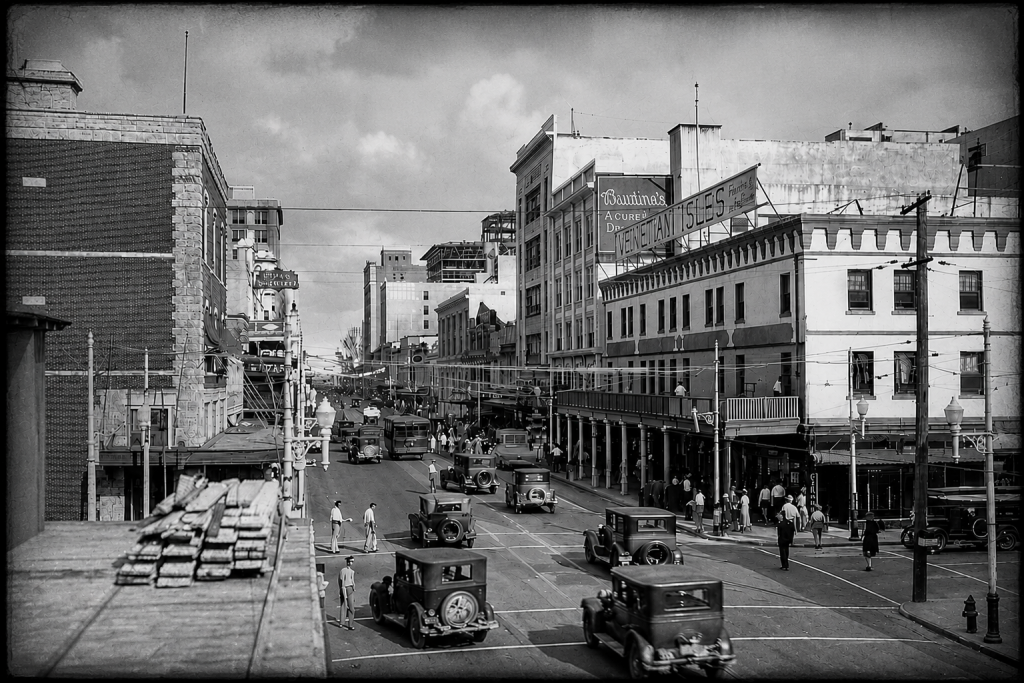
The street stretches in both directions beneath awnings, hanging signs, telephone wires, and the upper stories of buildings that would appear modest beside the towers of modern Miami. In 1926, however, many of them seem enormous.
Some are so new that their walls have barely had time to gather dust.
Archival photographs taken during 1926 show Flagler crowded with automobiles, storefronts, pedestrians, commercial buildings, and street activity. They reveal something modern visitors might find surprising: Miami already looks like a city.
It is not a sleepy village waiting to be discovered.
It is loud, ambitious, increasingly congested, and determined to grow. (Florida Memory)
A streetcar approaches.
If you’ve never seen one, imagine a city bus that runs on steel rails instead of rubber tires. Long before modern buses and subways became common, streetcars carried people through downtowns all across America. In 1926, they weren’t a novelty—they were simply part of everyday life. (HistoryMiami Museum)
You hear it before you clearly see it.
Steel wheels grind against the rails embedded in the street.
The bell rings.
Clang.
People move aside without surprise.
The car travels through the center of downtown as naturally as an automobile or bus would in another era. Its windows are open. Men in shirtsleeves sit beside women wearing summer dresses and close-fitting hats.
The passengers have surrendered themselves to the heat.
The streetcar passes close enough for you to hear fragments of conversation.
A business address.
A land price.
A hotel reservation.
Someone discussing construction.
Someone asking whether a parcel west of the city is still available.
Then the words disappear beneath the noise of traffic.
Miami’s streetcars travel through the downtown commercial district and into the growing neighborhoods beyond it. The rails running through the center of the street are not remnants of an older Miami.
In 1926, they are part of daily life. (HistoryMiami Museum)
The streetcar disappears behind you.
An automobile takes its place.
Then another.
The cars come in different shapes and conditions. Some are polished until their bodies shine beneath the sun. Others cough dark exhaust into the warm air. Their engines sputter, rattle, and occasionally sound as though they might stop altogether.
There are no painted traffic lanes guiding them.
No electronic signals suspended above every intersection.
Movement depends on attention, patience, instinct, and a shared understanding that everyone is trying to get somewhere at the same time.
A delivery truck slows near the curb.
Wooden crates are carried through the open doors of a business.
A man pushes a handcart past you.
Another sweeps the pavement in front of his store, moving dust from one part of the street to another.
You step beneath an awning.
The temperature changes immediately.
Only a little.
It is enough.
Storefront windows display clothing, household goods, medicine, tobacco, jewelry, and products advertised as evidence of a better and more modern life. Painted lettering covers the glass. Signs compete for your attention from nearly every direction.
Nothing moves on a screen.
Nothing flashes electronically.
The street is the advertisement.
Letters are painted by hand.
Posters are pasted to walls.
Products are arranged carefully behind glass.
A person can understand much of the city simply by reading its buildings.
A newspaper boy moves through the crowd carrying a stack beneath one arm.
“Paper!”
His voice rises above the automobiles.
“Morning paper!”
He is young, although not quite as young as he first appears. The work has given him the practiced expression of someone who has already learned how quickly people decide whether to notice you.
A man reaches into his pocket.
A coin changes hands.
The newspaper opens with a snap.
The pages are large enough to hide half the reader’s body.
Miami’s newspapers are recording the city almost as quickly as developers can build it. The pages document a place consumed by property, commerce, construction, entertainment, politics, and its own rapid expansion. (University of Florida Digital Newspaper Library)
You consider buying a copy.
Then you remember something.
You already know tomorrow’s news.
You know the decades that follow.
You know which buildings will survive.
You know which names will disappear.
Most importantly, you know what will happen less than two months from now.
The newspaper boy does not.
Neither does the man reading beside you.
Neither does the shopkeeper standing beneath his awning.
On this Wednesday morning, the Great Miami Hurricane is still in the future.
The sky offers no warning.
The city continues with its day.
You keep walking.
At the corner of East Flagler Street and First Avenue stands the First National Bank.
Its masonry exterior rises above the intersection with the visual confidence banks were designed to project.
Permanence.
Security.
Authority.
A photograph made on May 24, 1926, less than two months before our visit, shows the building occupying this exact corner. (Florida Memory)
People enter and leave through its doors.
Some carry documents.
Others carry the nervous energy of individuals about to borrow money, deposit profits, or place another bet on Miami’s future.
Because that is what much of the city feels like in 1926.
A wager.
The Florida land boom has convinced thousands of people that fortunes can be made almost overnight. Property changes hands. Advertisements promise tropical opportunity. New arrivals step from trains carrying luggage, savings, and visions of beginning again.
Miami is not merely growing.
It is selling the idea of itself.
The city is presented as sunlight, possibility, beauty, wealth, and escape.
For many, that promise feels real.
For others, the labor behind the fantasy is much harder to see.
Construction workers carry materials through the heat.
Porters move baggage.
Domestic workers maintain the hotels and homes that make leisure possible.
You pause at the intersection.
The bank stands behind you.
East Flagler continues ahead.
And there, rising above the storefronts, you see something new.
A ten-story office building.
Mediterranean details.
An entrance opening from the street.
Above it, a name.
OLYMPIA.
The theater has been open for only five months.
It opened in February 1926 at 174 East Flagler Street. Designed by John Eberson, it is an atmospheric silent-movie palace whose auditorium creates the illusion of sitting beneath an outdoor night sky. It is also recognized as Miami’s first air-conditioned building. (University of Miami Libraries)
After several minutes beneath the July sun, that may be the most extraordinary detail of all.
From the pavement, however, you cannot see the stars above its auditorium.
You cannot yet hear the orchestra.
You only see people gathering near the entrance.
A poster advertises today’s entertainment.
The ticket booth waits inside the open arcade.
Someone opens the theater door.
A breath of mechanically cooled air escapes into the street and touches your face.
You stop walking.
After the heat, the sensation is almost impossible to ignore.
You look toward me.
I smile.
We were always coming here.
“Come on,” I say.
“There’s a picture starting soon.”
Chapter Four
A Nickel in Your Pocket
Before we go inside…
Let’s stay out here a little longer.
Cities reveal themselves best on foot.
You reach into your pocket.
The coins feel unfamiliar.
Heavier than the ones you’re used to carrying.
A nickel.
A few pennies.
Enough to buy something.
Across the street, a small drugstore has left its front door open.
The smell reaches you before you step inside.
Coffee.
Pipe tobacco.
Soap.
Fresh paper.
Wood polished by thousands of hands.
A ceiling fan turns lazily overhead.
It doesn’t cool the room so much as remind everyone that someone is trying.
A man stands behind the soda fountain drying a glass with a white towel.
He smiles.
“Morning.”
Not because he knows you.
Because that’s simply how many people greeted one another.
You slide onto one of the stools.
The counter is smooth beneath your hands.
Chrome catches the morning light.
Behind the counter are rows of glass bottles.
Some contain flavored syrups.
Others hold patent medicines promising relief from ailments you’ve never heard described quite that way before.
The menu is short.
Coffee.
Milk.
Ice cream.
Soft drinks.
Sandwiches.
Pie.
Nothing is rushed.
Nobody is staring at a screen.
Nobody is eating while walking somewhere else.
The city seems to move at the speed of conversation.
A waitress pours a fresh cup of coffee for a customer you’ve never met.
She calls him by name.
He asks about her family.
Neither appears to be in a hurry.
Outside, another automobile rattles past.
The bell above the front door rings.
A businessman walks in carrying his hat beneath one arm.
A construction worker follows him moments later.
Their clothes are different.
Their reasons for being here are different.
Yet for a few minutes they occupy the same counter beneath the same slowly turning fan.
You take a sip.
The coffee is darker than you expected.
Hotter too.
Outside, Miami continues growing one building at a time.
Inside, for just a moment…
The city pauses.
You leave a few coins on the counter.
The man behind the register nods.
“Have a good day.”
You step back into the Florida sunshine.
Across the street…
The Olympia waits.
Chapter Five
The Olympia
“There it is.”
You follow my gaze.
The Olympia.
For a moment, don’t look at the theater.
Look at the people.
That’s where every great story begins.
A couple pauses to study the poster outside the entrance.
A businessman checks his pocket watch before deciding he has enough time for a picture.
A mother straightens her son’s collar.
Two teenagers laugh as they climb the front steps.
Nobody realizes they’re about to spend the afternoon inside one of the most extraordinary buildings in the South.
Come on.
Let’s get closer.
The closer you stand, the larger the building feels.
Its Mediterranean Revival architecture is unlike anything else on the block. Arched openings welcome visitors beneath the office tower above, while decorative stonework gives the impression that this building has stood here for centuries.
It hasn’t.
It’s practically brand new.
The Olympia opened on February 18, 1926, just five months before our visit. Designed by the celebrated architect John Eberson, it became one of America’s great atmospheric theaters—a style of movie palace that transformed a night at the cinema into an experience that felt almost dreamlike. (University of Miami Libraries)
Take a moment before we go inside.
Look around.
Imagine you’ve never seen a television.
You’ve never streamed a movie.
You’ve never owned a DVD.
You’ve never even heard a voice coming from a motion picture.
For many of the people standing beside us…
This is as magical as entertainment becomes.
The ticket window sits beneath polished brass trim.
Small electric lights frame the entrance.
A young usher, dressed neatly in a pressed uniform, greets arriving guests with practiced politeness.
He tears each ticket by hand.
One half goes into a wooden box.
The other is returned with a smile.
Our turn.
I hand him two tickets.
He nods.
“Enjoy the show.”
The heavy doors swing inward.
Immediately…
Everything changes.
The temperature drops.
Cool air wraps around you.
After walking through the July heat, it feels almost impossible.
People stop talking for a moment.
Some smile without realizing it.
This is one of the first times in your life you’ve ever stepped into a building cooled by modern air conditioning.
Imagine what that must have felt like in 1926.
Not just comfort.
Wonder.
We continue through the lobby.
Marble beneath our feet.
Decorative plaster overhead.
Soft light spills from ornate fixtures.
Somewhere deeper inside the building…
A piano begins to play.
Not through speakers.
Not from a recording.
Someone is playing it.
Right now.
Live.
You hear only fragments at first.
A few notes.
Then a melody.
The music grows louder as we walk toward the auditorium.
I glance over my shoulder.
“You’ve never seen anything quite like this.”
I smile.
“Neither had they.”
Chapter Six
The Picture Begins
The music grows louder.
Then you see it.
The auditorium.
You stop without realizing you’ve stopped.
For a moment, your eyes forget you’re inside a building.
Above you stretches a deep blue evening sky.
Tiny stars sparkle overhead.
Soft clouds drift across the ceiling.
Balconies resemble the courtyards of a Mediterranean village.
Decorative towers rise from the walls.
The room doesn’t feel constructed.
It feels discovered.
John Eberson called these “atmospheric theaters.”
Instead of watching a motion picture inside a room, audiences felt as though they were sitting outdoors beneath a beautiful night sky. It was one of the most imaginative architectural ideas of the twentieth century. (University of Miami Libraries)
Take your seat.
Listen.
Before the movie begins, the room is alive.
People remove their hats.
Programs rustle.
Friends whisper to one another.
Children point toward the painted stars overhead.
No one is looking at a glowing phone.
No one is talking over a movie trailer.
No one has seen the ending online.
The lights slowly dim.
Conversation fades.
Then…
The pianist begins.
Not a recording.
Not speakers hidden in the walls.
A real musician.
Right now.
Every note you hear is being played for this audience alone.
The curtain rises.
The projector comes to life.
Its rhythmic mechanical sound echoes softly from the projection booth behind you.
The beam of light stretches across the darkened theater.
Dust dances inside it.
Then…
The picture appears.
Black and white.
Beautiful.
Silent.
Or at least…
Silent by modern standards.
This is something many people today have never experienced.
Motion pictures in 1926 did not speak.
Actors moved.
They laughed.
They cried.
They argued.
They fell in love.
But you never heard their voices.
Instead, the story unfolded through expressions, movement, carefully written title cards, and live music performed inside the theater.
The pianist wasn’t simply providing background music.
He was helping tell the story.
A chase became faster because he played faster.
A romance became more tender because his touch softened.
A frightening moment became frightening because the music warned you before the picture did.
Every performance was slightly different.
Every audience experienced a unique version of the same film.
Think about that.
If you and I returned tomorrow to watch this very picture again, it would never sound exactly the same.
The musician would make different choices.
The audience would laugh at different moments.
Even the projector might run at a slightly different speed.
For just a second…
Forget everything you know about movies.
Forget surround sound.
Forget dialogue.
Forget special effects.
Forget streaming.
Imagine seeing moving photographs projected onto a giant screen for the very first time.
You don’t compare it to anything.
Because there is nothing to compare it to.
This…
is the future.
The audience leans forward.
Someone laughs.
Someone gasps.
The pianist follows every emotion.
Without a single spoken word…
The room understands everything.
Chapter Seven
Outside Again
The afternoon sun feels warmer now.
Not because the temperature has changed.
Because you’ve been spoiled.
After only a short time inside the Olympia’s cool air, July reminds you who’s in charge.
You pause beneath the theater’s entrance and look back toward Flagler Street.
The city hasn’t slowed down.
Streetcars still rumble past.
Automobiles weave through traffic.
Construction continues somewhere in the distance.
Miami sounds like a city building itself.
“Take one last look,” I say.
“You’re standing in one of the fastest-growing cities in America.”
It’s easy to forget that.
When we think of old Florida, we often imagine sleepy fishing villages, dirt roads, and endless stretches of untouched coastline.
Miami isn’t that.
Not anymore.
By 1926, the Florida land boom has transformed this place into one of the most talked-about cities in the country. Newspapers from New York, Chicago, and across America are filled with stories about fortunes being made in South Florida real estate. Investors arrive by train every day, convinced paradise can still be purchased one lot at a time. (University of Florida Digital Newspaper Library)
Of course…
Not every dream survives.
History has a way of humbling even the most confident cities.
But today…
No one knows that yet.
As we continue walking, I want you to notice something else.
The names.
Some businesses you’ll never hear of again.
Others will become legends.
Far to the south, neighborhoods that one day become famous—including places connected with figures like Al Capone during the following decade—are still developing into the communities history will remember. (HistoryMiami Museum)
And west of downtown lies a place with a name you may recognize.
Tobacco Road.
Today, many people remember it because of the legendary bar that carried the name for generations. But in 1926, “Tobacco Road” referred to the rough settlement itself—a working-class neighborhood on the western edge of downtown, shaped by laborers, new arrivals, and the people doing the difficult work behind Miami’s astonishing growth. (HistoryMiami Museum)
History has an interesting habit.
Sometimes the places that begin quietly become the ones everyone remembers.
You smile.
“So…”
“Where do you want to go next?”
You could spend weeks exploring the Miami of 1926.
The hotels.
The train station.
The Royal Palm.
Biscayne Bay.
The docks.
The neighborhoods.
Every street has another story waiting.
But I have somewhere else I’d like to show you.
It’s only a short walk from here.
And almost no one expects to find it.
Chapter Eight
Toward the Water
“Ready?”
Good.
Because no visit to Miami in 1926 would be complete without seeing the water that made all of this possible.
We leave Flagler Street behind.
The sounds of downtown slowly change.
The clanging streetcars become less frequent.
The crowds thin.
The air feels different.
Saltier.
A breeze rolls in from Biscayne Bay, carrying with it the unmistakable smell of seawater, wooden docks, fuel, fish, and sun-warmed pilings.
Close your eyes for just a second.
You can almost tell where you are without looking.
Open them again.
Ahead of us, the bay sparkles beneath the afternoon sun.
It’s beautiful.
But don’t let its calm appearance fool you.
This water is Miami’s highway.
Long before Interstate 95, before Miami International Airport became one of the busiest airports in the world, Biscayne Bay connected Miami to the Caribbean, the Gulf of Mexico, and the Atlantic Ocean. Ships, fishing boats, ferries, and pleasure craft all helped shape the city’s identity. (HistoryMiami Museum)
Point your eyes toward the shoreline.
Do you notice what’s missing?
No cruise ships.
No towering skyline stretching for miles.
No PortMiami filled with floating cities.
The view is surprisingly open.
Palm trees sway along the waterfront.
Small boats rock gently against wooden docks.
Beyond them…
Nothing seems to hurry.
You hear gulls overhead.
The rhythmic knock of ropes against wooden masts.
A fisherman untangles his nets.
Another wipes saltwater from the deck of his boat.
A young boy sits at the edge of the dock with a cane fishing pole, completely convinced that the next cast will be the lucky one.
I smile.
Some things…
Never change.
A warm breeze brushes across your face.
“Take a deep breath,” I say.
“You’re breathing the same salt air that millions of people have breathed before us.”
The water before you has reflected Seminole canoes, Spanish ships, cargo vessels, fishing boats, and yachts.
It has watched Miami transform from a small frontier settlement into one of the fastest-growing cities in America.
And it’s still watching.
For all the changes we’ve seen today…
The bay may be the oldest witness of them all.
I lean against the railing.
“So…”
“Before we head back…”
“There’s one more thing I want to show you.”
“You’ve probably driven past it a hundred times.”
“But in 1926…”
“It looked very different.”
Chapter Nine
The Royal Palm
“There’s one more place I want you to see.”
We leave the waterfront and begin walking again.
The streets remain busy, but the pace changes.
The buildings become grander.
Palm trees line the sidewalks.
Automobiles pull to the curb as chauffeurs step out to open doors.
Men straighten their jackets before entering.
Women adjust wide-brimmed hats against the afternoon sun.
Ahead of us stands one of the most famous buildings in Florida.
The Royal Palm Hotel.
Long before Miami Beach became an international destination, the Royal Palm welcomed wealthy visitors arriving by train and steamship, offering a level of luxury few Americans had ever experienced. Built by railroad magnate Henry Flagler, it opened in 1897 and helped establish Miami as a winter resort for travelers escaping colder northern climates. (Florida Memory)
“Imagine checking in here.”
No air conditioning in every room.
No elevators with digital displays.
No televisions.
No room service app on your phone.
Instead…
A bellhop carries your luggage.
A clerk records your name by hand in a leather-bound register.
Your room key is made of brass.
Dinner is announced with elegance rather than notifications.
Luxury feels different in 1926.
It isn’t measured by technology.
It’s measured by craftsmanship, personal service, and the simple fact that you’ve arrived somewhere most people could only dream of visiting.
We pause across the street.
Look carefully.
Almost everyone entering the hotel has dressed for the occasion.
Travel itself is an event.
People don’t board trains in sweatpants.
Vacations aren’t casual.
For many families, coming to Florida represents one of the most significant journeys of their lives.
I smile.
“You know…”
“This building has already seen presidents, industrialists, entertainers, and dreamers.”
“But like everything we’ve seen today…”
“It won’t last forever.”
History has a way of changing even its most magnificent landmarks.
The Royal Palm Hotel remained one of Miami’s defining buildings for decades before it was demolished in 1939. Today, the site is occupied by Bayfront Park, and unless someone tells you where to look, it’s easy to walk past without realizing one of Florida’s grandest hotels once stood here. (HistoryMiami Museum)
You look once more at the hotel.
Then you glance toward the skyline you know.
Neither view is more real than the other.
They’re simply separated by time.
I nod toward the street ahead.
“Come on.”
“Our ride home is waiting.”
Chapter Ten
The Ride Home
One last look.
The afternoon sun still hangs over Miami.
Streetcars continue along their rails.
Automobiles rumble over brick streets.
Somewhere in the distance, a hammer strikes steel.
A train whistle echoes across the city.
Life goes on.
No one notices us.
No one knows we’ve come from a hundred years in the future.
And perhaps that’s exactly how it should be.
I smile.
“Ready?”
We retrace our steps through downtown.
Past the Olympia.
Past the newspaper boy.
Past the First National Bank.
Past the storefronts where merchants continue arranging tomorrow’s displays.
The city grows quieter behind us.
Not because Miami is becoming quieter.
Because we’re leaving it.
There she is.
The Time Machine.
Exactly where we left it.
She almost looks ordinary now.
Almost.
I reach for the handle.
The door opens with the same familiar sound.
“After you.”
You take one last look at 1926.
Take your time.
History has been here long before us.
It isn’t going anywhere.
You climb inside.
The door closes.
The outside world disappears.
The dashboard slowly comes to life.
Soft lights illuminate the controls.
The instruments awaken one by one.
A gentle vibration travels through the cabin.
The machine remembers the way home.
Destination confirmed.
Miami, Florida.
Present Day.
I rest my hand on the controls.
“See you in a few seconds.”
The vibration grows stronger.
Outside the windshield…
The city begins to blur.
Buildings soften.
Streetlights become streaks.
People become shadows.
Time itself seems to fold inward.
The sensation lasts only a moment.
Then…
Silence.
The vibration stops.
The dashboard grows still.
The doors unlock.
I look over.
“We’re home.”
The door swings open.
Warm Florida air greets us once again.
Only…
Something feels different.
The traffic is louder.
The buildings are taller.
Jet aircraft cross the sky.
Glass towers stand where smaller buildings once greeted visitors.
Phones glow in nearly every hand.
The skyline has changed.
The technology has changed.
The pace of life has changed.
But as we walk toward Biscayne Bay…
The breeze feels familiar.
The smell of saltwater hasn’t changed.
The sunlight still dances across the water.
The gulls still circle overhead.
Children still stop to watch boats.
For all the remarkable things humanity has built…
Some of the most beautiful parts of Miami were never ours to improve.
I turn toward you.
“So…”
“Where should we go next?”
Berlin?
London?
Tokyo?
Ancient Egypt?
The engine quietly hums behind us.
Waiting.
Patiently.
For its next destination.
Fasten your seatbelt.
Epilogue
Someone Is Remembering Us
Before we leave…
I want you to think about something.
Everything we’ve seen today…
The streetcars.
The Olympia.
The newspaper boy.
The Royal Palm Hotel.
The land boom.
The people walking along Flagler Street without the slightest idea what tomorrow will bring.
To us…
They’re history.
To them…
It’s just Wednesday.
They’re not trying to become part of the past.
They’re simply living their lives.
The businessman hurrying toward his office has no idea someone will wonder about him one hundred years from now.
The young usher at the Olympia doesn’t know historians will still talk about the theater where he works.
The newspaper boy can’t imagine that printed newspapers will one day become rare.
And the little boy fishing along Biscayne Bay…
He has no reason to believe someone from another century would ever wonder what he caught that afternoon.
History is like that.
Most people never realize they’re living inside it.
Now think about us.
Right now.
Today.
The cars we drive.
The phones we carry.
The music we listen to.
The buildings we construct.
The words we’re speaking.
One hundred years from now…
Someone may wonder what it felt like to live in our time.
They may smile at our technology.
They may laugh at some of our ideas.
They may be amazed by others.
Perhaps they’ll stand exactly where we’re standing now.
Looking backward.
Trying to understand us.
Just as we’ve tried to understand the people of 1926.
Maybe…
They’ll even have a Time Machine of their own.
I look at you and smile.
“The funny thing about history…”
“…is that nobody knows they’re making it.”
The engine hums quietly behind us.
Ready.
Whenever you are.
Because somewhere…
Another year is waiting.
Another city is waiting.
Another story is waiting.
Fasten your seatbelt.
We’ll see you on our next journey.
About the Author
Joe Chopski is a singer-songwriter, filmmaker, record producer, and founder of DARKWAVE Magazine. His writing explores the intersection of music, film, visual art, and cultural history, emphasizing the creative processes behind influential artists, landmark works, and the ideas that continue to shape generations. Rather than focusing on reviews or rankings, his work seeks to understand how creativity is born, how culture evolves, and why certain stories continue to resonate long after they are created.
About DARKWAVE Magazine
DARKWAVE Magazine explores music, film, culture, history, literature, architecture, folklore, and the ideas that continue to shape our world long after trends have faded. Rather than asking whether something is good or bad, we ask why it matters.
Our research-driven articles examine the history, context, and creative process behind influential works of art, remarkable people, forgotten places, enduring myths, and defining moments in culture. Guided by the belief that curiosity is more valuable than criticism—and that art is not a competition—DARKWAVE exists to inform, inspire, and encourage readers to look deeper.
Because every story has a history.
And every history has another story waiting to be discovered.
References & Further Reading
Florida Memory
HistoryMiami Museum
University of Miami Libraries
University of Florida Digital Collections
Library of Congress
Encyclopaedia Britannica
National Park Service
City of Miami
Greater Miami Convention & Visitors Bureau