Ouija Board: Mystery of the Spirit Board
By Kiya Laurent
Introduction: A Simple Board, an Endless Mystery
Few objects have inspired as much fascination, fear, skepticism, and curiosity as the Ouija board.
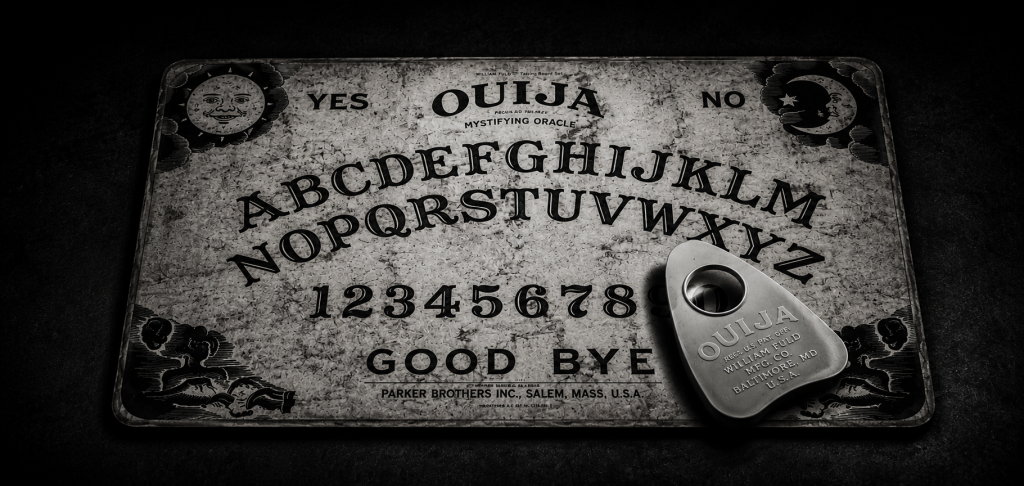
Its physical construction appears almost impossibly ordinary. There is a flat board printed with the alphabet, a row of numbers, and a handful of simple words: Yes, No, and usually Good Bye. A small movable indicator known as a planchette rests on its surface. Participants place their fingertips upon it, ask a question, and wait.
Then the planchette begins to move.
To some, the explanation is psychological. The board is cardboard or wood, the pointer is moved by unconscious muscular action, and the apparent message is produced by the minds and hands of the people gathered around it.
To others, the experience feels altogether different. The movement seems independent. Answers sometimes appear meaningful. The person touching the planchette may sincerely feel that something other than conscious intention is guiding it.
That disagreement has followed the Ouija board for more than a century.
It has appeared in family parlors, séance rooms, military camps, college dormitories, religious warnings, scientific experiments, horror films, newspaper reports, antique shops, and whispered stories shared after midnight. It has been sold as a toy, treated as an oracle, rejected as superstition, feared as a spiritual danger, and studied as a revealing example of the unconscious mind.
Few objects have traveled so easily between commerce, religion, psychology, folklore, entertainment, and private belief.
Whether the board communicates with spirits is a question history cannot settle. What history can reveal is how an American parlor game became the world’s most famous spirit board—and why its mystery has never disappeared.
Long Before the Ouija Board
The Ouija board belongs to the modern world, but the longing behind it is ancient.
Human beings have always wondered whether death ends communication.
Cultures across history developed rituals through which the living honored ancestors, interpreted dreams, sought omens, consulted oracles, or attempted to receive guidance from forces beyond ordinary perception. These traditions differed greatly in theology, purpose, and meaning, and they should not be treated as though they were all versions of the same practice. Yet many grew from a shared human impulse: the desire to know whether the invisible world might still be listening.
Ancient Egyptian religious texts described the soul’s journey through death and the afterlife. Greek and Roman societies consulted oracles and interpreted signs. Forms of automatic or spirit writing appeared in different cultural settings. Families across the world preserved relationships with the dead through remembrance, offerings, prayer, ritual, and storytelling.
The Ouija board did not invent the wish to speak with the dead.
It gave that wish a product, a trademark, a patent, and a place at the family table.
Victorian Spiritualism and the Age of Communication
The modern Ouija board emerged from the nineteenth-century Spiritualist movement.
Spiritualism became highly influential in the United States and Europe during an era shaped by rapid industrialization, scientific discovery, religious debate, and repeated encounters with death. Epidemics remained a threat. Childhood mortality was high. The American Civil War left families searching for meaning after devastating loss.
At the same time, new technology was transforming the meaning of communication.
The telegraph allowed words to travel invisibly across vast distances. Photography appeared capable of preserving human presence. Electricity moved through unseen circuits. Science was proving that forces invisible to the eye could nevertheless be real.
For many people, spirit communication no longer seemed completely incompatible with a technological age. If a telegraph could carry a message from someone hundreds of miles away, perhaps another kind of instrument could receive a message from someone who had crossed the boundary of death.
Séances entered private homes.
Mediums claimed to receive messages through rapping sounds, table movements, trance speech, automatic writing, and other physical signs. Some participants were devoted believers. Others attended out of grief, curiosity, fashion, or entertainment. Fraud existed within the movement, but so did sincere conviction.
The earliest talking boards developed within this atmosphere.
Before the commercially branded Ouija board appeared, newspapers were already describing devices through which letters and messages seemed to emerge under the hands of participants. The Library of Congress identifies newspaper discussion of a “new talking board” as early as 1887. By 1890, the device that would become known as Ouija was being manufactured in Baltimore. (Research Guides)
The important innovation was not simply the alphabet board itself.
It was accessibility.
A séance often depended upon a medium. A talking board required no ordained authority, specialized training, or elaborate ceremony. The mystery could be purchased, carried home, and placed on a table.
Anyone could ask a question.
Anyone could wait for an answer.
The Birth of the Commercial Talking Board
The early history of the Ouija board involves several people rather than a single inventor.
Charles W. Kennard, a Baltimore businessman, helped organize the Kennard Novelty Company, which began manufacturing the board commercially around 1890. Elijah J. Bond, an attorney and inventor associated with the company, filed the patent application for the device. Other early participants included William H. A. Maupin and, most memorably, Helen Peters, Bond’s sister-in-law.
Bond’s patent was filed on May 28, 1890, and granted on February 10, 1891 as United States Patent No. 446,054.
The patent described the device as a “toy or game” and called it an “Ouija or Egyptian luck-board.” It specified a board containing the alphabet, numerals, the words Yes and No, and a small movable table with a pointer. Two or more people could place their hands on the movable piece, ask questions, and receive answers as it indicated letters and signs. (Google Patents)
That patent matters because it preserves the board’s commercial identity at the moment of its creation.
Whatever supernatural claims surrounded it, the legal document described it as a game apparatus.
The board was not patented as a sacred object, scientific instrument, or verified method of spirit communication. It entered American commerce as an amusement whose mystery was central to its appeal.
Charles Kennard later patented an improved talking board in November 1891. His patent openly referred to the movement of the pointer as the result of the “involuntary action of the hands”—a striking acknowledgment that unconscious physical movement was already considered part of the device’s operation. (Google Patents)
This early language reveals one of the Ouija board’s enduring contradictions.
Its manufacturers could present it as a game while allowing users to decide whether the answers came from involuntary movement, hidden knowledge, spirits, or something else.
The board offered possibility without requiring proof.
Helen Peters and the Mystery of the Name
The origin of the word Ouija has inspired almost as much speculation as the board itself.
A frequently repeated explanation claims that the name combines the French word oui and the German word ja, both meaning “yes.” The phrase is plausible, memorable, and has circulated for generations.
The more intriguing account involves Helen Peters.
According to the history preserved by researchers of the board’s early commercial development, Peters was present during a session in which the board was asked what it wished to be called. The planchette reportedly spelled O-U-I-J-A. When the participants asked what the word meant, the board allegedly answered, “Good luck.”
The story cannot be independently reconstructed with perfect certainty. Like many origin tales, it survives through family accounts, commercial history, later interviews, and retelling.
Yet Peters’ role is important for another reason.
The patent office reportedly required proof that the board worked before approving the application. Peters and Bond are said to have demonstrated it before a patent official. The board supposedly spelled the official’s name, which neither Bond nor Peters was believed to know.
Whether the answer emerged from unconscious observation, prior knowledge, coincidence, cooperation, or something inexplicable cannot now be determined. The demonstration nevertheless became part of Ouija folklore.
The board did not merely receive a name.
According to its own mythology, it named itself.
Elijah Bond: The Man on the Patent
Elijah Jefferson Bond is sometimes described as the inventor of the Ouija board, although that description simplifies the collaborative and commercial nature of its development.
Bond’s most documentable contribution was crucial: he filed the successful patent that established the recognizable arrangement of the board and pointer. The patent’s drawings and description contain many elements that remain familiar today—curved rows of letters, numbers beneath them, and a movable indicator controlled by the users’ hands. (Google Patents)
Bond was not the person who ultimately transformed Ouija into a household name. His role belonged primarily to the board’s legal and developmental beginning.
Still, without Bond, its history might have unfolded differently.
Patents do more than protect inventions. They freeze a moment in time. They record what a creator believed an object was, how it operated, and what features were considered essential.
Bond’s 1891 patent reveals a device poised between fortune-telling, entertainment, and mechanical curiosity. It was an “Egyptian luck-board,” a toy, a game, and a machine through which answers seemed to appear.
The board’s spiritual meaning would be created by the people who used it.
Its commercial future would belong largely to William Fuld.
William Fuld and the Making of an American Icon
No person is more closely associated with the early commercial success of the Ouija board than William Fuld.
Fuld entered the history of the talking board through the Kennard Novelty Company and later became its dominant manufacturer and promoter. By the end of the nineteenth century, production passed into the hands of William and his brother Isaac. Their partnership eventually collapsed, leading to years of rivalry and litigation over who possessed the right to manufacture boards under the Ouija name.
The legal struggle helped turn a parlor novelty into a protected commercial empire.
The Library of Congress timeline describes a long battle between William and Isaac Fuld that was ultimately decided in William’s favor. By 1920, courts had affirmed William Fuld’s control over the manufacture of Ouija boards, ending nearly two decades of disputes. (Research Guides)
William Fuld understood that mystery could be marketed without being explained.
He promoted the board energetically, protected its trademarks, refined its design, and expanded production. Under his leadership, Ouija became more than one talking board among many. It became the talking board.
Early examples were made from joined pieces of wood and printed through stencils. Later Fuld boards used veneered wood, smoother surfaces, redesigned lettering, new planchettes, and increasingly efficient manufacturing methods. His boards appeared with distinctive moons, stars, decorative lettering, and repeated warnings that buyers should look for the William Fuld name to ensure that they had purchased the genuine article. (William Fuld)
Fuld also possessed a gift for publicity.
He sometimes spoke as though he regarded the board as a remarkable business instrument rather than a spiritual authority. At other times, promotional stories suggested that the board had guided his decisions, predicted commercial success, or directed him toward business opportunities.
This flexibility was ideal marketing.
Believers could see a supernatural instrument.
Skeptics could see an amusing novelty.
Families could see a game.
Retailers could see a product whose own controversy kept it visible.
After Fuld’s death in 1927, his family continued manufacturing the board. William Fuld, Inc. remained connected with Ouija until 1966, when the business and its assets were sold to Parker Brothers. Production then moved away from its Baltimore family origins and into the larger American board-game industry. (William Fuld)
The sale marked the end of one era, but it prepared the board for another.
Ouija was about to become not merely famous, but culturally unavoidable.
The Planchette: The Hand That Appears to Move Alone
The planchette is essential to the experience.
The word comes from French and means “little plank” or “small board.” Earlier planchettes were sometimes used in automatic writing and could hold a pencil. The Ouija planchette evolved into a pointer that moved across letters, numbers, and words.
Early models often resembled small wooden tables with legs and a projecting tip. Later versions became heart-shaped. Some pointed directly toward a letter, while others included a circular window through which the selected character could be seen.
Its design performs an important psychological function.
The planchette gathers tiny movements from multiple hands into one shared motion. No single participant necessarily feels responsible for its direction. Each person may believe the others are guiding it. Because the motion is distributed across the group, personal agency becomes difficult to identify.
The result can feel external.
That feeling is one of the board’s greatest powers.
Why Does the Planchette Move?
The most widely accepted scientific explanation is the ideomotor effect.
Ideomotor movement occurs when an idea, expectation, image, or suggestion produces small muscular actions without a person consciously deciding to make them. The participant is not necessarily pretending. The movement can be sincere, unintended, and subjectively surprising.
The concept was developed during the nineteenth century by researchers including William Benjamin Carpenter, who used it to explain table-turning, pendulums, dowsing rods, and other apparently mysterious movements.
In a Ouija session, participants rest their fingers lightly on a movable object. Tiny muscular changes from each person accumulate. The planchette magnifies those movements, allowing them to become visible and directional. Because no participant experiences a clear decision to move toward a particular letter, the motion may be attributed to another person, the group, the unconscious, or an outside intelligence. (PubMed)
This explanation does not require dishonesty.
It is entirely possible for someone to move the planchette while sincerely believing that they did not initiate the movement.
The distinction matters.
Skepticism is often expressed too crudely, as though every Ouija experience must be either supernatural or fraudulent. Ideomotor action provides a third possibility: genuine movement without conscious awareness of authorship.
The Psychology of Expectation
The ideomotor effect explains movement, but a complete psychological account must also consider the environment in which the movement occurs.
Expectation shapes attention.
Suggestion shapes interpretation.
Emotion shapes memory.
Imagine several people sitting around a board in a darkened room. They have already discussed ghosts, hauntings, or warnings about the Ouija board. The participants expect something unusual to happen.
Under those conditions, ordinary details become charged with meaning.
A house settling can sound like a footstep.
A draft can feel like a presence.
A coincidence can feel like confirmation.
An ambiguous sequence of letters can become a name after someone recognizes a possible pattern.
This is related to confirmation bias—the human tendency to notice, remember, and emphasize information that supports an existing belief while overlooking contradictions. If a board gives ten unclear answers and one strikingly relevant answer, the striking answer is likely to become the story that survives.
Group dynamics deepen the effect.
Participants may unconsciously anticipate the same answer. One person begins a slight movement, another follows it, and the group creates a shared response. Because the process unfolds beneath conscious awareness, the resulting message can surprise everyone involved.
Scientific research has also explored whether ideomotor actions might express information available outside immediate conscious recall. In one 2012 study, participants answered yes-or-no questions verbally and through a Ouija-style procedure. When participants believed they were guessing, their Ouija responses performed above chance in that experiment, leading the researchers to suggest that ideomotor responses might sometimes reveal implicit knowledge. The study did not demonstrate spirit communication, and later research has treated broader claims cautiously, but it showed that the Ouija board can be useful as an instrument for studying agency, unconscious movement, and memory. (ScienceDirect)
The board’s psychological interest is therefore more complex than the simple statement, “People move it.”
The deeper question is why people can move it without feeling that they moved it—and what that reveals about the boundaries of conscious intention.
Belief, Skepticism, and Everything Between
The Ouija board occupies a rare cultural position because it exists between competing systems of explanation.
A spiritual believer may regard the board as a genuine method of communication.
A psychologist may regard it as an elegant demonstration of unconscious action.
A folklorist may study the warnings, rules, and legends that have accumulated around it.
A historian may see a product shaped by nineteenth-century grief, technology, advertising, and religious experimentation.
A collector may see changing materials, trademarks, factories, and design periods.
A filmmaker may see the perfect dramatic object: visually simple, immediately recognizable, and capable of turning a human hand into the apparent instrument of an unseen force.
These interpretations do not carry equal evidentiary weight. A controlled psychological explanation can be tested in ways that a supernatural claim often cannot. Yet the board’s cultural meaning does not depend entirely upon laboratory proof.
Objects gain power through the stories people attach to them.
The Ouija board has accumulated more stories than almost any other game ever manufactured.
The Church and the Ouija Board
Religious reactions to the Ouija board vary, and no single statement can represent every Christian community, much less every religion.
Many Christian traditions discourage the board because its stated purpose involves divination or communication with spirits. Biblical passages such as Deuteronomy 18 warn against divination, consulting mediums, and seeking information from the dead. Catholic teaching similarly rejects practices intended to conjure the dead, consult mediums, or uncover the future through hidden powers. (Vatican)
From that perspective, the board’s physical mechanism is not the only issue.
Intent matters.
A person attempting to summon a spirit is participating in a practice the tradition rejects, even if the resulting movement can be explained psychologically.
Other Christians approach the subject primarily as superstition, arguing that the board has no independent power but may encourage fear, obsession, or unhealthy belief. Still others avoid it because of personal conscience, family teaching, or cultural experience.
Outside Christianity, perspectives vary widely. Some religious and spiritual traditions include forms of ancestor remembrance, divination, mediumship, or spirit communication, but these practices possess their own rules and meanings. They should not automatically be equated with a mass-produced American talking board.
A respectful article must distinguish between describing beliefs and declaring them proven.
DARKWAVE does not ask readers to accept or reject a religious interpretation.
It asks why a commercially manufactured game has become spiritually significant enough to inspire warnings, rituals, prohibitions, and fear.
From Family Game to Cultural Phenomenon
The modern reputation of the Ouija board can obscure how ordinary its early commercial setting once appeared.
It was marketed as a parlor amusement.
Advertisements presented friends and families gathered around it. Couples used it as entertainment. Newspapers described its popularity with fascination, humor, and occasional alarm. In some illustrations, the board appeared almost romantic, creating an excuse for two people to sit close together with their hands touching.
The Ouija board also flourished during periods of crisis.
After wars, epidemics, and mass-casualty events, public interest in spirit communication often increased. The First World War created a generation of grieving families. Newspaper reports connected Ouija use with attempts to receive messages from soldiers, locate missing people, predict events, and communicate with the dead.
One of the best-known figures associated with the board was Pearl Curran, a St. Louis woman who claimed to receive literary communications from a seventeenth-century spirit named Patience Worth. Curran’s writings drew serious public and literary attention, illustrating how the board could move beyond entertainment into authorship, identity, and cultural debate. The Library of Congress preserves extensive newspaper material on Curran and the wider Ouija phenomenon. (Research Guides)
At the same time, the board remained a consumer product.
That dual identity allowed Ouija to survive.
It could be a game during one decade, a spiritual tool during another, a psychological curiosity in one household, and a forbidden object in the next.
Parker Brothers and the 1960s Boom
In 1966, Parker Brothers purchased William Fuld, Inc. and acquired the Ouija business.
The timing was extraordinary.
The late 1960s brought renewed popular interest in mysticism, alternative religion, astrology, psychic phenomena, and the occult. Ouija sales surged. National Geographic reports that more than two million boards were sold in 1967 and that Ouija outsold Monopoly that year. (National Geographic)
The fact is revealing.
At the height of its popularity, Ouija was not yet universally treated as a demonic object. It was a mainstream game produced by a major company and purchased in enormous numbers.
Its reputation was certainly mysterious. Religious criticism existed. Stories of frightening experiences circulated. But the board had not yet completed its transformation into the visual shorthand for supernatural danger that it would soon become.
That change arrived through popular culture.
The Exorcist and the Birth of the Horror Icon
William Peter Blatty’s novel The Exorcist was published in 1971. William Friedkin’s film adaptation followed in 1973.
The story concerns a young girl, Regan MacNeil, whose disturbing behavior is eventually interpreted as demonic possession. Early in the story, Regan reveals that she has been communicating through an Ouija board with an unseen presence she calls Captain Howdy.
The board occupies only a small portion of the film, but its cultural effect was enormous.
The Exorcist suggested that a child’s apparently harmless use of the board could open a path toward possession. The film did not simply portray Ouija as spooky entertainment. It positioned the board near the beginning of a terrifying spiritual invasion.
National Geographic identifies The Exorcist as the pivotal moment in the board’s transformation from familiar parlor game into feared supernatural object. Later horror films, especially Witchboard and other occult stories, reinforced the idea that a talking board could act as a doorway through which dangerous entities entered the human world. (RealClearReligion)
The change was so effective that it altered cultural memory.
Many people who grew up after 1973 assumed that Ouija had always possessed a dark reputation. The earlier history of families, couples, party games, patent offices, newspaper novelties, and mass-market entertainment faded behind a new image.
A board.
A child.
A hidden presence.
A door that should never have been opened.
Hollywood had rewritten the object.
Fear became part of its design.
The Rules That Folklore Invented
Ouija boards are often surrounded by elaborate warnings:
Never play alone.
Never use the board in a graveyard.
Never ask when you will die.
Never allow the planchette to count backward through the numbers.
Never let it move through the alphabet in reverse.
Always say goodbye.
Never leave the planchette on the board.
Destroying the board improperly will bring misfortune.
These rules are part of modern Ouija folklore rather than the documented requirements of the original patent.
Their importance lies not in whether they are objectively true, but in how folklore grows.
A mysterious object invites explanation. Explanation becomes warning. Warning becomes ritual. Ritual is repeated until it sounds ancient.
Many of the board’s supposed rules were strengthened by horror films, paranormal books, internet stories, and personal anecdotes. They create a structure through which users interpret what happens.
If the experience is uneventful, the rules remain intact.
If something frightening happens later, a forgotten rule provides an explanation.
Perhaps someone failed to say goodbye.
Perhaps the session was never properly closed.
Folklore protects mystery by giving every outcome a meaning.
Why We Keep Returning to It
Despite criticism, scientific explanations, religious warnings, and decades of frightening movies, the Ouija board has never disappeared.
Its continued appeal says something fundamental about human nature.
We seek patterns.
We test boundaries.
We ask questions whose answers may not be available.
We are drawn toward experiences that allow mystery to become personal.
A ghost story is something we hear.
A horror film is something we watch.
A Ouija board asks us to place our hands on the instrument.
That participation changes everything.
The user is no longer an observer. The mystery seems to unfold beneath the fingertips. Even when someone understands the ideomotor effect, the sensation can remain uncanny. Knowledge of the mechanism does not always remove the emotional power of the experience.
The board’s simplicity also allows imagination to dominate.
There are no electronics, motors, speakers, or hidden screens. There is no visible mechanism to blame. The movement appears to come from the people at the table, yet no individual may feel responsible for it.
The board creates the illusion of an intelligence without revealing an author.
That is difficult to forget.
A Cultural Mirror
Perhaps the Ouija board reveals less about the dead than it reveals about the living.
During the age of Spiritualism, it reflected grief, technological wonder, and the hope that death had not ended conversation.
During William Fuld’s era, it reflected American entrepreneurship, advertising, patent battles, and mass production.
During the First World War, it reflected mourning and uncertainty.
During the 1960s, it reflected renewed fascination with mysticism and altered states of consciousness.
After The Exorcist, it reflected fears of possession, hidden evil, and innocent curiosity becoming dangerous.
In psychology, it became a window into unconscious action.
In collecting, it became an artifact of design and social history.
The board remained recognizable while culture repeatedly changed its meaning.
The object stayed still.
We moved around it.
The Ouija Board as a Modern Collectible
Vintage Ouija boards are now collected as historical objects, folk artifacts, design pieces, and relics of American popular culture.
Collectors examine manufacturer names, factory addresses, trademarks, materials, lettering, corner shapes, planchette construction, box artwork, and instruction labels. Early Kennard boards differ from William Fuld boards. Wooden boards differ from later hardboard and Masonite versions. The design changed as manufacturing methods evolved.
The Museum of Talking Boards preserves examples from Kennard, William Fuld, and numerous competing manufacturers. Its galleries reveal that Ouija was never the only talking board. It belonged to a much larger world of mystic boards, oracle boards, fortune-telling games, and commercial imitations. (Museum of Talking Boards)
Some surviving pieces are common.
Others are exceptionally rare.
A board’s value may depend on age, condition, completeness, manufacturer, planchette, packaging, and historical importance. A genuine early wooden board may appeal to collectors far beyond the paranormal community because it represents printing history, game design, American manufacturing, Spiritualist culture, and changing attitudes toward death.
Museums and private collections preserve these boards not because they prove supernatural communication, but because they document belief.
An object does not need to be magical to become historically important.
It only needs to reveal what people hoped, feared, purchased, and imagined.
Why the Mystery Endures
The Ouija board exists at the intersection of history, psychology, religion, folklore, commerce, grief, entertainment, and popular culture.
Each perspective reveals something.
None completely removes the others.
The patent establishes its commercial origin.
The ideomotor effect provides a persuasive account of its movement.
Psychology explains how expectation and unconscious action can create sincere experiences.
Religion explains why attempts to consult the dead carry moral and spiritual significance for many believers.
History explains why the board emerged when it did.
Hollywood explains how it became an emblem of danger.
Folklore explains why new rules and warnings continue to grow around it.
Collecting explains how yesterday’s game became today’s artifact.
Yet none of those explanations makes the board culturally powerless.
A Ouija board still changes the atmosphere of a room.
Place one on a table and people immediately respond. Some laugh. Some tell stories. Some refuse to touch it. Some become curious. Some become afraid.
Few commercial objects inspire such immediate emotional division.
That may be the secret of its longevity.
The Ouija board does not require everyone to believe the same thing.
It only requires them to wonder.
Conclusion: Questions That Never Grow Old
The Ouija board has survived changing fashions, scientific advances, religious debates, commercial rivalries, family ownership, corporate acquisition, and generations of horror films.
It began as part of a wider talking-board movement and entered American commerce through the efforts of Elijah Bond, Charles Kennard, Helen Peters, William Fuld, and others whose lives became attached to its legend.
It was patented as a toy.
Marketed as a mystery.
Used as an oracle.
Explained as psychology.
Condemned as divination.
Transformed by cinema.
Preserved as history.
Few objects have crossed so many boundaries while remaining instantly recognizable.
Whether one approaches it with belief, skepticism, caution, or curiosity, the board’s endurance reminds us of something deeply human.
We are storytellers.
We search for meaning.
We wonder whether absence is truly silence.
We imagine that somewhere beyond the limits of ordinary understanding, an answer may be waiting for the right question.
Perhaps that is the Ouija board’s greatest mystery.
Not whether it speaks to the dead—
but why it continues to speak so clearly to the living.
About the Author
Kiya Laurent is a contributing writer for DARKWAVE Magazine, where she explores the history of film, music, folklore, and the cultural movements that continue to shape the way we see the world. Drawn to subjects that exist between beauty and darkness, belief and skepticism, memory and myth, she approaches each article with curiosity, empathy, and a deep respect for the people and traditions behind the story.
Her work combines meticulous research with atmospheric long-form storytelling, uncovering forgotten histories, overlooked artists, and the ideas that connect cinema, music, art, and visual culture across generations. Rather than simply recounting events, Kiya is interested in why certain stories endure, what they reveal about the societies that created them, and why they continue to speak to us today.
About DARKWAVE Magazine
DARKWAVE Magazine explores music, film, culture, history, literature, architecture, folklore, and the ideas that continue to shape our world long after trends have faded.
Rather than asking whether something is good or bad, we ask why it matters.
Through thoughtful long-form journalism, DARKWAVE examines the people, places, and stories that continue to influence art, creativity, and culture. We believe curiosity is more valuable than criticism, that great art is meant to be experienced rather than judged, and that exploring the misunderstood often reveals the most enduring truths.
Because every story has a history.
And every history has another story waiting to be discovered.
References
Bond, Elijah J. “Toy or Game.” United States Patent No. 446,054, filed May 28, 1890, granted February 10, 1891. United States Patent Office. (Google Patents)
Catechism of the Catholic Church. “Divination and Magic,” Sections 2115–2117. The Holy See. (Vatican)
Gauchou, Hélène L., Ronald A. Rensink, and Sidney Fels. “Expression of Nonconscious Knowledge via Ideomotor Actions.” Consciousness and Cognition, vol. 21, no. 2, 2012, pp. 976–982. (ScienceDirect)
Hughes, Patrick, and George Williams. “Ideomotor Signaling: From Divining Spiritual Messages to Discerning Subconscious Answers During Hypnosis and Hypnoanalysis.” American Journal of Clinical Hypnosis, 2011. (PubMed)
Kennard, Charles W. “Talking-Board.” United States Patent No. 462,819, granted November 10, 1891. United States Patent Office. (Google Patents)
Library of Congress. “Ouija Board: Topics in Chronicling America.” Research guide and selected historical newspaper materials. (Research Guides)
Museum of Talking Boards. “Gallery of Talking Boards.” Historical examples from the Kennard Novelty Company, William Fuld, and other manufacturers. (Museum of Talking Boards)
National Geographic. “How Ouija Went from Quirky Parlor Game to the Most Feared Spirit Board in History.” September 19, 2024. (National Geographic)
The Holy Bible. Deuteronomy 18:10–12. New American Bible, Revised Edition. (Bible Gateway)
William Fuld Historical Archive. “Ouija Boards.” Manufacturing history, factory locations, design changes, family production, and the 1966 sale to Parker Brothers. (William Fuld)