Baba Yaga: The Witch the World Never Understood
Beyond the legend lies a story of wisdom, survival, and the ancient imagination that continues to shape the way we see the unknown.
By: Anna Volkov
Estimated reading time: 15-17 minutes
Chapter One
Beyond the Forest
If you have never heard of Baba Yaga, allow me to introduce you.
If you have heard of her, I hope you will allow me to introduce her again.
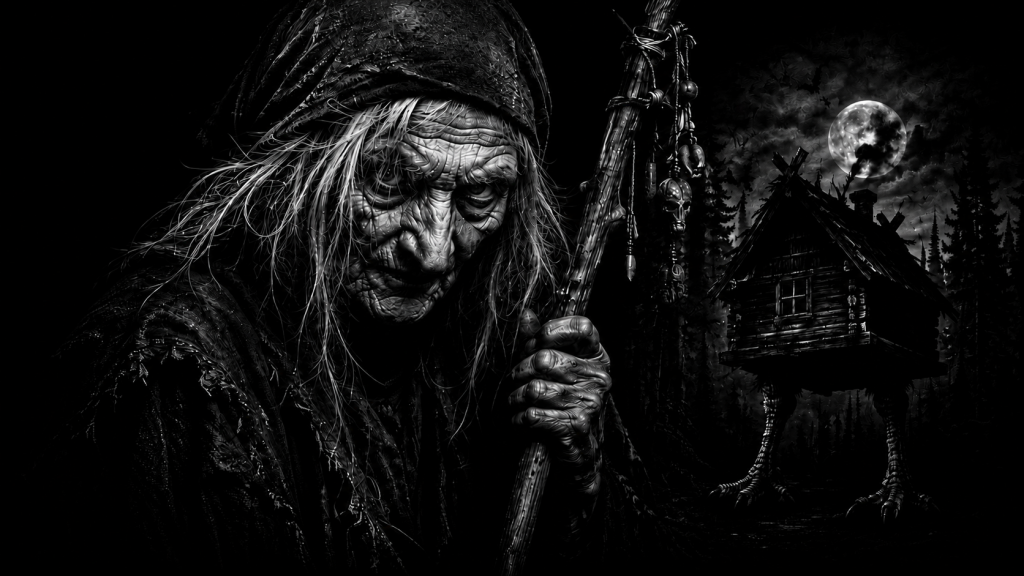
For centuries, Baba Yaga has been described as a witch who lives deep within the forest in a wooden house that stands upon enormous chicken legs. Children hear stories of glowing skulls that illuminate the night. They imagine an old woman flying through the trees in a giant mortar, steering with a pestle while sweeping away her tracks with a birch broom.
It is one of the most unforgettable images in all of folklore.
It is also only the beginning.
The first mistake many people make is believing Baba Yaga is simply the villain of the story.
She is not.
She is older than that.
More mysterious than that.
More human than we often realize.
Across the folklore of the Slavic world, few figures resist simple definitions as completely as Baba Yaga. She is feared, respected, avoided, sought out, cursed, thanked, and remembered. In one tale she threatens those who wander into her forest. In another, she becomes the only person willing to help a traveler continue the journey. She presents impossible tasks, but she also offers impossible gifts. She punishes arrogance and rewards humility. She can appear terrifying one moment and unexpectedly generous the next.
She is not a character who fits neatly into the categories of hero or villain.
She is a test.
Perhaps that is why she has survived for so many centuries.
When I was growing up in Russia, I learned very early that forests were never portrayed as empty places. They possessed a presence. They demanded respect. Adults spoke of the woods with quiet seriousness because they understood something modern life often encourages us to forget.
Nature does not negotiate.
A forest can feed you.
It can shelter you.
It can also swallow you without leaving a trace.
Long before highways, satellite navigation, or electric lights, the forest marked the boundary between the familiar world and the unknown. It was where hunters disappeared, where wolves roamed, where winter lingered longest, and where every path seemed capable of becoming another story. Around fires and kitchen tables, these stories were not told simply to entertain children. They preserved experience. They carried warnings. They passed wisdom from one generation to the next.
Baba Yaga belongs to that threshold.
She is not merely a witch waiting in the trees.
She is the guardian of the place where certainty ends.
That may be why she continues to fascinate us today.
Every culture creates figures who stand at the edge of the known world. Some become dragons. Some become spirits. Some become giants, tricksters, or wandering ghosts.
The Slavic imagination gave us an old woman whose wisdom is as dangerous as her temper, whose kindness must be earned, and whose forest belongs to no one but itself.
The more I have studied Baba Yaga over the years, the less interested I became in asking whether she ever existed.
A far more interesting question emerged.
Why did generations of people need her to exist?
The answer is not found in magic alone.
It is found in history.
In geography.
In the deep forests of Eastern Europe.
In long winters.
In oral tradition.
And in the timeless human desire to understand the unknown.
That is the journey I hope we take together.
Not into a haunted forest.
But into the imagination of the people who first saw one.
By the time we leave that forest, I hope you will discover that Baba Yaga was never simply a witch.
She was—and remains—a mirror reflecting the fears, hopes, values, and imagination of the people who created her.
To understand Baba Yaga is to understand something far greater than a legend.
It is to understand how folklore becomes memory, how memory becomes culture, and how culture can survive for centuries through the simple act of telling a story.
Chapter Two
Where the Forest Learned to Speak
Every legend has a birthplace.
Not always a single village or a single storyteller, but a world—a landscape that shapes the imagination of the people who live within it.
To understand Baba Yaga, we must first understand the world that imagined her.
Long before cities rose across Eastern Europe, vast forests stretched across the land like an endless green sea. Oak, pine, spruce, and birch covered the countryside. Rivers wound through valleys. Marshes concealed their depths beneath reeds and mist. During winter, snow transformed familiar paths into an unfamiliar wilderness where direction could disappear with the next snowfall.
For the early Slavic peoples, the forest was not simply scenery.
It was life itself.
It provided wood for homes, warmth for winter, herbs for medicine, berries and mushrooms for food, and game for hunters. At the same time, it demanded caution. Wolves hunted beneath its canopy. Bears wandered its clearings. Travelers who strayed from the path could vanish without a trace.
The forest gave generously.
The forest also reminded people of their limits.
In a world without electric lights or modern maps, darkness arrived with authority. As evening settled over the trees, familiar sounds became mysterious ones. The creaking of branches, the distant call of an owl, the rush of wind through leaves—each could awaken the imagination. It is not difficult to understand why stories flourished in such places.
Folklore was never merely entertainment.
It was education.
Long before many people could read or write, stories became libraries carried in memory. Parents taught children how to behave through tales. Elders preserved history through repeated telling. Communities explained the unknown by giving it a face, a voice, and a name.
Some stories warned against greed.
Others celebrated courage.
Many reminded listeners that respect—for nature, for neighbors, and for the unseen mysteries of the world—was essential to survival.
Baba Yaga emerged from this tradition.
She was never simply a frightening old woman waiting for lost travelers.
She represented the unpredictable character of the wilderness itself.
Approach the forest with arrogance, and it may humble you.
Enter with patience, preparation, and respect, and it may provide everything you need.
The same could be said of Baba Yaga.
This is one reason she is so difficult to classify. Modern audiences often divide characters into simple categories: heroes and villains, good and evil, light and dark.
Traditional folklore was rarely so absolute.
Nature itself is not evil because a storm destroys a harvest.
Fire is not wicked because it burns.
Winter is not cruel because it is cold.
They simply exist according to their own laws.
Baba Yaga belongs to that same moral landscape.
She is powerful, unpredictable, and deeply connected to the rhythms of the natural world. Those who meet her are often judged not by who they claim to be, but by how they behave when confronted with uncertainty.
That idea has echoed through centuries of storytelling because it speaks to something timeless.
Life itself tests us in much the same way.
Rarely do we receive clear instructions.
Rarely do we know what waits beyond the next turn.
We make choices with incomplete knowledge, hoping wisdom will guide us where certainty cannot.
Perhaps that is why Baba Yaga still feels alive.
She reminds us that every generation enters its own forest.
Some forests are made of trees.
Others are made of fear, grief, change, or the unknown future.
The landscape changes.
The journey does not.
As we continue deeper into Baba Yaga’s story, we will discover that nearly every detail surrounding her—the walking hut, the mortar and pestle, the fence of bones, the deep forest itself—carries layers of meaning that have fascinated scholars, storytellers, and readers for centuries.
The deeper we travel, the less this becomes the story of a witch.
It becomes the story of how human beings have always searched for wisdom at the edge of the unknown.
Chapter Three
The House That Walks
Every great legend has an image that lingers long after the story ends.
For Baba Yaga, it is her home.
Imagine walking through a dense forest. The trees grow closer together until the sunlight barely reaches the ground. The air becomes still. Every step seems louder than the last. Then, through the branches, you notice something impossible.
A small wooden house.
Not resting upon a foundation of stone.
Not standing on ordinary posts.
But balanced upon two enormous bird-like legs.
It waits.
Sometimes it turns.
Sometimes it faces away from the traveler.
Sometimes it seems almost alive.
The house of Baba Yaga is one of the most recognizable images in all of folklore, yet it is also one of the least understood.
To modern audiences, it often appears whimsical or surreal, as though it belongs only in a fairy tale. To the people who first imagined it, however, the house represented something far deeper than fantasy.
It was a threshold.
Throughout folklore, doorways rarely serve as ordinary entrances. They mark the boundary between one world and another. A traveler who crosses a certain bridge, enters a certain cave, or steps through a certain doorway often leaves behind the familiar and enters a place where different rules apply.
Baba Yaga’s house is no different.
Before anyone can meet its mysterious owner, they must first gain permission to enter her world.
In many traditional tales, the traveler cannot simply open the door.
The house must first be addressed.
It must be spoken to.
Only then does it slowly turn, presenting its doorway as though it has chosen to welcome—or perhaps merely acknowledge—the visitor.
This detail is remarkable.
The hero does not conquer the house.
The hero does not force it open.
The journey begins with respect.
That small moment tells us something important about the worldview behind these stories.
The natural world is not an object to be controlled.
It is something with which we must learn to coexist.
Over the centuries, scholars have offered many interpretations of the walking house. Some see it as a symbol of the boundary between civilization and wilderness. Others believe it reflects ancient beliefs about sacred spaces that existed outside ordinary human life. Still others view it as a reminder that wisdom is never found casually. One must leave behind certainty before discovering deeper understanding.
No single explanation answers every question.
That is part of the beauty of folklore.
Its symbols remain alive because each generation finds something new within them.
The house itself reflects Baba Yaga’s character.
It cannot be approached carelessly.
It cannot be understood at a glance.
Like its owner, it reveals only what it chooses to reveal.
And then there are the chicken legs.
At first glance they seem delightfully strange, almost playful. They have inspired countless illustrations, films, novels, and works of art. Yet their enduring power comes from more than their unusual appearance.
They remind us that this house was never meant to be ordinary.
It belongs neither entirely to humanity nor entirely to the wilderness.
It is always ready to move.
Always ready to turn.
Always reminding us that knowledge itself is never fixed.
The more we learn, the more our understanding shifts.
Perhaps that is why the house has continued walking through our imagination for centuries.
It refuses to remain still.
Just as every traveler who enters Baba Yaga’s forest must be willing to change, so too must every reader who hopes to understand her.
Before long, we will step through that doorway ourselves.
Inside, we will meet one of folklore’s most extraordinary figures—not as the caricature that popular culture often presents, but as generations of storytellers first imagined her.
Only then can we begin to understand why the world has never fully understood Baba Yaga.
Chapter Four
Meeting Baba Yaga
At last, the door opens.
For centuries, artists have tried to capture Baba Yaga’s appearance. Some portray her as frightening beyond imagination. Others soften her features until she resembles a kindly grandmother. Neither image tells the complete story.
Folklore rarely concerns itself with perfect appearances.
It is far more interested in character.
Traditionally, Baba Yaga is described as an elderly woman whose age seems impossible to measure. She is often depicted with a long nose, sharp features, wild hair, and eyes that notice far more than they reveal. She is a figure shaped by time itself, as though she has watched generations come and go while remaining rooted in the ancient forest.
She does not greet visitors with warmth.
Nor does she immediately threaten them.
Instead…
She observes.
That may be her greatest strength.
Before she speaks, she watches.
Before she judges, she listens.
Before she decides whether to help or hinder, she studies the person standing before her.
This quiet act of observation is one of the most overlooked aspects of Baba Yaga’s character.
Modern storytelling often celebrates action.
Traditional folklore respected patience.
Again and again, those who enter Baba Yaga’s home are tested—not through combat, but through conduct.
Will they speak honestly?
Will they remain respectful?
Will they show gratitude?
Will they complete the work placed before them without complaint?
The answers matter.
Because Baba Yaga is not searching for perfection.
She is searching for character.
This is one reason she has endured for centuries.
She reminds us that wisdom cannot always be recognized by appearances.
How often do we dismiss someone because they seem unusual?
How often do we overlook insight because it arrives in an unexpected form?
Folklore asks these questions long before psychology gave them names.
Baba Yaga challenges assumptions.
She asks us to look beyond first impressions.
Perhaps that is why children often fear her while adults become fascinated by her.
The older we grow, the more we recognize that life itself rarely divides neatly into heroes and villains.
Good people make mistakes.
Difficult experiences become valuable teachers.
Unexpected strangers sometimes change our lives.
Baba Yaga embodies that uncertainty.
She refuses to become predictable.
She belongs to a tradition in which wisdom is earned rather than given freely.
Even the way she speaks reflects this philosophy.
She rarely provides direct answers.
Instead, she presents choices.
Tasks.
Questions.
The traveler must participate in the journey of understanding.
No one leaves her house unchanged.
Some depart carrying knowledge.
Others leave carrying humility.
Often, they carry both.
Perhaps this is why I have never thought of Baba Yaga as merely a witch.
To me, she resembles something closer to an ancient teacher whose lessons are demanding because the world itself is demanding.
The forest does not promise safety.
Neither does life.
Yet both offer remarkable rewards to those willing to learn.
As we continue our journey, we will discover that many of Baba Yaga’s most famous adventures follow this pattern. They are not simply tales of magic or mystery. They are stories of transformation, where ordinary people enter the forest carrying one understanding of the world and return with another.
That, I believe, is the true magic of Baba Yaga.
Not that she can perform impossible feats.
But that she has inspired generations of readers to see themselves differently after encountering her story.
And perhaps…
That is the greatest gift any legend can offer.
Chapter Five
The Many Faces of Baba Yaga
One of the greatest mistakes we can make is asking, “Which Baba Yaga story is the real one?”
There isn’t one.
Baba Yaga belongs to a tradition that lived through spoken storytelling for centuries before many of its tales were written down. Grandparents told these stories to grandchildren. Travelers carried them from one village to another. Each storyteller remembered different details. Each generation added its own voice while preserving the heart of the legend.
In many ways, Baba Yaga was never meant to remain unchanged.
She evolved because the people telling her story evolved.
That is one of folklore’s greatest strengths.
Unlike a novel with a single author, folklore belongs to everyone who keeps it alive.
Perhaps the best-known story featuring Baba Yaga is the tale of Vasilisa the Beautiful.
At first glance, it appears to be a familiar fairy tale. A young girl faces hardship after the loss of her mother. She is treated cruelly by those around her and is eventually sent into the forest on what seems like an impossible journey.
There, she finds Baba Yaga.
Readers expecting a simple battle between good and evil are often surprised.
Baba Yaga does not rescue Vasilisa.
She does not destroy her.
Instead, she gives the young woman a series of demanding tasks.
The work requires patience.
Care.
Discipline.
Attention.
Vasilisa succeeds not because she is stronger than Baba Yaga, but because she remains thoughtful, humble, and resourceful even when fear surrounds her.
When she finally leaves the forest, she has gained far more than survival.
She has gained confidence in herself.
Many folklorists have suggested that this tale represents a journey into adulthood. Whether or not one accepts that interpretation, it is difficult to ignore the pattern.
The forest changes those who enter it.
So does Baba Yaga.
In another tale, a traveler seeks knowledge that cannot be found anywhere else.
Again, Baba Yaga does not simply offer answers.
Knowledge has value.
Value requires effort.
The traveler must first prove worthy of receiving it.
This idea appears again and again throughout Slavic folklore.
Wisdom is rarely handed to those unwilling to work for it.
Modern audiences sometimes expect magical characters to solve problems for the hero.
Traditional folklore often asks something far more demanding.
Who have you become by the time your journey ends?
That question matters more than whether the hero wins.
As I have revisited these stories throughout my life, one pattern has become impossible to ignore.
Baba Yaga almost never creates the hero.
The hero arrives carrying the seeds of courage already within.
She simply reveals whether those qualities are genuine.
In that sense, she resembles a mirror more than an enemy.
She reflects character.
She exposes weakness.
She rewards sincerity.
She humbles arrogance.
Perhaps that explains why readers continue debating her centuries later.
Is she good?
Is she evil?
The stories refuse to answer.
Instead, they invite us to ask a better question.
What kind of person stood before her?
The answer often tells us more than any description of Baba Yaga herself.
This is the quiet brilliance of folklore.
Its greatest lessons are rarely spoken aloud.
They emerge through choices.
Through actions.
Through consequences.
Every generation discovers something different in these tales because every generation brings different questions into the forest.
That is why Baba Yaga still walks among us—not as a historical figure, nor as proof of the supernatural, but as an enduring symbol of the challenges that shape human character.
Long after individual kingdoms faded, borders shifted, and languages evolved, these stories continued their journey.
Not because people feared Baba Yaga.
Because they recognized themselves within the travelers who met her.
Chapter Six
Why We Never Understood Baba Yaga
There is a reason Baba Yaga has never disappeared.
Empires have risen and fallen.
Borders have changed.
Religions have spread.
Languages have evolved.
Yet somewhere, deep within the human imagination, the old woman in the forest still waits.
Why?
Because Baba Yaga was never simply a character.
She became an idea.
Many of us grow up believing stories exist to tell us who is good and who is evil. We expect the hero to wear one face and the villain another. We look for certainty because certainty is comforting.
Baba Yaga offers no such comfort.
She reminds us that wisdom is rarely simple.
She cannot be understood by asking whether she is good or bad.
Instead, she asks whether those are the right questions to begin with.
Perhaps this is why modern audiences often misunderstand her.
We inherit a tradition of clear endings and simple morals, while Baba Yaga comes from a world where survival depended upon judgment, patience, and humility. The people who first told these stories understood that life itself was unpredictable. A harsh winter was not evil. A failed harvest was not wicked. A flood did not arrive because nature was cruel.
The world simply demanded respect.
So did Baba Yaga.
In many ways, she behaves less like a villain than like the forest itself.
Enter carelessly, and you may suffer.
Enter thoughtfully, and you may leave wiser than when you arrived.
That is not punishment.
It is transformation.
This idea has fascinated historians, folklorists, psychologists, and literary scholars for generations because Baba Yaga refuses to remain trapped inside a single interpretation.
Some see her as a guardian of ancient wisdom.
Others understand her as a symbol of nature’s untamed power.
Some view her as a guide who stands between childhood and adulthood, testing those who seek to cross that invisible threshold.
None of these interpretations cancel the others.
Instead, they reveal how richly layered folklore can become.
Perhaps that is why stories endure.
The best legends do not provide answers.
They provide companions for life’s questions.
Every generation returns to Baba Yaga carrying different concerns.
Children wonder whether they would survive meeting her.
Adults begin asking why she behaves as she does.
Scholars search for historical origins.
Artists discover endless inspiration.
Writers find new meanings hidden beneath old words.
The legend continues because the conversation never ends.
When I think of Baba Yaga today, I no longer imagine a witch waiting inside a forest.
I think of every difficult teacher who expected more from us than we expected from ourselves.
I think of every unfamiliar path that forced us to grow.
I think of every moment when life demanded courage before revealing understanding.
Perhaps that is Baba Yaga’s greatest lesson.
Growth rarely begins where we feel comfortable.
It begins at the edge of the unknown.
That is where every meaningful journey starts.
The forest is only a setting.
The real journey has always taken place within the traveler.
And perhaps that is the misunderstanding hidden inside Baba Yaga’s story.
For centuries, people searched the forest looking for the witch.
They rarely noticed that she had been quietly searching them all along.
Chapter Seven
The Forest Never Truly Ends
There is an old saying among storytellers that a good story never really ends.
It simply waits for the next person willing to tell it.
Perhaps that is why Baba Yaga has survived for so many centuries.
She has outlived kingdoms.
She has crossed borders.
She has traveled from whispered stories beside winter fires to printed books, paintings, films, music, television, and modern video games.
Every generation rediscovers her.
Every generation imagines her differently.
Yet somehow…
She remains unmistakably herself.
That is the remarkable power of folklore.
Unlike history, folklore does not ask us to remember every detail exactly as it happened.
It asks us to remember what mattered.
The stories change.
The truth they carry remains.
Today, Baba Yaga appears in novels, fantasy films, illustrations, animation, tabletop games, and video games. Artists continue to reinterpret her because she refuses to become ordinary. She is mysterious without being unknowable, frightening without existing only to frighten, ancient without ever feeling outdated.
She continues to inspire because she still asks questions we have not finished answering.
How should we face the unknown?
What qualities matter when life becomes uncertain?
Can wisdom be found in unexpected places?
Must every frightening encounter end in violence?
Or can it become the beginning of understanding?
Perhaps that is the greatest gift folklore offers us.
It reminds us that human beings have always wrestled with the same hopes and fears.
The names change.
The clothing changes.
The centuries pass.
But the questions remain.
As I have reflected on Baba Yaga throughout my life, I have come to believe that her greatest lesson has very little to do with magic.
It has everything to do with perspective.
We often fear what we do not yet understand.
We rush to label people, places, and ideas before taking the time to learn their stories.
Folklore gently asks us to slow down.
To listen.
To wonder.
To remain curious.
Perhaps that is why I have never thought of Baba Yaga as merely a witch.
To me, she is a reminder that wisdom often waits just beyond the edge of certainty.
The forest has always represented the unknown.
Every one of us enters such a forest eventually.
Sometimes it is a new chapter in life.
Sometimes it is grief.
Sometimes it is love.
Sometimes it is simply the courage to ask a question no one around us has asked before.
Whatever form it takes, the journey is the same.
We step forward without knowing exactly what awaits us.
That is what every great folktale has always understood.
The destination matters.
But the person we become along the way matters even more.
If this article has accomplished anything, I hope it has encouraged you to look beyond the familiar image of an old woman living in a house upon chicken legs.
Behind that unforgettable image stands centuries of storytelling, generations of imagination, and countless voices that refused to let a remarkable legend disappear.
Baba Yaga was never simply a witch.
She was, and remains, one of the world’s greatest reminders that stories are among humanity’s oldest teachers.
The forest is still there.
Its paths are still waiting.
And somewhere, beyond the trees, Baba Yaga still reminds us that the unknown is not always something to fear.
Sometimes…
It is where wisdom begins.
References & Suggested Reading
Readers interested in exploring Baba Yaga and Slavic folklore further may enjoy the following works:
- Afanasyev, Alexander. Russian Fairy Tales.
- Johns, Andreas. Baba Yaga: The Ambiguous Mother and Witch of the Russian Folktale.
- Warner, Marina. From the Beast to the Blonde: On Fairy Tales and Their Tellers.
- Propp, Vladimir. Morphology of the Folktale.
- Hubbs, Joanna. Mother Russia: The Feminine Myth in Russian Culture.
These works examine Baba Yaga through the lenses of folklore, history, literature, symbolism, and cultural tradition, demonstrating why she continues to fascinate readers and scholars alike.
About the Author
Anna Volkov is a contributing writer for DARKWAVE Magazine, where she explores folklore, cultural history, architecture, literature, and the enduring stories that shape civilizations. Her work focuses on the intersection of myth, memory, history, and the human imagination, approaching legendary figures with historical curiosity, thoughtful research, and deep respect for the cultures from which they emerged.
About DARKWAVE Magazine
DARKWAVE Magazine explores music, film, culture, history, literature, architecture, folklore, and the ideas that continue to shape our world long after trends have faded.
Rather than asking whether something is good or bad, we ask why it matters.
Through thoughtful long-form journalism, DARKWAVE examines the people, places, and stories that continue to influence art, creativity, and culture. We believe curiosity is more valuable than criticism, that great art is meant to be experienced rather than judged, and that exploring the misunderstood often reveals the most enduring truths.
Because every story has a history.
And every history has another story waiting to be discovered.