Architecture of Darkness: Gothic Cathedrals, Ancient Tombs, Brutalism and the Buildings of Fear
How Gothic cathedrals, underground temples, ruined cities, brutalist monuments, and structures of absolute power taught humanity to build with shadow
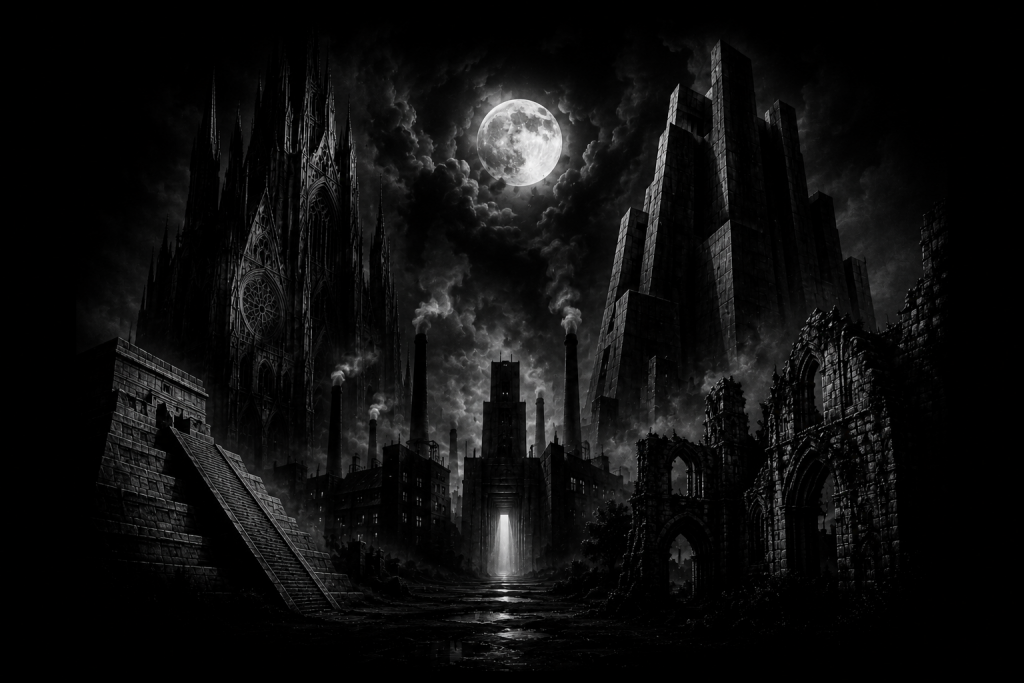
By Kiya Laurent
Estimated reading time: 45 minutes
Architecture is usually discussed as the art of creating shelter.
A roof protects us from the rain. A wall protects us from the wind. A doorway allows one world to end and another to begin. Buildings give physical form to the ordinary requirements of human life: eating, sleeping, worshipping, working, governing, remembering and dying.
But architecture has never been limited to protection.
Human beings also build to intimidate. We build to conceal. We build to mourn, dominate, imprison, worship, confuse and overwhelm. We create rooms in which the ceiling seems to disappear into heaven, corridors that deliberately narrow around the body, tombs that descend into the earth and government buildings that make the individual feel insignificant before the state.
Long before cinema discovered expressionist shadows, long before musicians used abandoned factories as visual shorthand for alienation, and long before Gothic became the name of a subculture, human beings had already learned how to construct darkness.
Dark architecture does not necessarily mean a black building.
It is not a style in the same way that Gothic, Baroque, Brutalism or Art Deco are styles. It is a psychological quality that can appear across centuries, religions, nations and political systems. It may be created through low light, extreme scale, repetition, enclosure, decay, silence or the knowledge of what occurred within a place.
Sometimes darkness is produced by beauty.
Sometimes it is produced by fear.
Sometimes it is carved into the side of a mountain in pursuit of the divine.
Sometimes it is poured in concrete by a government determined to appear permanent.
Every civilization has built structures that stand somewhere between sanctuary and nightmare. The architecture of darkness is the history of those structures—and of the human desires buried within them.
Before Architecture, There Was the Cave
The first architecture was not constructed. It was entered.
Before humans stacked stone or raised columns, the natural cave provided one of our earliest models of interior space. A cave was shelter, but it was also mystery. Its walls appeared to continue beyond the reach of daylight. Its chambers distorted sound. Its passages seemed to lead downward into the body of the earth.
The cave established an architectural language that humanity would continue to imitate: the threshold, the passage, the chamber, the hidden room and the descent.
To enter a cave was to cross from one kind of reality into another.
Above ground, the world was visible. The sun revealed distance, movement and danger. Underground, the senses became unreliable. A person could no longer see the entire environment at once. Firelight illuminated one surface while allowing everything beyond it to remain unknown.
Darkness became spatial.
It occupied the distance between what could be seen and what might be waiting beyond it.
Some of the earliest surviving human art was placed inside caves rather than on their exterior surfaces. Whatever the precise ritual, social or symbolic purposes of those images may have been, the location mattered. The journey inward transformed the experience. Art was encountered through physical movement, enclosure and darkness.
The room itself became part of the meaning.
This relationship between underground space and spiritual experience can be found across the world. Human beings repeatedly returned to the earth when creating places for burial, ritual, meditation and divine encounter.
At the Ħal Saflieni Hypogeum in Malta, chambers were cut into soft limestone across three underground levels using stone tools and antlers. The complex was not merely a hole made for the dead. Its interior surfaces imitate architectural forms, suggesting that the builders transferred the visual language of aboveground structures into a subterranean world. (UNESCO World Heritage Centre)
The Hypogeum is among the purest examples of architecture created through subtraction.
Most buildings are produced by adding material. Stones are stacked. Beams are raised. Walls expand outward into the landscape.
Subterranean architecture moves in the opposite direction. Space is discovered by removing what surrounds it. The architect does not place walls around a room. The architect releases the room from inside the earth.
This makes underground architecture feel less like construction than excavation—as though the chamber had always existed and human hands merely uncovered it.
The darkness of such places is not decorative. It is structural. Darkness is the material that fills every newly opened space.
Egypt and the Architecture of Eternity
Few civilizations understood the psychological force of architecture more deeply than ancient Egypt.
Egyptian sacred architecture was built around the relationship between permanence and death. Temples, tombs, processional routes, columns, chambers and monumental sculpture worked together to create a world in which political authority, religious belief and the afterlife became physically inseparable.
On the west bank of the Nile at ancient Thebes, the landscape contains the Valley of the Kings, the Valley of the Queens, funerary temples and thousands of discovered tombs spread across an immense necropolis. UNESCO describes Thebes and its necropolis as a major testimony to Egyptian civilization at its height. (UNESCO World Heritage Centre)
The architecture of an Egyptian royal tomb was not primarily intended for the living.
It was built for passage into eternity.
A tomb could be hidden within rock, approached through descending corridors and divided by thresholds, chambers and symbolic barriers. The deeper one traveled, the farther one moved from the world of daylight. Architecture became a map of spiritual transformation.
The tomb was both a protected container and a machine for resurrection.
Its darkness represented secrecy, danger and death, but darkness was not the final destination. Egyptian funerary belief imagined death as a journey toward renewal. The sealed chamber preserved the body while images and inscriptions helped the deceased navigate the world beyond life.
The darkness of the tomb was therefore not empty.
It was populated by gods, trials, spells, celestial bodies, animals and scenes of regeneration. Every wall could become active. Every corridor could contain instruction. The architecture enclosed a universe.
This is one of the recurring paradoxes of dark architecture: the most enclosed spaces often contain the greatest imaginative expansion.
A person may stand in a narrow underground chamber while surrounded by an entire cosmology.
Modern visitors experience Egyptian tombs as archaeological sites, but their original power came partly from exclusion. These spaces were not designed as public museums. They were concealed, guarded and sealed. Their darkness was protected from ordinary life.
The unknown was part of their authority.
Architecture becomes darker when we sense that we were never meant to enter it.
Rock-Cut Worlds: Ethiopia, India and Cappadocia
The desire to enter the earth did not end with prehistoric caves or Egyptian tombs.
Across different cultures, builders carved complex sacred environments directly into mountains, cliffs and volcanic stone. These structures demonstrate that underground architecture cannot be reduced to fear. Darkness can also provide concentration, protection and spiritual intimacy.
In Lalibela, Ethiopia, eleven medieval churches were carved from volcanic rock and connected through a network of trenches, tunnels and passages. UNESCO describes the complex as a thirteenth-century “New Jerusalem” and an enduring center of Ethiopian Christianity. The buildings are monolithic: rather than being assembled stone by stone, they were cut downward from the surrounding rock. (UNESCO World Heritage Centre)
At Lalibela, the pilgrim does not simply approach a church standing above the land.
The pilgrim descends toward it.
The architecture reverses the usual relationship between sacred building and skyline. In many traditions, religious structures rise upward. Towers, domes and spires announce themselves across great distances. Lalibela’s churches are reached by moving below the ordinary surface of the world.
The sacred is not always above us.
Sometimes it is beneath our feet.
The maze of connecting passages allows architecture to function as pilgrimage. Faith is experienced through walking, turning, descending, emerging and disappearing again. Light arrives from narrow openings and from the open sky above the excavated courtyards. Shadow does not oppose the sacred space. It frames it.
In western India, the Elephanta Caves were cut into rock between approximately the fifth and sixth centuries. Located on an island near present-day Mumbai, the cave temples contain monumental sculptural programs associated primarily with Shiva. (ASI)
Here, stone becomes both structure and image.
Columns appear to support the mountain even though the columns and mountain are parts of the same continuous material. Sculpted divine figures emerge from walls that were once solid rock. Architecture and sculpture cannot be cleanly separated.
The effect is one of revelation.
The figure was not carried into the chamber. It was drawn out of the chamber’s substance.
In Cappadocia, within present-day Türkiye, erosion created a landscape of cones, valleys and rock formations into which communities carved dwellings, sanctuaries, monasteries and underground settlements. UNESCO notes the region’s rock-hewn Byzantine sanctuaries, troglodyte villages and underground towns. (UNESCO World Heritage Centre)
Cappadocia demonstrates another function of architectural darkness: survival.
An underground city can conceal a population, stabilize temperature and create defensible spaces hidden from the exposed landscape. Ventilation shafts, narrow corridors and chambers transform geology into infrastructure.
To an outsider, such a place can appear labyrinthine and oppressive. To the community that depends on it, the same darkness may represent refuge.
Dark architecture is always shaped by the position of the observer.
The tunnel that terrifies an invader may protect the person who knows where it leads.
Gothic Architecture and the Invention of the Beautifully Haunted
When most people hear the phrase “dark architecture,” they imagine Gothic cathedrals.
The association is understandable, but historically complicated.
Gothic architecture was not created as an architecture of gloom. Its builders pursued height, structural lightness and luminous sacred interiors. Pointed arches, ribbed vaults and flying buttresses allowed walls to open into increasingly large stained-glass windows. The Metropolitan Museum of Art describes Gothic construction as a striking departure from the rounded, fortress-like mass of earlier Romanesque buildings. (The Metropolitan Museum of Art)
Medieval theologians and artists often associated natural light with divine light. Stained glass transformed sunlight into color, turning the interior of the cathedral into a symbolic vision of heaven. (The Metropolitan Museum of Art)
Yet the Gothic cathedral also contains nearly every element that later generations would interpret as dark.
It dwarfs the human body.
It fills its exterior with gargoyles, saints, devils, monsters, martyrs and scenes of judgment.
It contains tombs.
Its corridors and chapels create partial views rather than complete visual clarity.
Its stone changes character with weather and age.
Its bells measure time while reminding the surrounding city of death, worship and obligation.
Its towers disappear into fog.
The cathedral’s emotional power comes from the coexistence of radiance and terror.
Light streams through stained glass, but it enters a structure filled with images of suffering, sacrifice, damnation and mortality. Heaven is promised, but judgment remains close. Beauty offers salvation while stone reminds the visitor of the grave.
This tension is essential to Gothic architecture.
The cathedral does not merely make the believer feel welcomed. It makes the believer feel small.
Scale becomes theology.
The building communicates that the sacred exceeds human proportion, human time and human understanding. A person entering the nave is surrounded by a system vastly larger than the individual body.
Centuries later, Romantic writers, painters and architects rediscovered medieval ruins as places of melancholy and mystery. A ruined abbey no longer performed its original religious function, yet its broken walls seemed to contain memory.
Ruins introduced time into architecture.
A complete building presents itself as stable. A ruin reveals that stability was temporary.
The roof is gone.
Rain enters the sanctuary.
Plants emerge through stone.
Windows frame empty sky rather than stained glass.
The building survives, but its civilization has moved on.
German Romantic artists were particularly drawn to Gothic ruins. The abandoned monastery at Oybin, for example, became a subject through which architecture could be transformed into atmosphere, loss and contemplation. (The Metropolitan Museum of Art)
This Romantic fascination helped shape what modern audiences now identify as Gothic darkness.
The Gothic castle, abbey or cathedral became more than an architectural structure. It became a psychological setting. In Gothic literature, buildings remembered crimes, concealed family histories and trapped characters inside inherited systems of power.
Architecture became a mind.
The corridor became repression.
The locked chamber became memory.
The ruin became history refusing to disappear.
Germany: Forests, Ruins and the Shadow of Romanticism
Germany occupies a central place within the modern imagination of dark architecture, but not because darkness belongs uniquely to Germany.
Rather, several powerful traditions converged there: medieval architecture, dense northern forests, Romantic landscape painting, Expressionist cinema, industrial modernity, wartime destruction, totalitarian monumentalism and postwar confrontation with memory.
German Romanticism frequently placed the individual before forces that could not be mastered: mountains, forests, ruins, fog, night and the remains of religious structures. The human figure appears small within a landscape that feels spiritually charged and emotionally uncertain.
The ruin was especially important because it allowed past and present to occupy the same image.
A ruined monastery could represent lost faith, historical violence, the passage of time or the desire for transcendence. Its architecture was incomplete, but imagination supplied what was missing.
By the early twentieth century, German Expressionist cinema transformed architecture into psychological distortion.
Films such as The Cabinet of Dr. Caligari did not merely place characters inside buildings. They designed buildings that appeared to participate in madness. Streets tilted unnaturally. Doorways narrowed into points. Painted shadows ignored realistic light sources. Walls leaned inward as though the world itself had become unstable.
Expressionist architecture on film rejected neutral space.
A room was never just a room.
It could accuse, trap or disorient the person inside it.
This principle would become foundational to horror cinema, film noir, music video, theatrical stage design and the visual language later associated with post-punk, industrial music and darkwave culture.
The architecture of darkness moved from stone into image.
Once filmmakers understood that buildings could express internal states, every staircase, window and corridor became part of the emotional performance.
Catacombs, Ossuaries and the Architecture of the Dead
Every society must decide where the dead will be placed.
Burial architecture is among humanity’s oldest and most revealing forms of design because it gives physical structure to beliefs about memory, identity and the afterlife.
Some cultures bury the dead beneath modest markers. Others construct pyramids, mausoleums, necropolises, catacombs or cities of tombs. In each case, architecture mediates the relationship between the living and the absent.
A cemetery is an organized landscape of grief.
A catacomb turns grief into an underground city.
At Bet She’arim in present-day Israel, dozens of subterranean burial complexes were cut into limestone, forming an extensive ancient necropolis. (UNESCO World Heritage Centre)
At the Early Christian Necropolis of Pécs in Hungary, burial chambers and memorial structures reflect the architectural and artistic world of early Christian communities. (UNESCO World Heritage Centre)
The Etruscan necropolises at Cerveteri and Tarquinia in Italy contain tombs shaped in ways that recall houses and domestic interiors, suggesting that burial space could become an architectural continuation of life. (UNESCO World Heritage Centre)
Such places challenge the distinction between city and cemetery.
Rooms are created.
Routes are planned.
Walls are decorated.
The dead are given addresses within a parallel settlement.
The living enter temporarily and then return to daylight.
The ossuary intensifies this relationship by incorporating human remains directly into the visual environment. Bones cease to be hidden beneath architecture and become part of its ornament, symbolism or devotional message.
To modern eyes, this can appear macabre. Yet the original intention was not always horror. In many religious contexts, visible human remains served as reminders of mortality.
Remember that you will die.
The phrase memento mori does not celebrate death. It places earthly ambition within a larger scale of time.
An ossuary is dark because it refuses abstraction. Death is not represented through a distant symbol. It is present in the material remains of people who once occupied the world of the living.
The building becomes a collective body.
The Haunted Castle and the House That Knows
The castle entered the architecture of darkness through its relationship with power.
A fortified castle is designed to separate insiders from outsiders, safety from danger, authority from submission. Thick walls, towers, gates, battlements, dungeons and elevated positions make political hierarchy visible.
The castle occupies the landscape while controlling access to itself.
When the military function of castles faded, their psychological power remained.
A castle in ruins became an ideal Gothic setting because it joined several forms of darkness: inherited authority, family secrecy, violence, isolation, age and physical decay.
The Gothic house performed a similar function on a more intimate scale.
Unlike the cathedral or palace, a house should be familiar. It should offer safety, privacy and rest. When a house becomes frightening, it violates one of architecture’s most basic promises.
The haunted house is disturbing because it remains recognizable.
It has bedrooms, staircases, windows and family portraits. Yet those ordinary elements no longer behave as expected. A door opens by itself. A room appears larger within than outside. A corridor seems to lengthen. A staircase leads somewhere that the floor plan cannot explain.
The house knows something its inhabitants do not.
This idea has shaped generations of literature and cinema because architecture provides a perfect language for the unconscious mind.
The basement contains what has been buried.
The attic contains what has been forgotten.
The locked room contains what the family refuses to discuss.
The window separates the observer from the world.
The mirror creates another room that cannot be entered.
The staircase promises movement while exposing the body.
A haunted building is rarely frightening because of its exterior alone. It is frightening because its interior has developed intentions.
Prisons, Asylums and Architecture as Control
Dark architecture becomes most literal when a building is designed to control bodies.
Prisons, workhouses, detention centers and psychiatric institutions have frequently used architecture as a form of discipline. Walls restrict movement, but control can also be created through visibility, isolation, repetition and uncertainty.
A cell limits the body.
A corridor limits direction.
A locked door limits choice.
A surveillance system alters behavior even when no guard is physically present.
The most influential example is the Panopticon, Jeremy Bentham’s proposed circular prison design in which a central observer could potentially watch prisoners housed around the perimeter. The prisoners could not know when they were being watched, so the possibility of surveillance was intended to encourage self-discipline.
The architecture placed authority inside the mind.
This is a crucial development in the architecture of darkness. Power no longer needed to announce itself through massive walls alone. It could operate through uncertainty.
The individual begins to monitor the self.
Institutional architecture can become frightening through repetition. Identical doors, identical windows, identical beds and identical corridors reduce personal identity. The building tells each occupant that they are interchangeable.
A labyrinth confuses because nothing repeats predictably.
An institution can confuse because everything repeats too perfectly.
The hospital, asylum and prison have become central locations in horror not merely because suffering occurred within them, but because their architecture was designed around vulnerability.
Patients, prisoners and residents surrender control over movement, privacy, time and bodily autonomy. A locked institution turns ordinary architectural features into instruments of dependence.
The key belongs to someone else.
Industrial Architecture and the Beauty of Abandonment
The Industrial Revolution created new cathedrals.
Factories, mills, warehouses, mines, rail terminals and power stations were not built primarily for spiritual transcendence. They were built for production. Yet their scale, machinery and structural repetition produced a new form of awe.
Iron replaced carved stone.
Smoke replaced incense.
The assembly line replaced the procession.
The factory whistle replaced the bell.
Industrial architecture reorganized both space and time. Workers moved according to shifts, machinery and production requirements. The building determined rhythm.
By the twentieth century, industrial spaces had become symbols of modern power and modern alienation. Their vast interiors reduced workers to small moving components within larger mechanical systems.
When these structures were abandoned, they took on a different beauty.
Rust spread across metal.
Windows shattered.
Water entered through roofs.
Paint peeled from walls.
Machines remained in place after their purpose disappeared.
The abandoned factory became one of the defining visual environments of post-punk, industrial music and darkwave photography because it embodied the collapse of progress.
Modernity had promised efficiency, prosperity and technological mastery. The ruin revealed the abandoned shell left behind when industry moved elsewhere.
Decay became evidence.
The building preserved the physical traces of labor while erasing the people who had once filled it.
This is why industrial ruins feel haunted even when no ghost story is attached to them. Their emptiness is social. The architecture was created for crowds, noise and movement. Silence becomes unnatural within it.
A deserted house suggests the absence of a family.
A deserted factory suggests the absence of an entire economy.
Brutalism: Concrete, Honesty and Misunderstanding
No architectural movement is more frequently described as dark than Brutalism.
Its monumental concrete surfaces, exposed structural systems, repetitive forms and often severe silhouettes have made Brutalist buildings popular settings for dystopian cinema, science fiction and album photography.
The name itself encourages misunderstanding.
Brutalism was not named because its architects wanted buildings to be brutal. The term is associated with the French phrase béton brut, meaning raw concrete. The movement emerged in the postwar period and often emphasized structural honesty, social purpose and the direct expression of materials.
Yet public experience does not always follow architectural intention.
Concrete stains.
Large forms cast deep shadows.
Repetitive façades can appear institutional.
Elevated walkways and enclosed plazas may become hostile when maintenance fails or when a design does not respond well to the needs of the people using it.
A building conceived as socially progressive can later be experienced as oppressive.
This tension explains Brutalism’s continuing fascination.
Its best buildings possess extraordinary sculptural power. They do not apologize for their weight. They reject the decorative politeness of commercial architecture and allow structure to become image.
Brutalism can feel ancient and futuristic at the same time.
A concrete megastructure resembles a fortress, a monument, a machine and an archaeological ruin from a civilization that has not yet existed.
Cinema understood this immediately.
Brutalist locations could represent authoritarian government, technological bureaucracy, alien civilization or a future stripped of warmth. The same building could be admired by architects for formal daring and feared by audiences for emotional severity.
Dark architecture often lives within that contradiction.
The building does not contain one meaning. It becomes a screen onto which society projects its hopes and anxieties.
Fascist Architecture and the Monumentalization of Power
There is no serious discussion of the architecture of darkness without confronting architecture created in service of authoritarian power.
Fascist regimes understood that buildings could function as propaganda.
A speech ends.
A parade disperses.
A poster deteriorates.
A stone monument can remain for centuries.
Architecture allows political ideology to present itself as permanent, inevitable and larger than any individual citizen.
In Nazi Germany, Adolf Hitler and Albert Speer pursued monumental architectural and urban plans intended to embody the power of the regime. The Nazi Party rally grounds at Nuremberg used severe classical forms, immense scale and choreographed open space to communicate what the United States Holocaust Memorial Museum describes as the supposedly enduring grandeur of National Socialism. (Holocaust Encyclopedia)
This architecture was not dark because it used shadow or stone.
It was dark because it transformed human beings into visual material.
At mass rallies, architecture, banners, searchlights, uniforms and disciplined crowds were assembled into a single political image. The individual disappeared into repetition. The building and the gathering reinforced one another.
Speer’s famous “cathedral of light” used columns of searchlights to create temporary walls in the night sky. The effect borrowed the emotional language of sacred architecture while redirecting it toward political worship.
The regime understood that awe could bypass reason.
A person surrounded by immense scale, repeated symbols and a synchronized crowd may experience power physically before interpreting it intellectually.
This is why authoritarian architecture so often borrows from temples, imperial Rome and classical monuments. It seeks legitimacy through visual ancestry. It wants the present regime to appear as the inheritor of eternity.
Nazi plans for Berlin—intended to transform the city into the monumental capital sometimes called Germania—used colossal scale to imagine the regime as the center of a permanent world order. Speer’s proposals included structures designed to dwarf existing landmarks and accommodate enormous political gatherings. (United States Holocaust Memorial Museum)
The darkness cannot be separated from the conditions under which these visions were pursued.
Speer was not simply an architect who happened to work for the government. He became Hitler’s personal architect and later Minister of Armaments and Munitions. The war economy under his leadership exploited millions of forced laborers. He was convicted at Nuremberg of war crimes and crimes against humanity. (Holocaust Encyclopedia)
To admire the dramatic scale of totalitarian architecture without acknowledging the people crushed beneath the system is to accept the building’s propaganda on its own terms.
The monument wants us to look upward.
History requires us to look underneath.
Fascist architecture demonstrates that beauty, order and technical achievement are not moral qualities.
A symmetrical building can serve an irrational ideology.
A magnificent space can be used to erase individuality.
A disciplined façade can conceal organized violence.
Architecture does not become ethical merely because it is impressive.
Bunkers and the Architecture of Fear
If monumental architecture presents power confidently, the bunker reveals power’s fear.
A bunker is designed around anticipation.
It assumes that attack will come.
Its walls are thick because the outside world is dangerous. Its openings are narrow because visibility must be controlled. Its position may be concealed, buried or integrated into the landscape.
The bunker is architecture in a defensive posture.
Unlike a palace, which displays authority, the bunker retreats from exposure. Yet the two forms are connected. Governments that construct grand monuments above ground may also construct hidden systems below it.
One architecture stages invincibility.
The other prepares for catastrophe.
Twentieth-century warfare produced bunkers, air-raid shelters, command centers and underground facilities across Europe and beyond. Concrete was shaped not for openness but survival.
These structures often remain after the military systems that created them disappear. Their persistence is unsettling because their forms resist ordinary reuse. A bunker does not easily become a home. Its architecture remembers emergency.
Even when empty, it waits.
The bunker also changed the modern imagination of the underground. Earlier subterranean spaces were associated with burial, ritual or divine mystery. The modern bunker connects the underground with technology, secrecy, state power and extinction.
The ancient tomb prepares one body for eternity.
The nuclear bunker imagines a small group surviving while the world above becomes uninhabitable.
Ruins After War
War produces architecture unintentionally.
Bombed cities, collapsed houses, burned churches and shattered public buildings become monuments without having been designed as monuments.
The ruin after war is different from the picturesque medieval ruin admired by Romantic artists. Its destruction is recent. Survivors remember the building when it was whole. Empty windows may correspond to specific rooms, families and lives.
A damaged building becomes evidence.
Reconstruction raises difficult questions.
Should a destroyed structure be rebuilt exactly as it was?
Should ruins remain visible?
Should new architecture mark the break in history?
Should a city restore continuity or preserve the wound?
Postwar Germany faced these questions with particular intensity. Architecture became part of the national struggle over memory. Some structures associated with Nazism were destroyed, repurposed, neglected or preserved as historical sites. Cities rebuilt after bombing while debating how much of the past should remain physically present.
Darkness entered architecture through absence.
What no longer stood became as meaningful as what survived.
A vacant space can be a monument.
A missing building can shape a city.
A preserved ruin can prevent history from becoming visually complete and emotionally comfortable.
Memorial Architecture: Building With Absence
Traditional monuments often communicate through presence.
A statue stands.
A column rises.
A hero occupies a pedestal.
Modern memorial architecture frequently works in the opposite direction. It uses voids, fractured surfaces, descending spaces, repetition and disorientation to represent loss that cannot be repaired.
This is architecture that refuses triumph.
A memorial to mass violence faces an impossible task. No building can contain the scale of suffering. No material can recreate the people who were murdered. No design can resolve the historical event it remembers.
The most powerful memorials acknowledge that failure.
They do not pretend to replace the absent.
They make absence spatial.
A visitor may descend below street level, lose sight of the surrounding city, move between forms that block the horizon or enter a room where sound behaves strangely.
The body becomes part of remembrance.
This is one reason architectural memorials can be more affecting than statues. The visitor does not merely look at an object. The visitor submits to a sequence.
Approach.
Enter.
Descend.
Turn.
Lose direction.
Stop.
Return.
Memorial architecture transforms history into movement without turning suffering into spectacle.
Its darkness is ethical when it creates attention rather than fascination.
The City at Night
Architecture changes when the sun disappears.
A familiar city can become another city after dark. Windows turn into illuminated rectangles. Streets become corridors between shadowed walls. Reflections appear in glass. Buildings lose detail and become silhouettes.
At night, architecture is edited by light.
Only selected surfaces remain visible.
A doorway under a lamp may feel safer than the dark street surrounding it. A skyscraper with illuminated windows may appear occupied even when most floors are empty. A church tower becomes a black shape against the sky.
Artificial lighting also redistributes power.
Commercial districts use light to invite consumption. Government buildings use it to project permanence. Security lighting removes hiding places. Entertainment districts turn architecture into color and movement.
Yet darkness always survives between illuminated zones.
Film noir understood the modern city as a system of partial visibility. Wet pavement reflected signs. Blinds divided faces into bars of light and shadow. Fire escapes formed cages across windows. Alleys concealed movement.
The city became an emotional maze.
Darkwave and post-punk inherited this urban night: train stations, underpasses, clubs, apartment blocks, industrial districts and streets emptied after midnight.
This environment is not the medieval Gothic castle.
It is modern Gothic.
Its towers are office buildings.
Its crypts are subway tunnels.
Its stained glass is neon.
Its bells are sirens.
Its ghosts are the people who pass one another without speaking.
Architecture in Horror Cinema
Horror cinema did not invent frightening architecture. It inherited thousands of years of spatial memory.
The cave became the underground lair.
The tomb became the sealed chamber.
The castle became the inherited curse.
The cathedral became the site of sacred terror.
The prison became the institution of control.
The factory became the machine that outlived its workers.
The bunker became the last room at the end of the world.
The haunted house combined all of them.
Production designers and filmmakers understood that architecture could create fear before any monster appeared. A low ceiling produces pressure. A distant doorway creates anticipation. A staircase exposes the body during movement. A long corridor delays arrival. An off-center composition makes the room feel unstable.
The most memorable horror locations possess rules.
Certain doors remain closed.
Certain rooms are forbidden.
Certain paths repeat.
Certain spaces alter time.
Architecture gives supernatural danger a physical system.
This is why a poorly designed horror setting feels empty even when the story is violent. Fear needs geography.
The audience must understand enough of the space to imagine what could be hidden within it.
David Lynch repeatedly used architecture as a threshold between social appearance and psychic reality. Apartments, theaters, industrial rooms, hallways and suburban houses open into worlds that cannot be explained by ordinary geography.
Tim Burton’s architecture bends, stretches and curls because his worlds reject the authority of the straight line. Houses lean. Roofs sharpen. staircases twist. Suburban repetition becomes threatening while the strange and decayed become unexpectedly warm.
German Expressionism remains present in both.
The architecture does not illustrate the story.
The architecture dreams the story.
Darkwave Architecture
Darkwave is often described through sound: synthesizers, deep vocals, drum machines, reverb, minor tonalities and atmospheres of melancholy or romantic unease.
But darkwave has always possessed an architecture.
It lives in vast rooms and empty streets.
It echoes through concrete.
It gathers in clubs below ground level.
It photographs well against ruins, warehouses, cemeteries, churches and decaying institutional walls.
This relationship is not accidental.
Darkwave music often creates the sensation of interior space. Reverb suggests distance. Repetition suggests corridors. Sustained tones suggest walls without visible boundaries. A bass line can feel like a staircase descending beneath the song.
The music constructs a building inside the listener’s imagination.
Some songs feel like cathedrals.
Some feel like abandoned apartments.
Some feel like trains moving through tunnels at night.
Some feel like a room remembered from childhood but no longer accessible.
The visual culture surrounding Gothic rock, post-punk, industrial music and darkwave repeatedly returns to architecture because buildings can express emotional conditions without explanation.
A ruin says that something ended.
A monument says that power wants to survive.
A tunnel says that return is uncertain.
A window says that another world is visible but separated.
A locked door says that knowledge has a boundary.
The architecture of darkness is therefore not only a historical subject.
It is part of the language through which modern music imagines itself.
Darkness Is Not Evil
There is a danger in treating darkness as a synonym for evil.
Darkness can conceal violence, but it can also provide rest.
It can be imposed through imprisonment or chosen through meditation.
It can represent ignorance or privacy.
It can terrify the person who is lost and protect the person who is hiding.
The underground church, the tomb, the bunker and the nightclub are all dark spaces, but they are not morally equivalent.
Architecture acquires meaning through purpose, history and use.
A building may appear severe while serving a humane function.
A beautiful building may conceal exploitation.
A ruin may inspire peace in one person and grief in another.
A cathedral may produce awe, fear, comfort or anger depending on the life of the person entering it.
Dark architecture is not evil architecture.
It is architecture that makes us conscious of forces larger than comfort.
Death.
Memory.
Faith.
Authority.
Time.
The unknown.
The Building Remembers
Buildings survive people.
This simple fact gives architecture much of its emotional power.
A person may design a house, live within it and die, while the staircase remains. Generations may pass through the same doorway. Governments may fall while their administrative buildings continue to stand. A place of worship may become a warehouse, museum, ruin or place of worship again.
Architecture accumulates meaning.
Stone does not literally remember, but people behave as though it does because physical surroundings preserve traces.
Wear appears on steps.
Names are carved into walls.
Paint layers record changing tastes.
Blocked windows reveal earlier rooms.
Bullet damage records violence.
An empty foundation marks what was removed.
The building becomes an archive that cannot explain itself.
We supply the story.
This is why visiting a historical structure differs from looking at a photograph of it. The body enters the scale of the past. The hand touches material that existed before one’s birth. Sound moves through the same volume of air.
History becomes dimensional.
Dark architecture intensifies this feeling because it limits visual certainty. We become more aware of footsteps, surfaces, temperature and distance. The imagination enters every area the eye cannot fully resolve.
The darkness completes the building.
What We Choose to Preserve
Every preserved structure represents a decision.
Some buildings are protected because they are beautiful.
Some because they are old.
Some because they represent technical achievement.
Some because they are sacred.
Some because terrible events occurred within them.
Preserving the architecture of oppression creates particular difficulty. Demolition can prevent a site from becoming a shrine to hateful ideology, but destruction can also remove physical evidence. Preservation can support education, yet it can also become spectacle if history is poorly interpreted.
There is no universal answer.
Context matters.
A totalitarian monument should not be treated as a neutral design object. Its scale, materials and composition must be connected to the political system that commissioned it and to the people harmed by that system.
Architecture is never only architecture.
Money funded it.
Labor produced it.
Laws authorized it.
People were displaced for it.
Ideas shaped it.
Bodies occupied it.
Any serious history of architecture must ask not only who designed a building, but who paid, who worked, who benefited, who was excluded and what the structure was intended to make people believe.
The Final Room
The architecture of darkness begins with a threshold.
We stand outside something we cannot fully see.
A cave.
A tomb.
A cathedral.
A tunnel.
A ruined factory.
A bunker.
A house with one illuminated window.
We decide whether to enter.
What waits inside may be sacred or political, ancient or modern, beautiful or unbearable. The room may have been designed to protect us, impress us, control us or preserve someone who died thousands of years before we were born.
But the deepest power of dark architecture does not come from the absence of light.
It comes from the presence of meaning.
Darkness slows the eye. It allows the mind to project. It turns space into uncertainty and uncertainty into imagination.
Human beings have always built against darkness, creating fires, windows, courtyards and illuminated rooms.
We have also built with darkness.
We have used it to create secrecy, transcendence, spectacle, discipline, remembrance and fear.
Every civilization leaves behind structures that reveal what it worshipped and what it dreaded.
The temple reveals its gods.
The palace reveals its hierarchy.
The prison reveals its methods of control.
The tomb reveals its understanding of death.
The ruin reveals that nothing remained permanent.
Architecture is humanity’s attempt to give ideas a body.
Dark architecture gives a body to the ideas we cannot easily face.
It reminds us that beauty is not innocence, that order is not morality, that power is never abstract and that every monument casts a shadow.
Long after the architect is gone, the building continues to speak.
Sometimes it speaks through light.
Sometimes it speaks through silence.
And sometimes, to understand what it is saying, we must enter the darkness.
About the Author
Kiya Laurent is a contributing writer for DARKWAVE Magazine, where she explores the history of film, music, and the cultural movements that continue to shape them. Her work combines meticulous research with long-form storytelling, uncovering forgotten histories, overlooked artists, and the ideas that connect cinema, music, and visual culture across generations.