Victorian Spiritualism (1848-1901): When the Dead Became an Obsession
How an Entire Era Tried to Speak with the Other Side
By Kiya Laurent
Estimated reading time: 27-33 minutes
There are moments in history when an entire civilization becomes captivated by an idea so completely that it reshapes almost every aspect of daily life. Religion begins to speak its language. Science attempts to explain it. Artists paint it. Novelists write about it. Architects build spaces around it. Families discuss it over dinner, newspapers report it as serious news, and entrepreneurs find ways to profit from it.
Victorian Spiritualism was one of those rare cultural obsessions.
For much of the nineteenth century, millions of people in Britain and the United States believed that communication with the dead was not merely possible—it was becoming increasingly practical. Parlors became séance rooms. Ordinary dinner tables became portals to the spirit world. Respected scientists attended séances alongside clergy, politicians, actors, and members of the aristocracy. Newspapers printed reports of ghostly manifestations with the same seriousness they devoted to elections and international affairs. New inventions such as photography and the telegraph convinced many that invisible worlds might be closer than anyone had imagined.
Today it is easy to dismiss Victorian Spiritualism as superstition or clever stagecraft. Certainly, fraud existed. Many mediums were eventually exposed, and professional magicians later demonstrated how numerous séance phenomena could be reproduced through illusion. Yet reducing the movement to deception alone misses something far more significant.
Spiritualism flourished because it answered one of humanity’s oldest and most painful questions.
Can death really separate us forever?
For a generation surrounded by epidemic disease, high infant mortality, industrial accidents, and war, the possibility that loved ones could still speak from beyond the grave was not simply comforting—it was transformative.
Victorian Spiritualism became far more than a religious movement.
It became an emotional revolution.
Its influence spread into literature, architecture, fashion, theater, photography, psychology, and eventually cinema. Even today, when ghost hunters investigate abandoned hospitals with infrared cameras or horror films portray séances by candlelight, they are borrowing visual language first perfected in the Victorian age.
To understand why ghosts continue to fascinate us, we must first understand the century that tried harder than any other to hear them speak.
An Age Surrounded by Death
The Victorian era, spanning Queen Victoria’s reign from 1837 to 1901, is often remembered as an age of refinement and extraordinary progress. Railroads connected cities at unprecedented speeds. Steamships shrank oceans. Telegraph wires carried messages almost instantaneously across continents. Scientific discoveries reshaped medicine, engineering, and industry. Great museums, libraries, and universities flourished. London became the heart of the largest empire the world had ever seen.
Yet beneath that confidence lay an almost constant presence of death.
Tuberculosis claimed millions of lives throughout the nineteenth century and was so widespread that it became known as the White Plague. Cholera epidemics swept through overcrowded cities with terrifying speed. Typhoid fever, scarlet fever, diphtheria, influenza, and smallpox regularly devastated entire communities. Before antibiotics, a seemingly minor cut or infection could become fatal within days.
For children, survival was never guaranteed. In Britain and America, infant mortality remained tragically high throughout much of the century. It was not uncommon for families to lose several children before they reached adulthood. Parents often kept tiny mourning clothes and miniature coffins because death had become a familiar visitor.
Modern society has largely hidden death behind hospital walls, funeral homes, and private ceremonies. Victorians experienced it differently.
People died at home.
Children witnessed the deaths of grandparents, siblings, and parents.
Neighbors helped prepare bodies for burial.
Funeral processions passed regularly through city streets.
Church bells announced another loss.
Death was not an interruption to daily life.
It was woven into it.
Because mortality remained so visible, mourning itself developed into an elaborate cultural language.
Following the death of Prince Albert in 1861, Queen Victoria entered an extended period of mourning that influenced fashion across Britain. Black clothing became both personal expression and social expectation. Widows frequently wore dull black crepe during what etiquette books called Deep Mourning, a period that could last one to two years depending upon the relationship. Afterward came Second Mourning, where fabrics became slightly less severe, followed by Half Mourning, during which muted shades of gray, lavender, violet, and mauve slowly replaced black.
Entire manuals explained appropriate mourning periods for parents, spouses, siblings, cousins, and even distant relatives. Wearing the wrong color too soon could be interpreted as disrespectful.
Jewelry became deeply symbolic. Hair from deceased loved ones was braided into bracelets, brooches, lockets, and rings. Unlike modern perceptions, this practice was not considered macabre. Hair was one of the few parts of the human body that remained unchanged after death, making it a tangible keepsake of someone who had been lost.
Jet jewelry—particularly pieces carved from fossilized wood mined near Whitby in northern England—became enormously fashionable because its deep black color reflected Victorian mourning traditions. Family portraits often included memorial objects, while funeral cards and pressed flowers were carefully preserved for generations.
Perhaps most striking to modern eyes was the practice of post-mortem photography.
Photography was still relatively new and expensive. For many families, the only photograph ever taken of a loved one occurred after death. Infants were gently posed as though sleeping peacefully. Adults were arranged in chairs surrounded by flowers or photographed lying serenely in their coffins. Sometimes relatives appeared beside them in the same portrait.
To contemporary audiences these images can seem unsettling.
To Victorians they represented love.
The photograph became one final opportunity to preserve a face before memory began its slow work of fading.
It is difficult to understand Victorian Spiritualism without first understanding this relationship with mortality.
Death was not hidden from view.
It sat beside families at the dinner table.
It appeared in newspapers every morning.
It walked the streets.
And eventually, millions began wondering whether it might also answer when called.
The Fox Sisters and the Birth of Modern Spiritualism
Although belief in ghosts stretches back thousands of years, historians generally identify one event as the beginning of the modern Spiritualist movement.
It happened in the tiny hamlet of Hydesville, New York, during the spring of 1848.
Two sisters, Margaret Fox and Kate Fox, claimed that mysterious knocking sounds inside their family’s farmhouse were coming from an unseen intelligence. Curious rather than frightened, they began asking questions aloud.
“If you are a spirit,” one reportedly said, “do as I do.”
A series of sharp raps answered.
The family developed a simple code.
One knock meant “yes.”
Two knocks meant “no.”
Soon the invisible communicator was answering increasingly complex questions. Neighbors crowded into the modest farmhouse hoping to witness the strange phenomenon for themselves. Local newspapers quickly spread the story far beyond Hydesville, transforming what might have remained a rural curiosity into an international sensation.
The spirit was eventually identified through questioning as the ghost of a traveling peddler who had allegedly been murdered years earlier and buried beneath the house.
Whether that story was true has remained the subject of debate ever since.
Decades later, Margaret Fox publicly confessed that she and her sister had produced many of the mysterious raps by cracking joints in their toes and feet—a confession she later partially retracted. Historians continue to debate the extent of fraud surrounding the original demonstrations, but one fact is beyond dispute.
The Fox sisters changed history.
Within only a few years, thousands of mediums appeared throughout the United States and Britain claiming to communicate with the dead. Newspapers published accounts of séances. Public lecture halls filled with curious audiences. Spiritualist churches were established. Publishers produced books explaining methods of spirit communication. Wealthy patrons invited famous mediums into their homes, while ordinary families attempted séances around their own dining room tables.
The movement spread with astonishing speed because it appeared at precisely the right historical moment.
The Industrial Revolution had transformed everyday life.
Science was overturning old assumptions.
Traditional religious certainty was being questioned.
The telegraph had demonstrated that invisible messages could travel across enormous distances.
If human beings could suddenly communicate through unseen electrical currents stretching hundreds of miles…
Was it truly impossible that another unseen world might also be trying to speak?
For millions of Victorians, the question no longer seemed unreasonable.
It seemed inevitable.
Inside a Victorian Séance
If Victorian Spiritualism had a beating heart, it was the séance.
The séance was more than a social gathering. It was part religious service, part scientific experiment, part theatrical performance, and part deeply personal act of mourning. To believers, it was an opportunity to bridge the greatest divide known to humanity. To skeptics, it was either wishful thinking or an elaborate deception. To almost everyone who attended one, it was unforgettable.
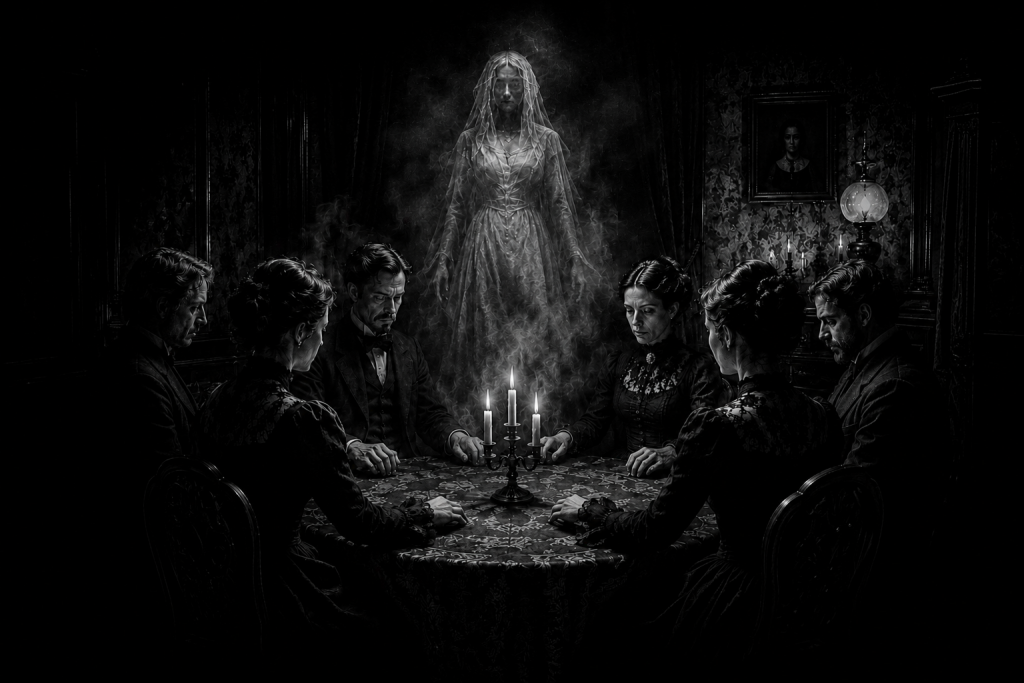
Most séances took place in private homes, particularly in the drawing room or parlor—the most formal room in a Victorian house. Wealthier families sometimes transformed these rooms specifically for séances, covering mirrors with heavy drapery, dimming gas lamps, and arranging chairs in a perfect circle around a polished wooden table.
There was a reason circles became so important.
Spiritualists believed that joining hands created a continuous flow of what they often called psychic force or magnetic energy. Every participant was thought to contribute to this invisible current, allowing spirits to manifest more easily. Whether this energy was understood as divine, electrical, or entirely supernatural depended upon the beliefs of those present.
Guests were usually instructed to arrive with an open mind.
Arguments were discouraged.
Excessive drinking was frowned upon.
Many mediums believed negative emotions could interfere with communication.
A typical séance began in silence.
The medium would ask everyone to place their hands lightly upon the table or to hold hands with the people seated beside them. Candles provided most of the light, although many séances took place under dim gaslight. Contrary to popular belief, not every séance occurred in complete darkness. Some investigators insisted upon enough light to observe what was happening, while many physical mediums argued that darkness made spirit manifestations possible.
The room would grow quiet.
Sometimes a prayer was spoken.
Sometimes a hymn was sung.
Many Spiritualists believed music attracted benevolent spirits, and familiar hymns often became part of the evening’s ritual.
Then everyone waited.
The first sign was often said to be a series of sharp knocks.
These became known as spirit raps.
Participants would ask questions, and the unseen intelligence supposedly answered through coded knocks. One rap might mean “yes.” Two could mean “no.” More elaborate systems assigned numbers to letters of the alphabet, allowing entire messages to be spelled out one letter at a time.
To believers, these raps represented the first proof that someone beyond the grave had entered the room.
Table-Turning and Moving Furniture
Among the earliest and most widespread séance phenomena was table-turning, sometimes called table-tipping.
Participants rested their fingertips lightly upon a small, round wooden table. After several minutes, the table allegedly began to vibrate. Then it tilted. Sometimes one leg lifted from the floor. Occasionally, witnesses claimed the table spun across the room or rocked violently without anyone appearing to push it.
During the height of the Spiritualist movement, table-turning became so fashionable that newspapers published instructions explaining how readers could try it themselves at home.
Entire families experimented after dinner.
University students held séances in dormitories.
Even members of the aristocracy participated.
Scientists investigated whether unknown physical forces were involved.
Modern researchers generally attribute most table-turning to the ideomotor effect—small, unconscious muscle movements made without deliberate intention. The same phenomenon helps explain dowsing rods and later spirit boards. Yet nineteenth-century participants had no such explanation, and many left séances convinced they had witnessed genuine supernatural events.
The fascination spread rapidly across Europe and America.
For a time, it seemed as though nearly everyone wanted to see a table move.
Spirit Cabinets and Materialization
Not all séances centered around tables.
Some mediums specialized in what became known as physical mediumship, claiming spirits could temporarily assume visible, physical form.
To facilitate these demonstrations, mediums often used a spirit cabinet.
Despite its mysterious name, the cabinet was usually nothing more than a curtained enclosure large enough to contain a chair. The medium entered the cabinet before the séance began, and the curtains were drawn closed.
Participants waited in darkness.
Moments later, extraordinary things were said to happen.
Hands emerged from behind the curtains.
Faces appeared in the darkness.
Musical instruments floated into the air.
Spirit voices called attendees by name.
Flowers reportedly materialized from nowhere.
Some witnesses even claimed full human figures stepped out of the cabinet before disappearing again into the shadows.
These apparitions became known as materializations.
Believers argued that spirits temporarily assembled physical bodies from a mysterious substance called ectoplasm, allowing them to become visible to the living.
Today, the word ectoplasm immediately evokes images from horror films and ghost stories, but during the late nineteenth century many Spiritualists considered it an entirely real phenomenon. Mediums claimed the substance emerged from the mouth, nose, or skin while in a trance before taking shape as spirit forms.
Investigations later revealed numerous fraudulent mediums using gauze, muslin, cheesecloth, paper, and even carved masks hidden beneath their clothing.
Yet even after repeated exposures, reports of materialization séances continued to attract enormous audiences.
Spirit Trumpets and Direct Voices
Perhaps the strangest object found in Victorian séance rooms was the spirit trumpet.
Usually constructed from lightweight metal or papier-mâché, these cone-shaped devices resembled oversized megaphones.
According to Spiritualists, spirits found it easier to amplify their voices through the trumpet.
During dark séances, participants sometimes reported the trumpet floating through the air before stopping beside a particular sitter. A voice—sometimes whispering, sometimes speaking clearly—would emerge from the narrow end of the cone.
Many believed they recognized the voices of deceased parents, spouses, or children.
These sessions became known as direct voice séances, because the spirit supposedly spoke independently rather than through the medium.
Skeptics argued that skilled ventriloquism explained many such demonstrations.
Professional magicians later recreated similar effects on stage.
Still, for grieving families, hearing what they believed to be the familiar voice of someone they had loved could become the defining emotional moment of their lives.
Slate Writing and Messages from Beyond
Another popular form of mediumship involved spirit slates.
School slates—small writing boards framed in wood—were cleaned carefully before each séance. Sometimes two slates were tied together with a tiny piece of chalk sealed inside.
Participants examined them thoroughly.
No writing was visible.
The slates were then placed beneath a table or held tightly by members of the audience while the medium entered a trance.
Minutes later, scratching sounds supposedly came from inside.
When the slates were opened, neat handwritten messages appeared upon the previously blank surfaces.
Some messages offered words of comfort.
Others answered personal questions.
Occasionally they appeared signed by deceased relatives.
Slate writing became one of the most convincing forms of mediumship for many believers because the audience often inspected the slates themselves before the demonstration.
Later investigations exposed numerous methods by which fraudulent mediums secretly substituted prepared slates or manipulated hidden writing.
Even so, authentic or not, the emotional impact remained powerful.
To someone mourning a lost child, a few handwritten words could feel priceless.
Automatic Writing and the Planchette
Not every Spiritualist believed spirits needed dramatic manifestations.
Many thought the dead communicated quietly.
One of the most common methods was automatic writing.
The medium—or sometimes an ordinary participant—held a pencil loosely above paper while entering a relaxed or trance-like state. The hand began moving seemingly on its own, producing words, sentences, and occasionally entire pages without conscious effort.
Some writings claimed to come from deceased family members.
Others purported to originate from historical figures, angels, or unnamed spirit guides.
Automatic writing fascinated psychologists as much as Spiritualists. Later researchers explored whether these writings reflected unconscious mental processes rather than supernatural communication.
Closely connected to automatic writing was an ingenious little device known as the planchette.
Usually heart-shaped and fitted with two small wheels and a pencil, the planchette glided across paper while participants rested their fingertips lightly upon it.
Instead of pointing to letters, it wrote them.
Long before the famous Ouija board became a household name, Victorian families were purchasing planchettes in toy shops and stationers’ stores, hoping they might receive messages from beyond the grave.
The commercial Ouija Board would not appear until 1891, near the end of Queen Victoria’s reign. Rather than replacing earlier Spiritualist practices, it evolved from them.
In many ways, the Ouija board was simply the next chapter in a conversation that had already lasted more than forty years.
The Mediums Who Captivated the Victorian World
As Spiritualism spread across Britain and America, certain mediums became household names. Newspapers covered their séances. Wealthy patrons invited them into their homes. Scientists attended their demonstrations. Some were celebrated as extraordinary individuals standing at the frontier of human knowledge. Others were denounced as frauds. Most occupied a curious space somewhere between the two.
Whether genuine or deceptive, these men and women transformed Spiritualism from a fringe curiosity into an international movement.
No figure better represents that transformation than Daniel Dunglas Home.
Daniel Dunglas Home: The Man Who Was Never Caught
Born in Scotland in 1833, Daniel Dunglas Home (pronounced “Hume”) became the most famous physical medium of the Victorian era.
Unlike many mediums of his day, Home never charged admission for his séances. Supporters pointed to this fact as evidence of his sincerity, arguing that he had little financial incentive to deceive his audiences. Instead, he accepted invitations into the homes of wealthy families, aristocrats, diplomats, and even members of European royalty.
Reports surrounding Home became increasingly extraordinary.
Witnesses claimed tables rose from the floor.
Musical instruments played without visible hands.
Hands appeared in darkened rooms and touched participants.
Objects floated through the air.
The most famous account, however, involved levitation.
During a séance in London in 1868, several respected witnesses—including Lord Adare and Captain Wynne—reported seeing Home float out of one third-story window and re-enter through another. The event became one of the most famous—and controversial—stories in the history of Spiritualism.
Skeptics have argued that darkness, suggestion, or faulty memory explain the account.
Believers insist it remains one of history’s most convincing paranormal cases.
Home also astonished audiences by handling glowing pieces of charcoal. Witnesses described him carrying burning coals in his bare hands without visible injury and placing them upon the heads of astonished participants without causing burns.
To nineteenth-century observers, such demonstrations appeared impossible.
To modern historians, they remain fiercely debated.
Remarkably, despite decades of investigation by skeptics, journalists, and scientists, Home was never publicly exposed using the kinds of concealed apparatus that ruined the reputations of many other mediums.
That does not prove his claims.
But it helps explain why Daniel Dunglas Home continues to occupy such a unique place in the history of the paranormal.
Florence Cook and the Spirit Called Katie King
Few stories illustrate Victorian Spiritualism’s mixture of mystery and controversy better than that of Florence Cook.
Cook was only a teenager when she began conducting séances in London during the early 1870s. While in a trance, she claimed that a spirit named Katie King materialized physically before those in attendance.
According to witnesses, Katie King looked entirely human.
She walked around the room.
She spoke with visitors.
She allowed her pulse to be examined.
She even permitted locks of her hair to be cut as evidence that she possessed physical substance.
Perhaps the most remarkable aspect of the story was that Florence Cook allegedly remained unconscious inside the spirit cabinet while Katie King interacted with guests outside.
Were they truly two separate individuals?
Or was Cook somehow leaving the cabinet unnoticed?
The debate intensified after the respected chemist and physicist Sir William Crookes agreed to investigate.
Crookes conducted multiple sittings and reported that he believed he had observed genuine phenomena. His support gave the case enormous publicity, although many contemporaries criticized his methods and questioned whether he had been deceived.
To this day, the Katie King case remains one of the most famous—and disputed—episodes in Spiritualist history.
Science Walks Into the Séance Room
One of the greatest misconceptions about Victorian Spiritualism is that only the uneducated believed in it.
In reality, many respected scientists approached mediumship with genuine curiosity.
The nineteenth century was an age of astonishing discoveries.
Electricity had become practical.
Invisible magnetic fields could now be measured.
The telegraph carried messages through wires across continents.
Soon, invisible radio waves would fill the air.
If nature already contained unseen forces once thought impossible, why couldn’t consciousness survive death?
Among the scientists willing to investigate was Sir William Crookes, one of Britain’s most distinguished chemists.
Crookes discovered the element thallium in 1861.
He invented the Crookes tube, an important step toward the later discovery of X-rays.
He served as president of the Royal Society, one of the world’s oldest scientific institutions.
Yet despite these accomplishments, Crookes also spent years studying mediums.
His willingness to investigate Spiritualism remains controversial.
Some historians argue he allowed personal belief to cloud scientific judgment.
Others admire his willingness to examine extraordinary claims rather than dismiss them outright.
Regardless of one’s conclusions, Crookes demonstrated that Victorian Spiritualism could not simply be dismissed as an anti-scientific movement.
Many participants believed they were exploring an undiscovered branch of nature.
The Society for Psychical Research
By the 1880s, Spiritualism had grown so influential that scholars established organizations dedicated to investigating paranormal claims using systematic methods.
The most important was the Society for Psychical Research, founded in London in 1882.
Its membership included philosophers, physicians, physicists, psychologists, and scholars from some of Britain’s leading universities.
Their goal was not to promote Spiritualism blindly.
Nor was it to ridicule believers.
Instead, members attempted to examine reports of apparitions, haunted houses, telepathy, dreams, deathbed visions, and mediumship with careful documentation and critical analysis.
Investigators interviewed witnesses.
Compared independent testimony.
Visited reportedly haunted locations.
Observed séances under controlled conditions.
Published detailed reports.
Although many cases were explained through misperception or fraud, others remained unresolved.
The Society’s work laid important foundations for later research into psychology, consciousness, and paranormal belief.
More importantly, it revealed something about the Victorian mindset.
This was a generation that believed even the strangest claims deserved careful investigation.
Spirit Photography: Capturing the Dead on Glass
Few inventions changed Victorian society as dramatically as photography.
For the first time in history, ordinary people could preserve remarkably accurate images of themselves and those they loved.
It did not take long before someone asked a startling question.
If cameras could record the visible world…
Could they also record the invisible one?
The most famous spirit photographer was William H. Mumler of Boston.
During the 1860s, Mumler produced portraits in which faint, translucent figures appeared beside living subjects.
Many grieving families believed these ghostly forms represented deceased relatives returning for one final photograph.
Perhaps his most famous client was Mary Todd Lincoln, widow of President Abraham Lincoln.
Using the name “Mrs. Lindall” to avoid attention, she reportedly sat for one of Mumler’s portraits. The resulting photograph appeared to show Abraham Lincoln standing protectively behind her with his hands resting upon her shoulders.
The image became one of the most famous spirit photographs ever produced.
Skeptics argued that Mumler achieved his results through double exposures and photographic manipulation.
He was eventually brought to trial for fraud.
Although he was acquitted because prosecutors could not conclusively prove deception, his reputation never fully recovered.
Today, historians generally agree that spirit photography relied upon photographic tricks.
Yet to thousands of grieving Victorians, those faint figures represented something far more valuable than evidence.
They represented hope.
Why Women Led the Movement
Victorian society offered relatively few opportunities for women to speak publicly or exercise authority outside the home.
Spiritualism unexpectedly changed that.
Many mediums were women.
They claimed they did not speak for themselves but merely served as instruments through which spirits communicated.
This distinction proved important.
A woman delivering political opinions in public might have been criticized.
A woman delivering messages from the spirit world attracted enormous audiences.
Mediums such as Emma Hardinge Britten, Cora L. V. Scott, and others became internationally known lecturers, authors, and reformers.
Many Spiritualists also supported progressive causes including abolition, educational reform, and women’s suffrage.
In this way, Spiritualism became more than a conversation about ghosts.
It became one of the few movements in Victorian society where women could achieve public influence on an international stage.
Fraud, Faith, and the Great Debate
The rapid growth of Spiritualism brought fame, fortune, and inevitably, fraud.
Not every medium who claimed to communicate with the dead possessed remarkable abilities. Some relied upon clever stage techniques that would later become standard tools of professional magicians.
Hidden assistants waited behind curtains.
False cabinet walls concealed accomplices.
Spirit trumpets were manipulated with black thread in darkened rooms.
Pre-written messages were secretly substituted for blank slates.
“Ectoplasm” sometimes turned out to be nothing more than gauze, cheesecloth, egg whites, paper, or muslin hidden beneath a medium’s clothing.
As investigators became more experienced, they began requesting brighter rooms, controlled conditions, and independent observers. Under these circumstances, many spectacular manifestations disappeared.
Yet exposing fraudulent mediums did not destroy Spiritualism.
In some ways, it strengthened the movement.
Believers argued that counterfeit money did not prove all money was counterfeit. Likewise, they insisted that fraudulent mediums merely imitated genuine ones.
The debate became one of the defining intellectual battles of the late nineteenth century.
Harry Houdini’s Search for the Truth
No one embodied that debate more dramatically than Harry Houdini.
Today he is remembered as history’s greatest escape artist, but during the final years of his life Houdini devoted extraordinary energy to investigating Spiritualist mediums.
His interest was deeply personal.
After the death of his beloved mother, Houdini desperately wanted to believe that communication with the dead was possible. If anyone could have been convinced by a genuine medium, it was him.
Instead, he encountered deception.
Again and again, he attended séances where he recognized methods borrowed directly from stage magic.
Because he understood illusion better than almost anyone alive, Houdini could often identify hidden techniques that escaped ordinary observers.
He spent years exposing fraudulent mediums, demonstrating publicly how tables could appear to float, how mysterious voices could be produced, and how spirit manifestations could be created without supernatural forces.
Yet Houdini’s campaign was never an attack on grief itself.
He repeatedly said that if genuine evidence of communication with the dead ever appeared, he would gladly accept it.
His target was exploitation.
He believed dishonest mediums preyed upon families at their most vulnerable moments.
The Friendship That Couldn’t Survive
One of the most fascinating chapters in the history of Spiritualism involved Houdini’s friendship with Sir Arthur Conan Doyle, creator of Sherlock Holmes.
Despite creating history’s most famous fictional detective—a man devoted entirely to evidence and reason—Conan Doyle became one of Spiritualism’s most passionate defenders after the deaths of several loved ones during and after the First World War.
To Doyle, the evidence seemed overwhelming.
To Houdini, much of it was expertly staged.
Their disagreement eventually became deeply personal.
In 1922, Doyle’s wife conducted what she believed was a genuine automatic writing session intended to contact Houdini’s late mother.
The resulting message was written in English and began with the sign of the cross.
Houdini immediately rejected it.
His mother had spoken Hungarian.
She was Jewish.
The message contained details he believed she never would have used.
The incident shattered their friendship.
What had begun as an intellectual disagreement became an emotional divide that neither man could bridge.
Their story perfectly illustrates the enduring tension at the heart of Spiritualism.
Sometimes two intelligent people can examine the same event and arrive at entirely different conclusions.
Why Spiritualism Refused to Die
By the beginning of the twentieth century, countless fraudulent mediums had been exposed.
Photography became better understood.
Psychology offered new explanations for automatic writing, suggestion, memory, expectation, and unconscious movement.
Scientific standards became increasingly rigorous.
Yet Spiritualism did not disappear.
Then came the First World War.
Millions of soldiers never returned home.
Entire communities mourned sons, husbands, fathers, brothers, and friends.
The scale of loss was almost unimaginable.
Once again, grieving families searched for comfort.
Séances returned.
Mediums found new audiences.
Spiritualist churches experienced renewed growth.
History repeated itself.
When loss becomes overwhelming, people naturally begin asking whether death is truly the end.
The Legacy of Victorian Spiritualism
Even people who have never attended a séance continue living in a world shaped by Victorian Spiritualism.
Walk through a haunted attraction during Halloween.
Watch a supernatural film.
Read a Gothic novel.
Play a horror video game.
The fingerprints of the Victorian imagination are everywhere.
Heavy velvet curtains.
Dust-covered portraits.
Gas lamps flickering in long hallways.
Grand staircases disappearing into darkness.
Old cemeteries filled with weathered angels.
A medium seated before a round table illuminated by candlelight.
These images have become so familiar that we rarely stop to ask where they originated.
The answer is almost always the nineteenth century.
Modern ghost hunting also owes an enormous debt to Victorian Spiritualism.
The equipment has changed.
Instead of spirit trumpets, investigators carry digital recorders.
Instead of slate writing, they analyze electronic voice phenomena.
Instead of gaslight, they rely on infrared cameras and thermal imaging devices.
Yet the central question remains exactly the same.
Is anyone there?
What Victorian Spiritualism Reveals About Human Nature
Perhaps the greatest lesson of Victorian Spiritualism has very little to do with proving or disproving ghosts.
Its real importance lies in what it reveals about us.
Every civilization has developed stories about the dead.
Ancient Egyptians believed the soul continued its journey into the afterlife.
The Greeks imagined shades wandering the Underworld.
Japanese folklore gave us the sorrowful yūrei.
Mexico honors ancestors during Día de los Muertos.
Victorian Britain transformed grief into séances.
Each culture speaks a different symbolic language.
Yet each asks the same question.
Can love survive death?
Whether one believes mediums communicated with spirits or merely reflected the hopes of grieving families, the emotional truth remains unchanged.
People have always searched for ways to remain connected with those they have lost.
That longing may be one of humanity’s oldest instincts.
The Last Candle
Imagine stepping into a Victorian drawing room just after sunset.
Rain taps softly against the windows.
Heavy velvet curtains block the outside world.
A fire burns low in the grate.
The furniture gleams beneath the glow of gaslight.
Twelve strangers sit quietly around a circular mahogany table.
Some have traveled for miles.
Others have come only a few streets.
Each carries an invisible burden.
A daughter lost to scarlet fever.
A husband taken by tuberculosis.
A child who lived only a few months.
A brother who never returned.
The medium closes their eyes.
The room falls silent.
Hands join together.
Someone begins singing a hymn barely above a whisper.
Minutes pass.
The silence becomes almost unbearable.
Then—
A single knock.
No one moves.
Another knock.
Somewhere in the darkness, a bell rings softly.
Whether that sound came from the spirit world, an unconscious movement, or an ingenious illusion no longer matters as much as the reason everyone remains seated.
Hope has entered the room.
That hope—not certainty, not proof, but the possibility that love might somehow outlive death—is what transformed Victorian Spiritualism from a curious movement into one of the defining cultural phenomena of the nineteenth century.
Its séances have ended.
Its candles have long since burned away.
Its famous mediums have become figures of history.
Yet the questions they asked continue to echo through every ghost story, every haunted house, every paranormal investigation, every photograph that seems to show more than it should, and every quiet moment when someone wonders if a loved one might still be listening.
Perhaps that is why Victorian Spiritualism continues to fascinate us.
It was never simply about ghosts.
It was about memory.
It was about grief.
It was about love refusing to surrender to silence.
And in that sense, the conversation that began around Victorian séance tables has never truly ended.
About the Author
Kiya Laurent is a contributing writer for DARKWAVE Magazine, where she explores the history of film, music, and the cultural movements that continue to shape them. Her work combines meticulous research with long-form storytelling, uncovering forgotten histories, overlooked artists, and the ideas that connect cinema, music, and visual culture across generations.