Sleeping Beauty: Before Disney
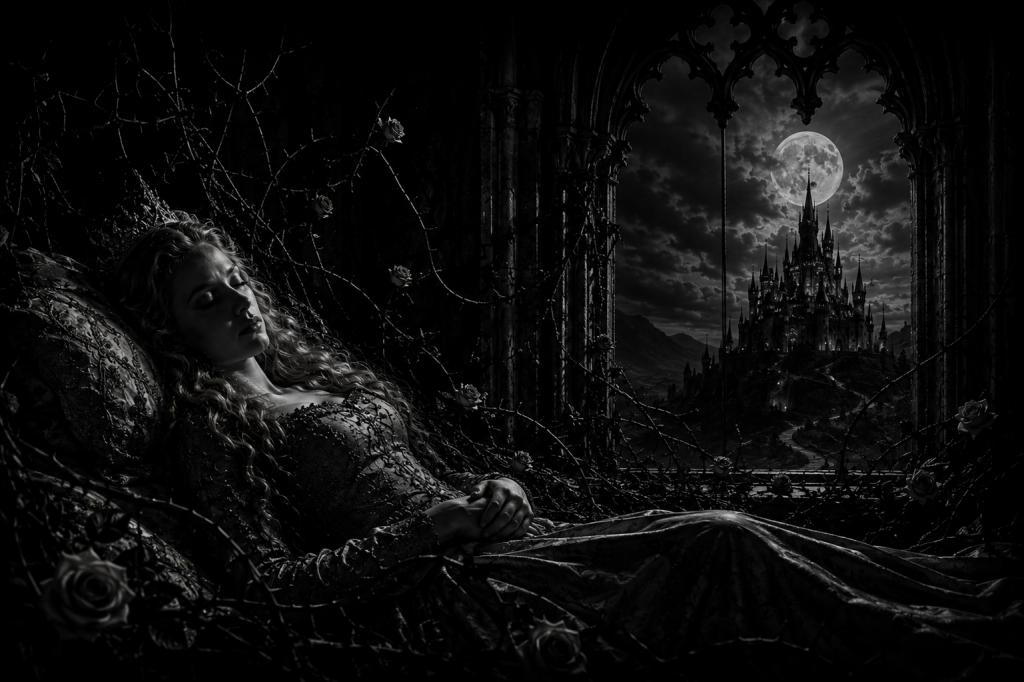
By: Kiya Laurent
Part One: The Story Before the Castle
For many people, Sleeping Beauty begins with a castle.
A spinning wheel.
A cursed princess.
Three fairies.
A dragon.
A prince.
And, at last, true love’s kiss.
The story feels timeless, as though it has always existed in exactly that form. Yet the version known by millions today is only the latest chapter in a tale that has traveled across centuries, languages, and civilizations. Long before Disney transformed it into an animated classic in 1959, Sleeping Beauty belonged to a much older world—a world where stories were carried by memory instead of film, where each generation reshaped them, and where fairy tales were not written primarily for children.
Like many of history’s greatest legends, Sleeping Beauty was never born all at once. It grew slowly. Every storyteller added something. Every culture left its fingerprints behind. Some versions emphasized fate, others romance, and still others explored the mysteries of time, destiny, and transformation.
When we look beyond the familiar castle walls, we discover that Sleeping Beauty is not merely a fairy tale. It is part of a much older conversation that humanity has been having for centuries.
Why do we sleep?
What does it mean to awaken?
Can time itself become a character in a story?
These questions are older than Disney. They are older than the Brothers Grimm. In many ways, they are older than written history itself.
Before Fairy Tales Had Authors
Today, stories usually have creators.
We can name the novelist who wrote a book or the filmmaker who directed a movie. Fairy tales are different.
For hundreds of years, stories lived almost entirely through oral tradition. Grandparents told them beside fireplaces. Travelers shared them along roads. Villagers repeated them during festivals. Each telling changed a little. Names shifted. Settings moved from one kingdom to another. New lessons appeared while older ones disappeared.
There was no “official” version.
Instead, there were countless versions.
That is why scholars often describe fairy tales as living stories. Rather than remaining frozen on the page, they evolved with every generation that inherited them.
Some storytellers wanted to entertain.
Others wanted to explain the world.
Some offered cautionary lessons.
Others simply delighted in mystery.
The earliest ancestors of Sleeping Beauty emerged from this remarkable tradition. They crossed borders without passports, survived without books, and endured because people continued telling them.
Long before cinema, stories themselves were living things.
Sleep as Mystery
Modern readers often think of sleep as an ordinary biological necessity. Ancient civilizations frequently viewed it differently.
Sleep occupied a strange space between life and death.
Dreams seemed capable of carrying messages.
Visions appeared during the night.
Some cultures believed the soul wandered while the body rested.
Across mythology, sleeping figures often represented transformation rather than inactivity. Heroes entered enchanted sleep before returning wiser. Kings dreamed of future kingdoms. Prophets received guidance through visions that arrived only after their eyes had closed.
To sleep deeply was not always to disappear.
Sometimes it meant waiting.
Waiting for the proper season.
Waiting for destiny.
Waiting for the world itself to change.
When viewed through this older lens, Sleeping Beauty becomes something larger than the story of a princess. It becomes a meditation on time itself.
What happens when the world moves on without you?
Who are you when you awaken?
Can love survive decades—or even centuries—of waiting?
These are surprisingly philosophical questions for a tale many people first encountered as children.
The Forest That Keeps Growing
One image appears again and again throughout different versions of Sleeping Beauty.
A sleeping figure.
An abandoned castle.
And nature quietly reclaiming everything.
Trees continue growing.
Thorns spread.
Vines climb stone walls.
Birds nest where people once lived.
The forest becomes almost like another character.
This image speaks to something deeply human.
Nature never stops.
Time never pauses.
Civilizations rise and disappear.
Buildings crumble.
Forests return.
Long before environmentalism became a modern conversation, fairy tales quietly reminded audiences that humanity exists inside nature—not above it.
The sleeping castle becomes less a prison than a time capsule.
The world continues turning while one life remains suspended between yesterday and tomorrow.
Charles Perrault and a New Kind of Fairy Tale
By the late seventeenth century, many oral stories were beginning to find permanent homes on paper.
One of the most influential collectors was the French writer Charles Perrault.
In 1697, Perrault published Histoires ou contes du temps passé (Stories or Tales of Times Past), introducing literary versions of several stories that remain famous today, including Cinderella, Little Red Riding Hood, Puss in Boots, and The Sleeping Beauty in the Wood.
Perrault did not invent these stories.
He preserved and reshaped traditions that had circulated for generations before him.
His version of Sleeping Beauty introduced many of the elements familiar to modern audiences: a royal birth, a prophetic curse, a spindle, a century of sleep, and a prince who arrives after the appointed time has passed.
Yet even Perrault’s tale differs from the version many readers know today. Like most storytellers of his era, he wrote for an audience that appreciated wit, symbolism, and layered meanings. His fairy tales often blended wonder with reflections on patience, society, and human nature.
In many respects, Perrault built the bridge between ancient oral folklore and the modern fairy tale.
Without him, the story might have remained scattered across countless regional traditions.
With him, it began its journey toward becoming one of the world’s most enduring legends.
More Than a Fairy Tale
It is tempting to think that Disney transformed a dark story into a cheerful one.
The truth is more interesting.
For centuries, storytellers continuously reshaped Sleeping Beauty to reflect the values, hopes, and fears of their own time. Every generation polished the tale differently. Some emphasized romance. Others focused on destiny. Still others highlighted patience, family, or the passage of time.
Stories evolve because people evolve.
That may be the greatest secret hidden inside Sleeping Beauty.
It is not simply the story of one princess.
It is the story of storytelling itself.
Every age awakened the tale in its own way.
And every generation left something behind for the next.
Part Two: Before the Brothers Grimm
Every generation left something behind for the next.
So where did Sleeping Beauty come from before Disney? Before the Brothers Grimm? Before Charles Perrault?
The answer isn’t found in a single book.
It’s found in centuries of storytelling.
Unlike a novel that begins with one author, Sleeping Beauty has no single creator. It belongs to the thousands of anonymous storytellers who carried the tale from village to village, kingdom to kingdom, and eventually across continents. Each storyteller borrowed from the one before, adding new details while quietly allowing others to disappear.
That may be why the story still feels alive today.
It has never stopped changing.
A Story Older Than Its Name
One of the fascinating things about fairy tales is that they rarely begin with the names we know.
There was no “Sleeping Beauty.”
There was no Princess Aurora.
There was no Prince Phillip.
There wasn’t even a castle covered in roses.
Instead, there were fragments.
A mysterious sleep.
An impossible passage of time.
A forgotten kingdom.
A young woman whose fate seemed intertwined with destiny itself.
Scholars have spent generations tracing these fragments through European folklore, and while no one can point to a single beginning, many agree that the roots of Sleeping Beauty stretch back hundreds of years before anyone ever wrote the story down.
Some pieces may be even older.
Across ancient myths, we find heroes and heroines placed into enchanted sleep, magical slumber, or states of suspended existence before awakening to an entirely different world.
The details change.
The idea remains remarkably familiar.
Sleep becomes transformation.
Stories Without Borders
Today, it’s easy to imagine countries separated by maps.
Centuries ago, stories ignored borders.
Merchants carried them.
Pilgrims carried them.
Soldiers carried them.
Traveling performers carried them.
A tale told one winter evening in Italy might slowly evolve before reaching France generations later. By the time it arrived in Germany, entirely new characters could appear, while others quietly vanished.
Fairy tales were never fixed.
They behaved more like rivers than monuments.
Always flowing.
Always changing.
That is why historians often discover several versions of what appears to be the same story, each reflecting the customs, language, and imagination of the people who embraced it.
Rather than asking which version is “correct,” a better question may be:
What did each generation find meaningful enough to preserve?
Giambattista Basile and Sun, Moon, and Talia
One of the earliest written ancestors of Sleeping Beauty appears in seventeenth-century Italy.
Its author was Giambattista Basile, whose remarkable collection of Neapolitan folk tales, The Tale of Tales, helped preserve stories that might otherwise have disappeared into history.
Among them was a tale known as Sun, Moon, and Talia.
Modern readers often recognize familiar echoes.
A young noblewoman.
A mysterious sleep.
The slow passage of time.
An eventual awakening.
Yet Basile’s version also reminds us that fairy tales were written for audiences very different from our own. Like much of seventeenth-century literature, it reflects the customs, assumptions, and storytelling traditions of its era.
Reading it today is a little like visiting an ancient cathedral.
Some details feel timeless.
Others clearly belong to another age.
Rather than viewing these differences as flaws, they reveal something important.
Stories are shaped by the people who tell them.
Every generation decides what should remain.
Every generation decides what should change.
Charles Perrault Changes the Story
Nearly eighty years later, a French writer named Charles Perrault approached the tale differently.
Where Basile preserved folklore, Perrault refined it.
His stories were elegant.
Measured.
Designed for readers rather than fireside audiences.
Many of the images we now associate with Sleeping Beauty appear because of Perrault.
The fairy’s curse.
The spinning wheel.
The hundred-year sleep.
The enchanted castle hidden beneath an ocean of thorns.
These elements became so influential that later storytellers often treated them as though they had always existed.
They hadn’t.
Someone chose them.
Someone preserved them.
That is one of the quiet miracles of literature.
A single storyteller can influence centuries that follow.
Then Came the Brothers Grimm
By the early nineteenth century, Jacob and Wilhelm Grimm had begun collecting German folk tales, not because they wished to entertain children, but because they feared Germany’s oral traditions might disappear forever.
They became historians as much as storytellers.
Collectors as much as writers.
When they included Little Briar Rose in their famous collection, they drew heavily from earlier traditions while giving the story a distinctly German character.
The Grimms believed folklore represented the memory of ordinary people.
Kings wrote history.
Villagers preserved legends.
That distinction matters.
Without collectors like the Brothers Grimm, countless stories—including Sleeping Beauty—might have vanished long before the invention of film.
A Mirror of Every Generation
Perhaps the most remarkable thing about Sleeping Beauty isn’t that it survived.
It’s how it survived.
Few stories have traveled so gracefully through changing cultures.
The tale adapted itself to every age.
Medieval audiences saw one story.
French aristocrats saw another.
German folklorists found something different still.
Then, in the twentieth century, Disney introduced the legend to millions of families around the world, creating what would become the best-known version in history.
None of these versions erased the ones before.
Instead, they became chapters in a much larger conversation.
Like rings inside an ancient tree, each generation added another layer.
Each preserved something worth remembering.
Each left something behind.
And perhaps that is the real enchantment hidden inside Sleeping Beauty.
Not magic.
Not castles.
Not curses.
But humanity’s remarkable ability to keep telling the same story—and somehow make it new every time.
Part Three: The Princess the World Remembered
By the middle of the twentieth century, Sleeping Beauty had already traveled through centuries of history.
It had crossed borders.
Changed languages.
Inspired poets, collectors, artists, and storytellers.
Then Walt Disney decided to tell the story one more time.
The result would become one of the most ambitious animated films ever created.
Walt Disney’s Biggest Gamble
When audiences think of Disney’s Sleeping Beauty, they often remember its beauty before they remember its story.
That was no accident.
Released in 1959, Sleeping Beauty was unlike any animated feature the studio had produced before. Disney wanted audiences to feel as though they had stepped inside a medieval tapestry rather than watching a traditional cartoon.
Background artist Eyvind Earle became one of the film’s defining creative voices. His artwork blended Gothic architecture, illuminated manuscripts, Renaissance paintings, and medieval design into something entirely unique.
Forests became cathedrals of trees.
Castles stretched toward impossible heights.
Even the smallest branches seemed carefully composed.
Every frame looked like it belonged inside an art museum.
Nearly seventy years later, the film remains one of the most visually distinctive animated features ever made.
Medieval Art Comes Alive
One reason Sleeping Beauty still feels different from other Disney classics is because it wasn’t trying to imitate reality.
It was trying to imitate history.
The artists looked to medieval Europe for inspiration.
They studied stained-glass windows.
Ancient tapestries.
Illuminated manuscripts decorated by monks centuries earlier.
Gothic cathedrals.
Royal manuscripts filled with elaborate borders, flowers, and impossible forests.
Rather than modernizing the Middle Ages, Disney embraced their artistic language.
Sharp lines replaced rounded shapes.
Elegant geometry replaced naturalism.
The result feels timeless because it doesn’t belong entirely to the twentieth century.
It reaches backward nearly a thousand years.
For readers of DARKWAVE, this may be one of the film’s greatest achievements.
It quietly introduced millions of children to medieval art without them ever realizing it.
Music That Predated the Film
Even the music carried history.
Rather than commissioning an entirely original score, composer George Bruns built much of the film around themes from Pyotr Ilyich Tchaikovsky’s 1890 ballet The Sleeping Beauty.
Long before Disney’s princess danced across movie screens, audiences had experienced the story through orchestras and ballet companies.
Tchaikovsky’s sweeping compositions gave the legend an emotional grandeur that perfectly suited Disney’s vision.
It also reminds us that Sleeping Beauty has inspired artists working in almost every medium imaginable.
Books.
Ballet.
Opera.
Painting.
Film.
Animation.
Each generation discovered something different waiting inside the story.
More Than a Princess
It is easy to describe Sleeping Beauty as the story of Princess Aurora.
Yet doing so misses something important.
Aurora appears on screen for surprisingly little time.
The film belongs equally to its supporting characters.
The three good fairies.
King Stefan.
King Hubert.
Prince Phillip.
Even Maleficent.
Each represents a different force moving history forward.
Hope.
Duty.
Friendship.
Love.
Fear.
The story becomes larger than any one individual.
Perhaps that explains why it continues to resonate.
Every viewer finds a different character to connect with.
The Shadow Everyone Remembers
No discussion of Sleeping Beauty would be complete without Maleficent.
She has become one of cinema’s most recognizable villains.
Yet her enduring popularity comes from more than dramatic animation.
She represents something much older than the film itself.
Throughout mythology and folklore, mysterious figures often arrive to disrupt moments of celebration.
Sometimes they appear as forgotten guests.
Sometimes as wandering strangers.
Sometimes as supernatural beings who remind humanity that no celebration is ever completely free from uncertainty.
Maleficent continues that ancient storytelling tradition.
She embodies the unexpected.
The force that changes everything with a single decision.
Even people who have never seen Sleeping Beauty recognize her silhouette.
The sweeping black cloak.
The towering horns.
The raven.
The green flames.
It is one of animation’s most unforgettable designs.
The Forest Between Childhood and Adulthood
Perhaps the greatest reason Sleeping Beauty has endured is that it quietly reflects something everyone experiences.
Change.
Aurora begins life protected.
Sheltered.
Hidden from the world.
Eventually she must leave the forest.
Face uncertainty.
Discover who she truly is.
In many ways, the enchanted forest becomes a symbol of growing up.
It is beautiful.
Sometimes frightening.
Always mysterious.
Yet it must be crossed.
Every generation understands that journey because every generation lives it.
That may explain why the story continues to feel relevant despite its medieval setting.
Its castles belong to another century.
Its emotions belong to every century.
More Than “Happily Ever After”
Disney’s adaptation gave millions of people their first encounter with Sleeping Beauty.
For many, it became the definitive version.
Yet one of its greatest achievements may be inspiring audiences to ask a simple question:
“Was there a story before this one?”
The answer, as we’ve discovered, is yes.
Many stories.
Many voices.
Many centuries.
Disney did not replace history.
He became part of it.
His film joined an extraordinary chain of storytellers stretching back hundreds of years—each preserving something beautiful while leaving room for the next generation to continue the tale.
That is how legends survive.
Not because they remain unchanged…
…but because they continue to awaken.
Part Four: Why We Still Tell the Story
Every great story eventually asks a question.
Not out loud.
Quietly.
Patiently.
It waits for each new generation to answer it.
Perhaps that is why Sleeping Beauty has never truly gone to sleep.
For centuries, people have returned to it—not because of the castle, the spindle, or even the kiss—but because beneath those familiar images lies something deeply human.
The story is about waiting.
About change.
About hope.
About believing that even after the longest night, morning eventually arrives.
⸻
The Meaning of Sleep
If we strip away the magic, Sleeping Beauty becomes surprisingly relatable.
Everyone experiences seasons where life seems to stand still.
Dreams pause.
Plans change.
Opportunities disappear.
Sometimes it feels as though the world keeps moving while we remain frozen in place.
The princess sleeps.
The kingdom waits.
Nature quietly continues its work.
Then, one day, life begins again.
Perhaps that is why the story has survived.
It reminds us that waiting is not always failure.
Sometimes waiting is part of becoming.
⸻
Time Is the True Magic
Fairy tales are often remembered for magic.
Yet Sleeping Beauty contains surprisingly little.
No endless battles.
No impossible quests.
No magical objects that solve every problem.
Instead, its greatest force is something every person experiences.
Time.
A hundred years pass.
Generations come and go.
Children become grandparents.
Forests reclaim forgotten roads.
Stone slowly softens beneath vines.
Everything changes.
The spell does not simply affect one princess.
It transforms an entire world.
Perhaps that is why the castle hidden beneath the forest remains one of literature’s most unforgettable images.
It reminds us that while time changes everything…
…it does not erase everything.
Some stories simply wait to be rediscovered.
⸻
The Power of Retelling
Every generation believes it is discovering Sleeping Beauty for the first time.
Children hear it through picture books.
Parents remember animated films.
Readers discover Charles Perrault.
Students encounter the Brothers Grimm.
Scholars trace the tale back to Giambattista Basile.
Each version feels new.
Yet they are all connected.
Imagine the story as an ancient tree.
Disney is one branch.
Perrault another.
The Brothers Grimm another.
Basile another still.
Beneath them all lie roots disappearing deep into history, where anonymous storytellers first imagined a mysterious sleep and wondered what might happen after the awakening.
Those storytellers will never know their names became immortal.
Yet every time someone tells Sleeping Beauty, they are remembered.
Not by name.
By legacy.
⸻
Why Fairy Tales Change
One of the most fascinating discoveries in exploring Sleeping Beauty is realizing that fairy tales are not fragile.
They are remarkably resilient.
They survive because they adapt.
Every generation chooses which parts speak most clearly to its own time.
Some emphasize courage.
Others kindness.
Others sacrifice.
Others hope.
That does not weaken the story.
It keeps it alive.
Stories that never change often become museum pieces.
Stories that evolve remain companions.
Perhaps fairy tales have always understood something that people sometimes forget.
Growth does not erase identity.
Growth reveals it.
⸻
Before Disney…and Beyond
When we say Sleeping Beauty: Before Disney, we are not stepping away from Disney.
We are stepping toward something larger.
Disney became part of a tradition that had already endured for centuries.
His artists added beauty.
His musicians added emotion.
His animators added unforgettable imagery.
They did what storytellers have always done.
They inherited a legend.
Then they left it richer than they found it.
That is how culture survives.
Not by preserving stories inside glass cases…
…but by continuing to tell them.
⸻
The Gift Hidden Inside the Story
Perhaps the greatest surprise in researching Sleeping Beauty is discovering that the oldest versions are not simply “darker.”
They are different.
They reflect different societies.
Different expectations.
Different audiences.
Rather than judging the past only through modern eyes, we can learn from it.
History does not ask us to approve of everything that came before us.
It asks us to understand it.
That understanding allows us to appreciate how stories evolve—and how humanity evolves alongside them.
When we recognize that journey, we begin to see fairy tales not as relics from childhood, but as living records of the people who told them.
⸻
The Story Never Ends
Long before there was an animated princess…
Before castles painted in watercolor skies…
Before orchestras filled movie theaters…
Before printed books…
There was simply a story.
Someone told it.
Someone listened.
Someone remembered.
Then they carried it to the next village, the next family, the next generation.
That simple act has lasted for centuries.
Perhaps that is the real magic hidden inside Sleeping Beauty.
Not the curse.
Not the spindle.
Not even the awakening.
The real magic is that a story could travel across hundreds of years and still find new ears willing to hear it.
And every time it is told, it awakens once more.
⸻
Final Thoughts
There is a tendency to think of fairy tales as relics from childhood—as simple stories that belong to another stage of life.
Yet the longer one studies them, the more they seem to grow alongside us.
As children, we marvel at castles and enchanted forests.
As adults, we notice the passage of time, the persistence of hope, and the quiet truth that every generation inherits stories before passing them on.
Sleeping Beauty has survived because it has never belonged to one author, one nation, or one studio.
It belongs to humanity.
Its journey from whispered folklore to printed page, from ballet to cinema, reminds us that stories are living things. They change because we change. They endure because each generation finds something worth preserving.
Perhaps that is why Sleeping Beauty still feels timeless.
Not because it has remained the same…
…but because it has never stopped awakening.
About the Author
Kiya Laurent is a contributing writer for DARKWAVE Magazine, where she explores the history of film, music, and the cultural movements that continue to shape them. Her work combines meticulous research with long-form storytelling, uncovering forgotten histories, overlooked artists, and the ideas that connect cinema, music, and visual culture across generations.