Bloody Mary: Don’t Say It Three Times
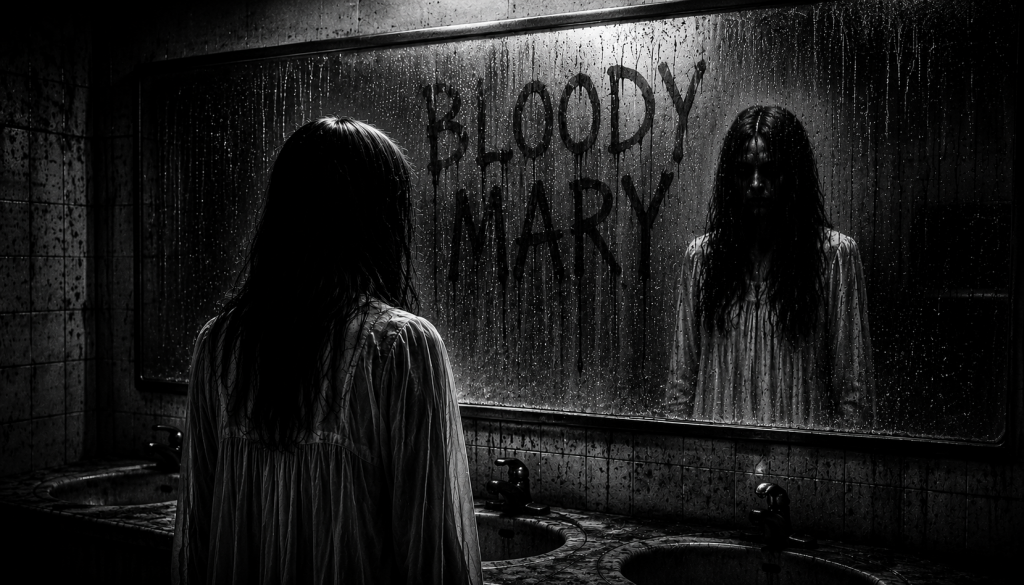
By Kiya Laurent
Estimated reading time: 20-25min
The Woman Behind the Glass
Every school had a bathroom no one wanted to enter alone.
Perhaps it was the one at the end of the oldest hallway, where the fluorescent light flickered without explanation. Perhaps it was a basement restroom that smelled permanently of wet concrete and industrial soap. Perhaps there was nothing visibly wrong with it at all. It contained the same porcelain sinks, metal stall doors, paper-towel dispensers, and scratched mirrors found everywhere else.
But the children knew.
Something lived there.
Her name was Mary.
The instructions varied, but only slightly. Go into the bathroom. Close the door. Turn off the lights. Stand before the mirror. Sometimes a candle was required. Sometimes the participant had to spin in a circle, run the faucet, flush the toilet, or splash water across the glass. In certain versions, the ritual had to be performed at midnight. In others, the school day provided all the darkness and danger necessary.
Then came the most important part.
Say her name.
“Bloody Mary.”
Say it again.
“Bloody Mary.”
And once more.
“Bloody Mary.”
What happened next depended on where you grew up, who told you the story, and how badly they wanted to frighten you.
A pale woman might appear behind your shoulder. A blood-covered face might replace your own. Mary might scratch your cheek, blind you, pull you through the mirror, follow you home, or remain attached to your reflection forever. Some children claimed that she carried a knife. Others described a woman holding her severed head. In certain tellings, she was a witch. In others, a murdered girl, a grieving mother, a queen, a bride, or simply something that had been waiting inside the glass long before anyone gave it a name.
The details were never stable.
The fear was.
For generations, children have entered bathrooms in groups, turned out the lights, and dared one another to summon a woman whose history none of them could clearly explain. Many fled before completing the ritual. Others shouted the name as quickly as possible, then ran screaming into the hallway. Some remained in front of the mirror long enough to become convinced that they had seen something move.
Nearly everyone knew someone who claimed to know someone who had stayed too long.
Bloody Mary is one of the most successful ghost stories in modern folklore. She has crossed countries, languages, religions, generations, and social classes without requiring a book, a movie, a church, or even an adult to carry her forward. Children teach her to other children. She travels through whispered conversations, sleepovers, school corridors, summer camps, older siblings, cousins, playgrounds, and bathroom doors held shut while someone inside begs to be released.
Unlike many famous monsters, Bloody Mary has no definitive appearance, birthplace, biography, or original text. There is no single authoritative version of the story. She belongs to no one, which may be precisely why she belongs to everyone.
But who is she?
And why must we meet her in a mirror?
A Legend Without an Original
The search for the “real” Bloody Mary usually begins with the assumption that there must have been an actual woman behind the legend.
The most famous candidate is Mary I of England, the Tudor queen who ruled from 1553 until 1558. The daughter of Henry VIII and Catherine of Aragon, Mary attempted to restore Roman Catholicism after the religious upheavals of her father’s reign. During her rule, roughly three hundred Protestant dissenters were burned for heresy. Her Protestant opponents later attached the enduring name “Bloody Mary” to her reign.
Mary I also suffered through false pregnancies that became matters of national attention. Her abdomen appeared to swell, preparations were made for an heir, and official announcements anticipated a royal birth that never came. Later storytellers have attempted to connect these personal tragedies with versions of Bloody Mary in which the mirror woman searches for a lost child or appears carrying a dead infant.
The association is tempting. Mary I was a real woman called Bloody Mary. She was a queen connected with religious violence, bloodshed, pregnancy, grief, and death. She seems ready-made for a ghost story.
Yet there is little evidence that the children’s bathroom ritual began as a deliberate attempt to summon the Tudor queen. The historical Mary may have influenced later explanations, but folklore often works backward. Once people encounter a mysterious name, they search history for someone who appears to fit it. The explanation can become part of the legend even when it was not the legend’s original source.
Other identities are equally uncertain.
Mary Worth is frequently named as the woman in the mirror, but her supposed biography changes dramatically. She has been described as a witch executed during the Salem trials, an old woman murdered by townspeople, a child-killer, a woman killed in a car accident, and a figure who punished enslaved people attempting to escape through the Underground Railroad. These stories cannot all describe the same person, and reliable historical evidence for a single Mary Worth matching the legend remains elusive.
Some children call her Mary Whales, Mary Jane, Mary Lou, Hell Mary, Black Agnes, or Mary Johnson. In a related ritual, the figure summoned is sometimes called the Bell Witch or the White Lady. The number of repetitions changes as well. Three is now the most recognizable number, but some versions require five, seven, thirteen, forty-seven, or even one hundred repetitions.
The variations are not flaws in the story.
They are evidence that the story is alive.
Folklore does not survive by remaining unchanged. It survives because each community reshapes it. A child hears the ritual, forgets one instruction, adds another, moves the haunting into the bathroom at her own school, and tells the next child that the event happened to someone nearby. The legend becomes local wherever it is repeated.
Bloody Mary is always said to have appeared somewhere else—but never so far away that she cannot reach you.
The Mirror Remembers
There is something unsettling about a mirror long before anyone whispers Mary’s name.
A window allows us to look outward. A painting asks us to look inward. A photograph freezes a moment that has already passed.
A mirror does something stranger.
It watches us while we watch it.
We know, rationally, that we are seeing our own reflection. Yet anyone who has stared into a mirror in near darkness for more than a few minutes understands how quickly certainty begins to erode. Tiny shifts in light become movement. Familiar features begin to look unfamiliar. A smile held too long becomes unnatural. Eyes that have belonged to us our entire lives suddenly seem to belong to someone else.
Perhaps Bloody Mary was inevitable.
Long before children gathered in school bathrooms, mirrors had already earned a reputation as objects that blurred the line between the ordinary and the supernatural.
A Doorway Between Worlds
For thousands of years, reflective surfaces have occupied a strange place in human history.
Ancient Greeks practiced forms of divination using polished metal and still pools of water. In parts of the ancient world, people believed that reflective surfaces could reveal hidden truths, predict illness, or offer glimpses beyond everyday reality. Across Europe, mirrors appeared in folklore as instruments capable of revealing the future—or warning of death.
One of the oldest wedding superstitions instructed young women to walk backward while holding a candle before a mirror on certain nights of the year. If fortune smiled upon them, they might glimpse the face of the man they would someday marry.
If fortune did not…
The reflection might reveal something far darker.
Instead of a future husband, they were said to see a skull, a coffin, or Death himself.
Whether anyone truly believed these rituals worked almost misses the point.
People kept performing them.
Generation after generation.
The mirror became something more than polished glass.
It became possibility.
Seven Years of Bad Luck
Perhaps no mirror superstition has survived longer than the warning never to break one.
Most children learn the rule before they learn where it came from.
Break a mirror.
Seven years of bad luck.
The explanation reaches surprisingly far into history.
The Romans believed that life renewed itself in seven-year cycles. Damaging one’s reflected image was thought to damage the soul itself, requiring seven years before balance could be restored.
Other cultures believed mirrors captured part of a person’s essence. Breaking one therefore carried consequences beyond replacing a piece of glass.
Even today, many people who dismiss ghosts, curses, and haunted houses hesitate—just for a second—after hearing a mirror crack.
Some traditions cover mirrors after someone dies, believing that a departing soul might become trapped inside the glass. Others feared spirits entering through reflective surfaces left uncovered during mourning.
These customs developed independently across different cultures, separated by oceans and centuries.
That doesn’t prove mirrors are supernatural.
But it does suggest that humanity has long sensed there is something psychologically different about looking at ourselves.
The Face Begins to Change
Science offers an explanation that is no less fascinating than folklore.
In 2010, Italian psychologist Giovanni Caputo published research exploring what happens when people stare at their own reflections in dim lighting for extended periods.
Participants were instructed to simply maintain eye contact with themselves.
Within minutes, many reported disturbing changes.
Some described facial features melting or distorting.
Others claimed they saw the faces of relatives.
Some reported strangers.
A few believed they were looking at monsters or elderly versions of themselves.
Caputo referred to the experience as the “strange-face illusion.”
The phenomenon likely results from a combination of neural adaptation, expectation, low lighting, and the brain’s remarkable tendency to search for meaningful patterns.
Our visual system is constantly filtering information.
Hold perfectly still.
Reduce the light.
Remove distractions.
Continue staring.
Eventually the brain begins filling in gaps that are no longer receiving fresh visual information.
The result feels deeply convincing.
The face changes.
Not because something entered the mirror…
…but because the mind refuses to tolerate uncertainty.
Yet knowing the explanation rarely makes the experience less unsettling.
If anything, it becomes more mysterious.
Because the frightening image didn’t come from the mirror.
It came from us.
The Power of Expectation
Imagine standing alone in a dark bathroom.
Someone has already told you exactly what will happen.
You have heard the stories since elementary school.
You know someone whose cousin supposedly tried it.
You know the rules.
Three repetitions.
No laughing.
Don’t run.
Don’t look away.
Now stand still.
Listen.
Watch.
Your heartbeat rises.
Every creak inside the building suddenly becomes meaningful.
The hum of fluorescent lights sounds louder.
Water pipes shift somewhere inside the walls.
Your breathing changes.
Psychologists have long understood that expectation dramatically influences perception.
If we expect danger, our brains become exquisitely sensitive to tiny movements, unfamiliar sounds, and ambiguous shapes.
This tendency has obvious evolutionary advantages.
Mistaking a shadow for a predator is inconvenient.
Mistaking a predator for a shadow can be fatal.
Bloody Mary exploits one of the oldest survival systems in the human brain.
She asks us to expect something impossible.
Then places us in an environment where ordinary sensations suddenly feel extraordinary.
Every School Had That Story
Ask enough adults about Bloody Mary, and a curious pattern begins to emerge.
Almost no one claims to have personally seen her.
Yet almost everyone knows someone who supposedly did.
“My older sister…”
“My cousin…”
“A girl two grades ahead…”
“It happened at another school…”
The witness always exists.
The location always feels close.
The evidence never quite arrives.
Folklorists have a name for stories like these.
They are called contemporary legends—or, more commonly, urban legends.
Unlike myths, which explain the distant past, or fairy tales, which unfold in imaginary kingdoms, urban legends insist they happened recently.
Nearby.
To real people.
Their power depends on proximity.
The closer the story feels, the more believable it becomes.
Bloody Mary may be one of the purest examples ever created.
She doesn’t haunt castles.
She doesn’t require ancient ruins.
She doesn’t wait inside abandoned hospitals.
She appears in the most ordinary room inside the most ordinary building imaginable.
Your school’s bathroom.
Which means every school can claim her as its own.
The Sleepover Test
There may be no more perfect environment for Bloody Mary than the childhood sleepover.
The lights go out.
The adults disappear downstairs.
Someone inevitably asks the question.
“Have you ever tried Bloody Mary?”
Within minutes, everyone is negotiating rules they barely remember.
Candles appear.
Flashlights replace them when candles aren’t allowed.
Someone volunteers to say the name.
Someone else refuses to enter.
Another insists they’re not scared while standing furthest from the door.
The ritual becomes less about proving ghosts exist and more about proving courage.
Or pretending to.
Most participants never expect Mary to appear.
They simply don’t want to be the first one who runs.
Looking back as adults, many people remember these moments with surprising affection.
The fear was real.
The laughter afterward was real too.
Bloody Mary became a shared rite of passage—a story passed from one generation of children to the next without any adult needing to organize it.
Like flashlight ghost stories around a campfire, the ritual teaches something deeper than fear.
It teaches imagination.
It teaches trust.
It teaches how communities build legends together.
Perhaps that’s the real magic.
Not that Bloody Mary appears…
…but that she has never stopped appearing in our collective imagination.
When the Legend Escaped the Bathroom
Legends rarely stay where they begin.
They migrate.
They slip through generations, change names, borrow details, shed old meanings, and quietly adapt themselves to whatever era they happen to inhabit. Every storyteller leaves fingerprints on them. Every listener remembers something slightly differently.
Bloody Mary may have begun as a whispered ritual between children, but she refused to remain there.
Eventually, she stepped out of the bathroom.
From Whispered Secret to Urban Legend
Unlike Dracula, Frankenstein’s monster, or the Headless Horseman, Bloody Mary has no single creator.
There was no novel.
No original screenplay.
No first publication that announced her arrival.
She spread the old-fashioned way—through conversation.
Folklorists call this oral tradition, one of humanity’s oldest methods of preserving stories. Long before books became common, knowledge traveled from person to person. Sometimes the stories carried history. Sometimes they carried warnings. Sometimes they carried fear.
Children are remarkably good at preserving folklore.
Adults often assume children’s stories are constantly changing, but many playground traditions survive for decades with surprisingly little alteration. Hand-clapping games, jump-rope rhymes, campfire stories, and ghost rituals are passed from one generation of children to the next with almost no adult involvement.
Bloody Mary belongs to that remarkable tradition.
Many adults are surprised to discover that children in entirely different countries performed nearly identical mirror rituals without ever meeting one another.
No internet.
No social media.
Just whispered instructions.
Somewhere, another group of children was standing in another dark bathroom saying the same name.
When Researchers Started Paying Attention
For centuries, scholars dismissed stories like Bloody Mary as childish nonsense.
Then folklore itself became a serious field of study.
During the twentieth century, researchers began documenting urban legends, collecting different versions, interviewing participants, and asking an unexpected question:
Why do intelligent people continue telling stories they know may not be true?
The answer wasn’t ghosts.
The answer was people.
Folklore reflects the hopes, fears, anxieties, humor, and imagination of the communities that create it. Whether a legend is factually true is often less important than why it continues to circulate.
Bloody Mary survives because every generation finds something meaningful inside her.
She becomes whatever people need her to become.
A ghost.
A warning.
A dare.
A mystery.
A shared childhood memory.
The School Bathroom Panic
By the late twentieth century, Bloody Mary had become so widespread that schools occasionally found themselves responding to it.
Teachers reported students refusing to enter certain bathrooms after rumors spread that someone had seen Mary in the mirror.
Custodians discovered candles, handwritten notes, and names scratched into stall doors.
School administrators occasionally addressed frightened students after stories circulated through classrooms.
Most of these incidents never became national headlines.
They didn’t need to.
Urban legends thrive locally.
A rumor inside one school can become more powerful than a story broadcast across the country because everyone believes someone nearby witnessed it firsthand.
Sometimes entire grades became convinced that one particular restroom was haunted.
The legend didn’t require evidence.
Belief supplied everything else.
The Internet Changes Everything
For thousands of years, folklore moved at the speed of conversation.
Then came the internet.
Suddenly, Bloody Mary no longer belonged to neighborhoods or individual schools.
She became global.
Message boards filled with personal accounts.
Video-sharing websites featured countless attempts to perform the ritual.
Social media introduced new variations almost overnight.
Some creators presented the challenge as entertainment.
Others insisted their recordings captured genuine paranormal events.
Most were impossible to verify.
Some were clearly staged.
Yet millions watched anyway.
The technology had changed.
Human curiosity had not.
Ironically, the internet did something folklore had rarely experienced before.
It froze the story.
Instead of constantly evolving through memory, many versions now existed permanently online.
Future generations could revisit older tellings instead of relying solely on word of mouth.
Even so, the legend continued mutating.
It always does.
Hollywood Finds the Mirror
Eventually, filmmakers noticed what children had understood for generations.
A mirror is terrifying.
Cinema embraced reflections almost immediately.
Long before Bloody Mary appeared directly on screen, mirrors had become visual shorthand for fractured identity, guilt, possession, hidden personalities, and supernatural intrusion.
A reflection could hesitate.
Smile at the wrong moment.
Turn its head independently.
Remain standing after the character walked away.
The audience instinctively understood something was wrong.
Modern horror films expanded on these ideas, often borrowing from Bloody Mary without naming her directly.
The image became instantly recognizable:
A dimly lit bathroom.
Fog gathering on glass.
Someone staring into their own reflection.
Silence.
Then…
something changes.
The mirror has become one of horror’s greatest stages precisely because everyone understands the rules before anything happens.
We’re already nervous.
The filmmaker simply waits.
Why Children Keep Coming Back
Adults sometimes ask why children willingly frighten themselves.
The answer is surprisingly complicated.
Fear experienced in a safe environment can be exhilarating.
Ghost stories around campfires.
Haunted houses during Halloween.
Roller coasters.
Scary movies watched beneath blankets.
They allow us to explore danger while remaining protected.
Psychologists sometimes describe this as a kind of emotional rehearsal.
We practice fear.
We experience uncertainty.
Our hearts race.
Then we discover we survived.
Children perform Bloody Mary for similar reasons.
The ritual tests courage.
It creates belonging.
Those who participate become part of a shared story.
Even those who refuse become part of it.
Everyone remembers who screamed first.
Who laughed.
Who ran.
Who insisted they saw something.
Decades later, those memories often remain surprisingly vivid.
Not because Mary appeared…
…but because childhood itself felt larger than life.
The Stories That Refuse to Die
Every few years, someone announces that Bloody Mary is fading away.
Children have smartphones now.
Surely they don’t gather in dark bathrooms anymore.
Yet the legend persists.
Perhaps not exactly as it once did.
But it remains.
It surfaces in new forms.
Videos.
Podcasts.
Television.
Conversations between siblings.
Campfires.
Late-night sleepovers.
It waits patiently until someone asks the same question children have asked for generations.
“Have you ever tried it?”
That’s how folklore survives.
Not through proof.
Through repetition.
The remarkable thing isn’t that Bloody Mary still exists.
It’s that after decades of films, books, websites, documentaries, and endless attempts to explain her away…
Children still lower their voices before saying her name.
Perhaps that is the true measure of a legend.
Not whether it can be proven.
But whether it still knows how to make us whisper. Part Four of Four: The Woman We Never Stopped Looking For
Every generation believes it is more rational than the one before it.
We have better technology.
Better science.
Better explanations.
Yet some stories refuse to disappear.
Bloody Mary is one of them.
She has survived because she was never dependent on evidence.
She depends on something far more durable.
Human nature.
For centuries, people have searched for meaning inside places that reflect us back to ourselves. We have looked into still water, polished metal, darkened windows, camera lenses, and mirrors—not only to see our faces, but to ask questions that cannot easily be answered.
Who am I?
What happens after death?
Am I alone?
Is there something beyond what I can see?
Those questions existed long before Bloody Mary.
She simply gave them a face.
More Than a Ghost Story
At first glance, Bloody Mary appears to be little more than a childhood dare.
Turn off the lights.
Stand before the mirror.
Say her name three times.
Run away laughing.
But beneath that simple ritual lies something much older.
It is a story about thresholds.
Childhood and adulthood.
Light and darkness.
Reality and imagination.
Belief and skepticism.
The bathroom becomes a stage where those worlds briefly overlap. Whether anything supernatural happens is almost beside the point. The experience changes because the participants change. They become intensely aware of every sound, every shadow, every tiny movement in the room—and, perhaps most importantly, of themselves.
That is why the legend has endured.
It is participatory.
You don’t simply hear Bloody Mary.
You experience her.
The Mirror Is Never Empty
The longer I researched Bloody Mary, the less interested I became in proving whether she exists.
Instead, I became fascinated by a different question.
Why do mirrors continue appearing in our stories?
Lewis Carroll sent Alice through one.
Folklore warned us not to leave one uncovered after death.
Filmmakers use them to reveal hidden truths.
Artists paint them as symbols of vanity, identity, memory, and mortality.
Psychologists study what prolonged reflection does to our perception.
Across cultures that never spoke to one another, mirrors repeatedly became objects of mystery.
That pattern is difficult to ignore.
Not because it proves the supernatural.
But because it reveals something about us.
A mirror is one of the few objects that forces us to confront ourselves.
Most of the time, we glance at it for only a few seconds.
Adjust our hair.
Straighten a collar.
Brush our teeth.
Then we leave.
Bloody Mary asks us to do something completely different.
Stay.
Keep looking.
Don’t blink.
That may be the most unsettling instruction of all.
Fear Has Always Told Stories
Fear is often treated as something to overcome.
Sometimes it should be.
But fear has another purpose.
It teaches.
It preserves memory.
It strengthens communities.
Long before written language, stories warned people about dangerous places, unfamiliar strangers, deep water, forests after dark, and unexplained illness. Some warnings were practical. Others became symbolic. Over time, they evolved into myths, folktales, ghost stories, and legends.
Whether every story was literally true mattered less than whether the story was remembered.
Bloody Mary belongs to that long tradition.
She reminds us that storytelling has always been one of humanity’s oldest survival skills.
The Legend Changes… We Stay the Same
Today’s children may hear about Bloody Mary through a video instead of a cousin.
Tomorrow’s children may discover her through technologies we can’t yet imagine.
The setting will change.
The language will change.
The details will change.
But the ritual will probably remain recognizable.
A dark room.
A reflective surface.
A whispered name.
A nervous laugh.
Someone insisting they saw something.
Someone insisting they didn’t.
And someone quietly wondering.
What if?
That question has kept folklore alive for thousands of years.
One Last Look
There is an old saying that every legend contains a grain of truth.
Perhaps.
But the truth is not always where we expect to find it.
Maybe Bloody Mary is not the woman in the mirror.
Maybe she never was.
Maybe the legend survives because it captures a universal moment—the instant when certainty gives way to imagination.
When we are alone.
When the room is quiet.
When our own reflection begins to feel unfamiliar.
That experience is real.
Whether anything else is standing there…
…is something each person must decide for themselves.
So, if someone ever invites you into an old bathroom…
If they switch off the lights…
If they grin and ask whether you’ve ever tried it…
You already know the rules.
Stand before the mirror.
Look into the glass.
Take a breath.
And whatever you do…
Don’t say it three times.
Selected Sources & Further Reading
- Alan Dundes (ed.), Bloody Mary in the Mirror: Essays in Psychoanalytic Folkloristics — one of the most influential scholarly examinations of the Bloody Mary legend and its cultural meanings.
- Giovanni B. Caputo, research on the “strange-face illusion,” exploring the psychological effects of prolonged mirror gazing in dim light.
- Jan Harold Brunvand, The Vanishing Hitchhiker and other works on urban legends, documenting how contemporary folklore spreads and evolves.
- Stith Thompson, Motif-Index of Folk-Literature, an essential reference for recurring themes and symbols found across world folklore.
- Collections of British and American folklore documenting mirror divination, Halloween customs, and nineteenth-century superstitions surrounding reflective surfaces.
Thank you for taking this journey with me.
Just don’t ask me to meet you in the bathroom after midnight.