Spring-Heeled Jack: The Shadow That Leapt Through London
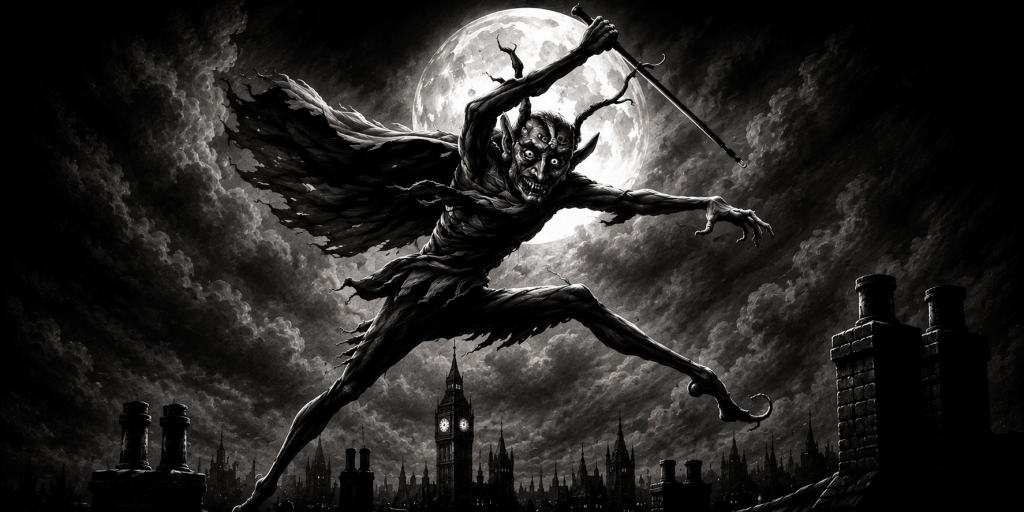
By Amy Holloway
Estimated reading time: 13-15 minutes
Chapter One
Whispers in the Fog
Some of the oldest stories do not begin with a book.
They begin with a warning.
Long before I understood history, I understood atmosphere. Growing up in London, there were evenings when the city seemed to change after sunset. The familiar streets became quieter. The brick buildings looked older than they had only an hour before. Fog softened the edges of everything, and ordinary places seemed capable of keeping extraordinary secrets.
As a child, I did not know whether I believed every story I heard.
That was never the important question.
The important question was why people continued telling them.
One of the first names I remember hearing was Spring-Heeled Jack.
No one sat me down and formally explained who he was. Like so much folklore, he arrived in fragments. A passing comment from an older neighbor. A mention during a school discussion about Victorian London. A television documentary watched far later than my bedtime. Each telling was slightly different, yet each shared the same quiet certainty that, at one time, people believed someone—or something—was moving through London’s streets in ways that defied explanation.
That fascinated me.
Not because I wanted to be frightened.
Because I wanted to understand.
Looking back now, I realize Spring-Heeled Jack says as much about London as he does about the mysterious figure himself.
London is a city built layer upon layer. Roman roads lie beneath modern traffic. Medieval churches stand beside glass towers. Ancient alleyways disappear behind railway stations. Every generation leaves something behind, and every generation inherits stories from those who came before.
Some of those stories celebrate heroes.
Others remember kings.
And some belong to the darkness.
Spring-Heeled Jack emerged during the Victorian era, a period often remembered for remarkable progress. Railways expanded across Britain. Scientific discoveries transformed everyday life. Photography was changing the way people remembered the world. Newspapers reached more readers than ever before.
Yet alongside all of that progress lived something older.
Imagination.
Rumor.
Fear.
It is easy, from our modern perspective, to dismiss stories like Spring-Heeled Jack as nothing more than strange entertainment. But doing so overlooks something deeply human.
Folklore rarely survives because people mistake it for history.
It survives because it expresses something history alone cannot.
Every culture creates figures that wander just beyond certainty. They remind us that there are still places where reason has not entirely conquered imagination.
In the forests of Eastern Europe there is Baba Yaga.
Across the Caribbean, stories speak of the Soucouyant.
Throughout Latin America, generations have whispered about La Llorona.
England, too, has its own shadow walking through cultural memory.
He did not haunt an isolated castle.
He did not emerge from an ancient forest.
He appeared in the streets of one of the world’s greatest cities.
Perhaps that is what makes Spring-Heeled Jack so enduring.
He belonged to the modern world.
Or at least he seemed to.
Descriptions varied dramatically. Some witnesses spoke of impossible leaps over walls and rooftops. Others described glowing eyes or strange clothing. Newspapers eagerly reported new sightings. Conversations spread from drawing rooms to factories, from pubs to family dinner tables. With every retelling, the legend became both larger and more elusive.
Was there ever one individual behind the stories?
Were there several imitators?
Did newspapers amplify scattered incidents until they became a phenomenon?
Those questions have occupied historians for generations.
They will occupy us as well.
But before we investigate evidence, dates, and newspaper reports, I think it is worth pausing to appreciate something simpler.
Imagine London on a winter evening in the nineteenth century.
Gas lamps glow against damp stone.
Horse-drawn carriages echo through narrow streets.
A distant church bell marks the hour.
Someone hurries home after hearing that another strange encounter has taken place somewhere across the city.
Whether they believed the story completely almost doesn’t matter.
The possibility was enough.
That, I think, is where folklore truly lives.
Not in certainty.
But in possibility.
And few figures have ever embodied that possibility more elegantly—or more mysteriously—than Spring-Heeled Jack.
Chapter Two
When London Invented a Monster
Every city tells stories about itself.
Some celebrate triumph.
Others remember tragedy.
The most enduring stories, however, often emerge from uncertainty.
To understand Spring-Heeled Jack, we must leave the comfortable distance of the twenty-first century and return to Victorian London—not as tourists, but as ordinary people living there.
Imagine a city expanding faster than almost anyone believed possible.
Factories stretched toward the horizon.
Railway stations connected neighborhoods that had once felt worlds apart.
New inventions appeared with astonishing regularity.
Every year seemed to promise another miracle of engineering.
Yet progress has an interesting companion.
The unknown.
Victorian London was one of the largest cities on Earth, but for many who lived there it could feel surprisingly lonely. A person might walk only a few streets from home and find themselves among complete strangers. Entire districts developed almost overnight. New arrivals came from every corner of Britain, each bringing different customs, accents, and beliefs.
Cities grow quickly.
Trust does not.
Night transformed that uncertainty.
Before electric streetlights illuminated every corner, much of London belonged to shadow. Gas lamps created islands of warm light separated by long stretches of darkness. Fog drifted through narrow streets, softening buildings into silhouettes and making familiar places appear unfamiliar.
The city became theatrical.
Shapes moved where no faces could be seen.
Footsteps echoed before anyone appeared.
A distant figure might vanish into mist long before you knew who—or what—you had seen.
It is in landscapes like these that folklore flourishes.
Today we often imagine myths belonging to forests, mountains, or isolated villages.
Spring-Heeled Jack reminds us that cities create their own folklore.
Perhaps even more effectively.
Unlike ancient legends passed quietly from grandparents to grandchildren, Victorian London possessed something new.
Mass newspapers.
For the first time, extraordinary stories could spread across an entire city within days. A strange encounter reported in one neighborhood became breakfast conversation in another. Each article invited another witness. Each witness inspired another rumor. Every rumor added another layer.
Soon the legend no longer belonged to one street.
It belonged to London itself.
The earliest reports described a figure unlike anything people expected.
He was said to move with impossible agility, vaulting walls and fences as though gravity were merely a suggestion. Some witnesses claimed his eyes glowed. Others remembered strange clothing, almost theatrical in appearance. Accounts disagreed on many details, yet agreed on one remarkable point.
He could leap.
Not merely climb.
Leap.
That single image captured the Victorian imagination.
One impossible movement can sometimes inspire more belief than a hundred ordinary ones.
Historians continue to debate what really happened.
Was there an unusually athletic prankster?
Were multiple individuals copying one another after newspaper reports spread?
Did frightened witnesses unknowingly transform ordinary encounters into extraordinary memories?
Those are worthwhile questions.
But another question interests me even more.
Why did people want to keep telling the story?
That is where folklore separates itself from journalism.
A newspaper reports an event.
Folklore preserves a feeling.
Spring-Heeled Jack became larger than any individual sighting because he represented something people recognized but struggled to describe.
The feeling that a city, no matter how well we believe we know it, still contains places beyond our understanding.
Every generation has experienced that sensation.
A street that feels different after dark.
An empty railway platform that suddenly seems occupied.
The strange certainty that someone was just there a moment ago.
Most of us dismiss those thoughts before they become stories.
Victorian London did something different.
It gave those feelings a name.
Spring-Heeled Jack.
That, I think, explains why he never truly disappeared.
Even after sightings faded, the idea remained.
Because every great city possesses corners where imagination quietly waits for evening.
And every generation eventually asks the same timeless question.
What did someone see?
Or perhaps…
What did they believe they saw?
Chapter Three
The Newspapers, the Witnesses, and the Making of a Legend
If stories begin around a fire…
Legends often begin in print.
By the late 1830s, newspapers had become one of the most powerful forces in Victorian Britain. For the first time, remarkable stories could travel across London almost as quickly as conversation itself. A strange encounter reported in one district could become the subject of discussion throughout the city only days later.
Spring-Heeled Jack was perfectly suited for this new world.
He was mysterious enough to capture attention.
Elusive enough to avoid explanation.
And different enough that every new report seemed to add another piece to an impossible puzzle.
One witness described a tall figure dressed in dark clothing.
Another insisted his eyes glowed with an unnatural light.
Some claimed he laughed.
Others remembered silence.
Many agreed on only one extraordinary detail.
He moved unlike anyone they had ever seen.
Walls.
Garden fences.
Iron gates.
Obstacles that should have slowed any ordinary person appeared almost meaningless to him.
He simply…
leapt.
That single image became the heart of the legend.
It is fascinating how often folklore preserves one unforgettable detail.
Robin Hood has his bow.
King Arthur has Excalibur.
Spring-Heeled Jack has the leap.
Whether any person truly possessed such athletic ability almost becomes secondary.
The image itself was unforgettable.
As the reports accumulated, another interesting pattern began to emerge.
Descriptions began influencing one another.
A newspaper published glowing eyes.
The next witness remembered glowing eyes.
Someone described claws.
Soon another account mentioned claws.
This does not necessarily mean anyone was lying.
Memory is more collaborative than we often realize.
When people hear stories before recalling their own experiences, the boundaries between memory and imagination sometimes become surprisingly delicate.
That observation does not diminish the witnesses.
If anything, it reminds us how deeply storytelling shapes human perception.
Perhaps that is why folklore survives for centuries.
It evolves with every telling.
One of the most remarkable aspects of Spring-Heeled Jack is that no single explanation has ever completely satisfied historians.
Some believe an aristocrat may have inspired the earliest reports through elaborate practical jokes.
Others suggest several imitators appeared once newspaper coverage made the legend famous.
Some historians think frightened citizens unintentionally connected unrelated events into a single narrative.
And there are, of course, those who remain convinced something stranger occurred.
I confess…
I find the uncertainty far more interesting than certainty.
Mysteries solved become history.
Mysteries preserved become folklore.
As children, we often believe the purpose of a mystery is to discover its answer.
As adults, we sometimes discover the mystery itself was the treasure.
I also wonder whether Spring-Heeled Jack quietly became something else inside Victorian homes.
Across the world, folklore has long helped parents explain danger to children. Stories remind young people not to wander too far into forests, not to approach lonely rivers, not to trust strangers after nightfall.
Whether every Victorian family spoke of Spring-Heeled Jack this way is impossible to know.
But it is easy to imagine a mother looking toward the darkened street before gently saying,
“Best stay close to home tonight.”
Sometimes a legend does not need to be believed completely.
It only needs to be remembered.
More than one hundred and eighty years have passed since London’s newspapers first carried these extraordinary reports.
The witnesses are gone.
The gas lamps have been replaced.
Horse-drawn carriages have yielded to buses, trains, and underground stations.
The city has changed almost beyond recognition.
And yet…
Say the words “Spring-Heeled Jack” almost anywhere in Britain…
…and someone will smile.
Someone will remember.
Someone will tell the story again.
Perhaps that is the greatest leap he ever made.
Not across rooftops.
But across generations.
Chapter Four
Why Spring-Heeled Jack Never Truly Disappeared
Every generation believes it has explained the mysteries of the previous one.
Then another mystery appears.
That may be the greatest lesson Spring-Heeled Jack leaves behind.
Nearly two centuries have passed since frightened Londoners first described an extraordinary figure moving through the night with impossible speed and impossible grace. Historians have searched newspaper archives. Writers have proposed theories. Skeptics have questioned every account. Believers have defended every witness.
Yet the legend remains.
That, I think, deserves our attention.
Because folklore has never survived simply because people believed it.
It survives because people continue telling it.
There is an old idea that stories behave almost like living things.
They adapt.
They travel.
They change their appearance while somehow remaining recognizable.
Spring-Heeled Jack has done exactly that.
Victorian newspapers introduced him to London.
Penny dreadfuls carried him into popular fiction.
Stage productions transformed him into entertainment.
Later generations rediscovered him through books, documentaries, radio dramas, comics, films, and the internet.
Each era quietly reshaped him.
Yet none replaced him.
That is remarkably rare.
Many legends disappear because they become too closely tied to one historical moment.
Spring-Heeled Jack escaped that fate because he represents something much larger than Victorian London.
He represents the feeling that every city contains corners we have not yet understood.
Walk through London today and you will find cafés where horse stables once stood.
Glass towers rise above Roman foundations.
Modern trains race beneath medieval streets.
The city has reinvented itself countless times without completely erasing its past.
That may explain why London remains such fertile ground for folklore.
History is never very far away.
Sometimes it is beneath your feet.
Sometimes it is hiding in plain sight.
And sometimes…
it waits in stories.
As I have worked on this article, I have found myself thinking less about Spring-Heeled Jack and more about the people who first spoke his name.
The frightened shopkeeper.
The curious child.
The newspaper editor deciding whether another sighting belonged on tomorrow’s front page.
The family gathered around a fireplace discussing what someone claimed to have witnessed only streets away.
Whether every account was accurate almost becomes beside the point.
Those conversations happened.
Those emotions were real.
Wonder was real.
Curiosity was real.
The legend became part of London’s memory because thousands of ordinary people participated in telling it.
Perhaps that is why I have always loved folklore.
It reminds us that history is not made only by kings, governments, and famous names.
History also belongs to neighbors.
To families.
To children listening carefully while adults think they are no longer paying attention.
Perhaps someone, somewhere in Victorian London, did whisper to a child,
“Stay close to home tonight.”
Perhaps another child lay awake imagining impossible footsteps across the rooftops.
Whether those moments happened exactly that way no historian can say with certainty.
But folklore has always carried quiet lessons alongside its mysteries.
Across the world, stories have encouraged children to respect rivers, forests, mountains, strangers, and the coming of night.
Spring-Heeled Jack may well have served that purpose for some families, even as he entertained others.
That possibility feels entirely human.
I sometimes wonder whether we ask the wrong question.
Instead of asking whether Spring-Heeled Jack was real…
Perhaps we should ask why London needed him.
Every society creates stories that give shape to its uncertainties.
Victorian London was growing faster than anyone could fully comprehend.
New technology transformed everyday life.
Newspapers connected millions of strangers.
The modern city was being invented.
Perhaps it was inevitable that the modern city would invent a modern legend.
A figure who did not emerge from forgotten ruins or enchanted forests…
But from crowded streets, gaslit intersections, newspaper headlines, and the imagination of ordinary citizens.
That is what makes Spring-Heeled Jack unique.
He belongs not only to English folklore.
He belongs to the folklore of the modern world.
As I think back to hearing his name for the first time, I realize something has changed.
When I was young, I wondered whether Spring-Heeled Jack had existed.
Now I find myself asking a different question entirely.
How many stories surrounding us today are quietly becoming tomorrow’s folklore?
Perhaps the true mystery was never whether Spring-Heeled Jack existed.
Perhaps the mystery is why, after nearly two centuries, London still refuses to let him disappear.
And perhaps…
That is exactly where every great legend hopes to live.
Not in certainty.
But in memory.
About the Author
Amy Holloway is a staff writer for DARKWAVE Magazine, where she explores the intersections of folklore, history, art, music, architecture, and cultural memory. Growing up in London instilled in her a lifelong fascination with the stories that linger beneath everyday places—from forgotten alleyways and ancient churches to legends that have quietly endured for centuries.
Her writing is guided by a simple belief: the world’s most enduring mysteries often reveal more about humanity than about the unknown itself. Rather than sensationalizing folklore, Amy approaches each subject with curiosity, historical context, and a deep appreciation for the traditions that continue to shape cultures around the world.
She is a principal contributor to DARKWAVE’s ongoing series, Folklore Around the World, uncovering the origins, evolution, and lasting significance of legends that refuse to be forgotten.
About DARKWAVE Magazine
DARKWAVE Magazine is dedicated to exploring the people, films, music, literature, architecture, history, folklore, and ideas that continue to shape culture long after trends have faded.
Rather than asking whether something is good or bad, DARKWAVE asks a different question:
Why does it matter?
Through carefully researched, long-form articles, DARKWAVE examines the stories behind influential artists, enduring legends, remarkable places, and the creative ideas that continue to inspire generations.
Rather than publishing reviews, ratings, or rankings, the magazine is built on the belief that curiosity is more valuable than criticism, and that understanding the creative journey can be just as rewarding as experiencing the finished work.
Our mission is simple:
To explore the misunderstood.
References
- British Library. Spring-Heeled Jack and the Victorian Press and related collections on nineteenth-century newspapers.
- Rosemary Ellen Guiley. The Encyclopedia of Ghosts and Spirits. Facts On File.
- The Folklore Society. Publications and research on British folklore and oral tradition.