Koschei the Deathless: The Immortal King of Slavic Folklore
Long before modern fantasy imagined immortal villains, Slavic folklore gave the world a king whose greatest secret was that death itself could be hidden.
By: Anna Volkov
Estimated reading time: 15–18 minutes
Chapter One
The Man Who Could Not Die
Most cultures tell stories about heroes searching for immortality.
Slavic folklore imagined something far more unsettling.
What if immortality had already been achieved?
What if death itself could be hidden away, locked inside impossible layers of protection, making one man almost impossible to destroy?
Long before novels, films, and fantasy games introduced audiences to immortal sorcerers and dark kings, storytellers across Eastern Europe were already whispering about a figure known as Koschei the Deathless.
He appears as a king.
Sometimes a sorcerer.
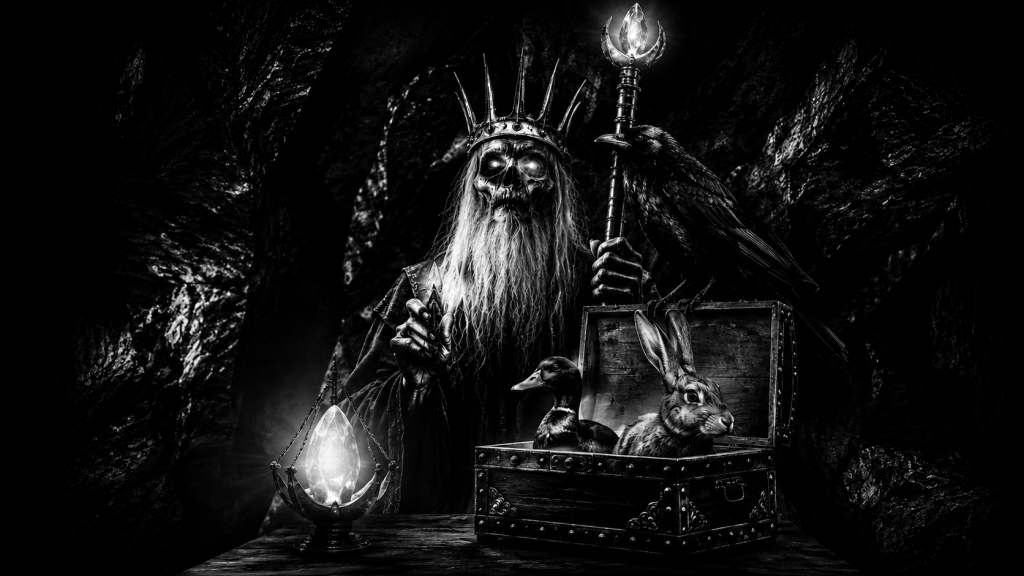
Sometimes a skeletal old man.
Sometimes something that feels less like a person and more like the embodiment of obsession itself.
Unlike dragons, wolves, or monsters that threaten villages through brute force, Koschei possesses something far more dangerous.
Patience.
He waits.
He schemes.
He cannot simply be defeated with courage or strength.
Because his greatest secret is hidden far away from his own body.
For centuries, listeners gathered around winter fires while storytellers unfolded a mystery unlike any other.
Death, they explained, did not always live where one expected.
Sometimes it could be hidden.
Protected.
Locked away beyond rivers, forests, islands, animals, and impossible riddles.
To defeat Koschei was never simply to win a battle.
It meant understanding a puzzle.
That idea continues to fascinate us today because it asks a timeless question.
If death could be separated from life…
…what would become of the person left behind?
Modern audiences often encounter Koschei through fantasy novels, films, comics, and video games, where fragments of his legend continue to inspire immortal villains and dark magicians.
Yet those modern interpretations are only echoes of a much older tradition.
To understand Koschei, we must travel back to a world where forests stretched beyond the horizon, every crossroads carried a story, and folklore was one of humanity’s oldest ways of asking difficult questions.
Who fears death?
Who seeks power?
And what is the cost of never letting go?
Chapter Two
The World That Imagined Koschei
Every legend begins somewhere.
Not with a single storyteller, but with generations of people trying to understand the world around them.
Long before the first kingdoms appeared across Eastern Europe, vast forests covered much of the landscape.
Rivers stretched for hundreds of miles.
Mist settled over marshes at dawn.
Winter transformed familiar roads into endless fields of snow.
For the early Slavic peoples, nature was not simply a backdrop for life.
It was life itself.
The forest provided shelter, food, medicine, and fuel.
It also concealed wolves, storms, strangers, and countless dangers that could not always be explained.
Living so closely with the natural world encouraged a way of thinking very different from our own.
Every river seemed capable of holding a spirit.
Every ancient oak appeared to possess a memory.
Every crossroads invited both opportunity and uncertainty.
Stories became a way of understanding those mysteries.
Before books were common, folklore served as history, philosophy, entertainment, and education all at once.
Children learned how to behave.
Adults reflected on courage, loyalty, greed, and sacrifice.
Communities preserved their identity by passing stories from one generation to the next.
Within that rich tradition emerged figures who represented different aspects of life.
Some protected the home.
Some ruled the forests.
Some guarded rivers or mountains.
Others reminded people that every decision carried consequences.
Koschei belonged to a different category altogether.
He was not a creature of nature.
He was a warning about human ambition.
Unlike spirits who lived in forests or waters, Koschei was driven by desire.
He sought power that could never satisfy him.
He wished to possess what could not truly be owned.
In many stories, he abducts princesses, hoards unimaginable wealth, or wages endless struggles against heroic figures.
Yet his greatest obsession was never gold or kingdoms.
It was escaping death itself.
That idea made him unlike almost every other figure in Slavic folklore.
Heroes sought honor.
Villains often sought riches.
Koschei sought permanence.
He wanted to outlive time.
It is no coincidence that these stories developed in societies where life could change quickly.
Harsh winters, famine, disease, and war reminded people that human life was fragile.
Against that reality stood Koschei—a figure who refused to accept the natural order.
His legend quietly asks a question that remains surprisingly modern.
If we could live forever…
Should we?
The answer offered by Slavic folklore is rarely spoken aloud.
Instead, it is woven into every encounter with the Deathless King.
Power without compassion becomes loneliness.
Immortality without wisdom becomes imprisonment.
And a life spent fearing death may never truly become a life at all.
Before we can understand how Koschei hid his death beyond the reach of ordinary men, we must first understand why anyone would attempt such a thing.
That secret lies at the very heart of his legend.
Chapter Three
Where Death Was Hidden
Every great legend has a mystery.
For Koschei the Deathless, that mystery was not who he was.
It was where he kept his death.
Unlike ordinary people, Koschei believed death could be separated from the body.
If it could be hidden…
It could be protected.
And if it could be protected…
Perhaps it could never find him.
This remarkable idea is one of the most imaginative concepts in all of world folklore.
Across the oldest versions of the tale, Koschei’s death is never nearby.
Instead, it is concealed through a series of increasingly impossible barriers.
The exact details vary from one storyteller to another, but the heart of the legend remains the same.
Far beyond the familiar world stands a distant island.
Upon that island grows an ancient oak.
Beneath the oak rests an iron chest.
Inside the chest waits a hare.
Within the hare is a duck.
Inside the duck is an egg.
And within that fragile egg…
…lies Koschei’s death.
It is one of folklore’s greatest puzzles.
Each layer represents another obstacle.
Another journey.
Another test of determination.
Heroes cannot simply defeat Koschei by force.
They must earn knowledge.
They must persevere.
They must solve a mystery that appears impossible.
For centuries, scholars have debated the meaning behind this extraordinary image.
Was the hidden egg simply a clever storytelling device?
Or did it symbolize something deeper?
Many believe it reflects an ancient understanding that true power always carries vulnerability.
No fortress is perfect.
No king is invincible.
No matter how carefully someone protects themselves, there remains one fragile point where everything can change.
That lesson extends far beyond folklore.
Every civilization has searched for ways to preserve itself.
Every ruler has sought lasting power.
Every generation has dreamed of overcoming mortality.
Yet the story quietly reminds us that absolute control is an illusion.
Perhaps that is why the image of the hidden egg has survived for centuries.
It transforms death into something physical.
Something that can be searched for.
Protected.
Lost.
Or finally discovered.
Modern audiences often recognize echoes of this idea without realizing its origins.
Fantasy literature, role-playing games, films, and novels frequently feature villains whose lives are bound to magical objects hidden far away from their bodies.
Although each modern version tells its own story, the underlying idea reaches back through centuries of Slavic storytelling to Koschei himself.
The legend has endured not because it promises immortality.
It endures because it asks us to imagine the impossible.
If death could be hidden…
Would we spend our lives protecting it?
Or would we spend our lives forgetting how to live?
Chapter Four
Heroes, Princesses, and Impossible Choices
No legend exists without conflict.
And no great villain exists without someone willing to challenge them.
Although Koschei is remembered as the Deathless King, his stories are never truly about him alone.
They are about the people who refuse to surrender to fear.
In many Slavic folktales, Koschei appears as an abductor.
A princess disappears.
A kingdom falls into despair.
A family is torn apart.
The hero’s journey begins not because glory is promised, but because someone chooses compassion over comfort.
Unlike modern fantasy, these heroes are rarely perfect.
They become lost.
They make mistakes.
They receive unexpected help from strangers, talking animals, wise women, and mysterious travelers.
Success belongs not to the strongest warrior, but to the one who remains humble enough to listen.
This is where Koschei’s stories become surprisingly human.
He represents certainty.
The hero represents growth.
Koschei believes that power can solve every problem.
The hero discovers that courage, kindness, and perseverance accomplish far more than force ever could.
One of the most fascinating aspects of Slavic folklore is that victory is almost never achieved alone.
A raven may carry an important message.
A wolf may guide the traveler through an unfamiliar forest.
A magical horse may outrun impossible dangers.
Even Baba Yaga herself sometimes helps those who approach her with honesty and respect.
The old stories remind us that wisdom often arrives from unexpected places.
Perhaps that is why these tales have remained meaningful for centuries.
Every obstacle teaches something.
Every companion matters.
Every choice shapes the ending.
Koschei, however, never learns.
He clings to possession.
He believes people can be owned.
He mistakes fear for loyalty.
He mistakes immortality for greatness.
Yet despite all of his power, he remains deeply isolated.
His greatest prison is not the castle where he keeps others.
It is the life he has built for himself.
Slavic storytellers understood something profound.
The opposite of death is not endless life.
It is meaningful life.
A person remembered for kindness may outlive someone who lived for centuries only in fear.
Perhaps that is the quiet lesson hidden beneath Koschei’s legend.
The Deathless King could escape mortality.
But he could never escape himself.
That truth has echoed through the folklore of Eastern Europe for generations, reminding us that the greatest battles are rarely fought with swords.
They are fought within the human heart.
Chapter Five
Beyond the Fairy Tale
For generations, Koschei the Deathless remained largely within the folklore of Eastern Europe.
His story traveled by memory rather than by maps.
Parents told it to children.
Grandparents shared it beside winter fires.
Traveling storytellers carried it from one village to another, each adding small details while preserving the heart of the legend.
Unlike characters created by a single author, Koschei belongs to everyone.
His story was shaped by countless voices across centuries.
As collections of Slavic folklore began to be written down during the eighteenth and nineteenth centuries, scholars realized they were preserving far more than fairy tales.
They were recording the imagination of entire cultures.
Among the most important collectors was Alexander Afanasyev, whose extensive compilation of Russian folktales introduced readers to figures such as Baba Yaga, Koschei, and many other legendary beings.
Without those efforts, countless stories might have disappeared forever.
Today, Koschei continues to live in places his earliest storytellers could never have imagined.
He appears in novels.
Films.
Illustrated books.
Television series.
Graphic novels.
Video games.
Tabletop role-playing adventures.
Each generation reshapes him to fit its own fears and imagination.
Sometimes he is portrayed as an ancient king.
Sometimes as a powerful sorcerer.
Sometimes as a skeletal immortal whose appearance reflects centuries of unnatural existence.
Yet no matter how much his appearance changes, one idea always remains.
His life is tied to something hidden beyond himself.
That extraordinary concept has influenced fantasy storytelling around the world.
Many modern villains protect their lives inside enchanted objects, magical artifacts, or distant places beyond ordinary reach.
Although these stories have developed their own identities, the echoes of Koschei’s legend remain unmistakable.
His influence extends far beyond Eastern Europe.
What makes Koschei endure is not simply his immortality.
It is the question his legend continues to ask.
What happens when the fear of death becomes greater than the desire to live well?
It is a question that speaks just as clearly today as it did hundreds of years ago.
Perhaps that is the greatest achievement of folklore.
It allows every generation to rediscover ancient ideas through new eyes.
Koschei has survived not because people believed he was real.
He has survived because the questions he represents never disappear.
As long as humanity wonders about mortality, power, and the limits of ambition, the Deathless King will continue waiting somewhere beyond the forest, guarding the secret that has fascinated storytellers for centuries.
Chapter Six
Why Koschei Still Matters
Every generation inherits its own monsters.
Some wear crowns.
Some wear uniforms.
Some exist only in stories.
Others live inside ideas.
That is why Koschei the Deathless continues to matter.
His legend was never simply about defeating an immortal king.
It was about understanding the dangers of believing that power alone can conquer every human limitation.
Across centuries, science has extended our lives.
Medicine has defeated diseases once thought unstoppable.
Technology allows us to preserve photographs, voices, and memories with remarkable clarity.
Every generation seeks a way to leave something behind.
There is nothing unusual about that desire.
It is deeply human.
Koschei reminds us, however, that there is an important difference between preserving life and refusing to accept its natural course.
His fear of death becomes greater than his love of living.
His pursuit of permanence costs him compassion.
His search for control leaves him increasingly isolated.
That lesson feels surprisingly modern.
Today we speak about legacy.
About influence.
About being remembered.
Yet the old storytellers quietly suggested that immortality is not achieved through endless existence.
It is achieved through the lives we touch.
The stories we tell.
The kindness we leave behind.
Perhaps that is why the heroes of Slavic folklore remain so memorable.
They are rarely the strongest people in the story.
They are the most generous.
The most patient.
The most willing to sacrifice for someone else.
Koschei possesses extraordinary power.
The heroes possess extraordinary character.
Only one of those qualities survives the final page.
Folklore has always served as a mirror.
It reflects the hopes, fears, and questions of the people who tell it.
When we read about Koschei today, we are not simply reading about an immortal king from long ago.
We are reading about ourselves.
About ambition.
About fear.
About the choices we make when confronted with the unknown.
The Deathless King has endured for centuries because every generation discovers something different within his legend.
Some see a villain.
Others see a warning.
Others still see a timeless meditation on mortality itself.
Perhaps that is the true magic of folklore.
The stories never change.
We do.
And each time we return to them, they reveal something we had never noticed before.
Chapter Seven
The Legacy of the Deathless King
Folklore survives because it continues to ask questions that every generation must answer for itself.
Koschei the Deathless has endured for centuries not because people believed an immortal king truly walked the forests of Eastern Europe, but because his story speaks to something timeless within the human experience.
The desire to escape death.
The temptation of absolute power.
The belief that security can be achieved by controlling everything around us.
These ideas are as relevant today as they were when the first storytellers gathered around village fires.
Although the details of Koschei’s legend changed from one region to another, the heart of the story remained remarkably consistent.
His death existed outside himself.
His power isolated him.
His fear became his greatest weakness.
Those themes have fascinated scholars of folklore for generations.
Russian folklorist Alexander Afanasyev preserved many of the tales that introduced Koschei to later readers, ensuring that these oral traditions would survive long after they might otherwise have disappeared.
During the twentieth century, scholars such as Vladimir Propp explored the deeper structure of Russian fairy tales, demonstrating that characters like Koschei were not simply villains but essential parts of stories that explored courage, sacrifice, transformation, and renewal.
Today, Koschei continues to appear in literature, film, theatre, illustration, and video games.
Each generation imagines him differently.
Yet every version returns to the same question.
What happens when the pursuit of immortality becomes more important than the purpose of life itself?
Perhaps that is why Koschei remains one of the great figures of world folklore.
He reminds us that death gives life meaning.
That compassion outlives power.
And that stories are often humanity’s oldest form of wisdom.
Long after kingdoms disappear…
Long after forests change…
Long after storytellers fall silent…
The Deathless King continues to wait.
Not because he cannot die.
But because every generation discovers him anew.
About the Author
Anna Volkov is a contributing writer for DARKWAVE Magazine, where she explores folklore, cultural history, architecture, literature, and the enduring stories that shape civilizations. Her work focuses on the intersection of myth, memory, history, and the human imagination, approaching legendary figures with historical curiosity, thoughtful research, and deep respect for the cultures from which they emerged.
About DARKWAVE Magazine
DARKWAVE Magazine explores music, film, culture, history, literature, architecture, folklore, and the ideas that continue to shape our world long after trends have faded.
Rather than asking whether something is good or bad, we ask why it matters.
Through thoughtful long-form journalism, DARKWAVE examines the people, places, and stories that continue to influence art, creativity, and culture. We believe curiosity is more valuable than criticism, that great art is meant to be experienced rather than judged, and that exploring the misunderstood often reveals the most enduring truths.
Because every story has a history.
And every history has another story waiting to be discovered.
References
Afanasyev, Alexander. Russian Fairy Tales. Pantheon Books.
Propp, Vladimir. Morphology of the Folktale. University of Texas Press.
Johns, Andreas. Baba Yaga: The Ambiguous Mother and Witch of the Russian Folktale. Peter Lang Publishing. (For discussion of the broader East Slavic folklore tradition.)
Warner, Marina. From the Beast to the Blonde: On Fairy Tales and Their Tellers. Farrar, Straus and Giroux.
Encyclopaedia Britannica. “Koschei (Koschey).” https://www.britannica.com