Dr. Seuss: The Making of an Imagination
How Theodore Geisel transformed simple rhymes and impossible creatures into one of the most recognizable artistic worlds ever created—and why his imagination continues to inspire children, artists, filmmakers, and dreamers generations later.
By: Joe Chopski
Estimated Reading Time: 20 minutes
Introduction
There are few artists whose work can be recognized from across a room.
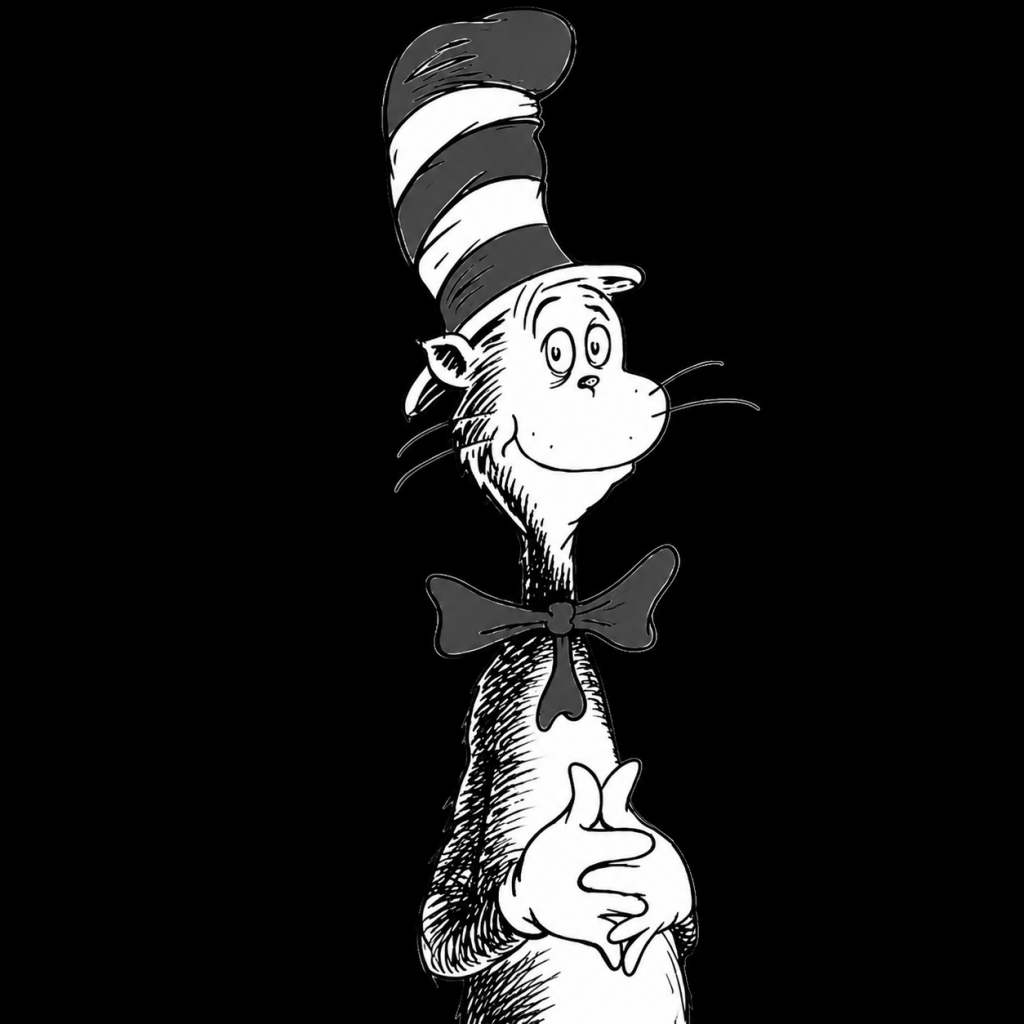
A single curved tree, a striped hat, an impossible machine balanced on spindly legs, or a creature with oversized eyes and impossibly long eyelashes is often enough. Before a word is read, before a rhyme begins, we already know where we are.
We have entered the world of Dr. Seuss.
For more than eighty years, that world has existed somewhere between dream and reality. It is a place where logic bends without breaking, where landscapes sway like music, where animals speak in riddles, and where every page seems to suggest that curiosity is more important than certainty. Children rarely question these worlds. They simply accept them. Adults, returning years later, often wonder how one person could imagine them in the first place.
That question lies at the heart of Theodore Geisel’s remarkable career.
Known around the world by his pen name, Dr. Seuss, Geisel created far more than children’s books. He developed a visual language unlike any other—one that continues to influence illustrators, filmmakers, architects, designers, animators, musicians, and storytellers decades after his death. His drawings remain instantly recognizable because they do something extraordinarily rare: they make the impossible feel inevitable.
Yet imagination does not appear from nowhere.
Behind every whimsical creature, every playful rhyme, and every impossible landscape was a lifetime of observation, experimentation, triumph, disappointment, political conviction, and artistic discipline. The man who encouraged millions of children to think beyond the ordinary first spent years learning how to see the ordinary differently himself.
This is not simply the story of a beloved children’s author.
It is the story of how Theodore Geisel became Dr. Seuss—and how one imagination changed the way generations learned to see the world.
Chapter One
Before There Was Dr. Seuss
Long before children laughed at the antics of the Cat in the Hat or followed Horton as he listened faithfully to a tiny voice on a speck of dust, there was simply a young boy growing up in Springfield, Massachusetts.
Born on March 2, 1904, Theodore Seuss Geisel entered a world very different from the one he would eventually create. Springfield was a prosperous industrial city at the turn of the twentieth century, a place of factories, trolley cars, public parks, and growing neighborhoods shaped by immigrants from across Europe. Among them was the Geisel family, whose German heritage would become both a source of pride and, during the First World War, an unexpected burden.
The family’s brewing business had earned respect within the community, but as anti-German sentiment spread across the United States during the war, even established families found themselves viewed with suspicion. Businesses changed, public attitudes hardened, and names that had once carried no controversy suddenly marked people as outsiders.
For the young Theodore Geisel, these experiences offered an early lesson in how quickly perception could shape reality. Although he rarely spoke about these years in dramatic terms, the themes of belonging, exclusion, prejudice, and empathy would later echo quietly through many of his books. Stories such as The Sneetches, Horton Hears a Who!, and others reveal an author deeply interested in fairness, compassion, and the dangers of judging others by appearances.
But before any of those ideas reached the page, Geisel was becoming something else entirely.
He was becoming an observer.
He watched people. He sketched constantly. He found humor in everyday life and delighted in exaggerating ordinary objects until they became wonderfully absurd. Long before readers met Truffula Trees or fantastical creatures with impossible names, Theodore Geisel had begun asking a simple artistic question that would guide the rest of his life:
What if the world were just a little stranger than we believe it to be?
That question would eventually become one of the most recognizable artistic signatures in modern history. But first, a curious young illustrator would have to discover his voice—and, eventually, the name by which the world would know him.
Chapter Two
The Name That Shouldn’t Have Existed
Every artist has a moment when possibility collides with circumstance.
For Theodore Geisel, that moment did not arrive in a publishing office or an art studio. It arrived in the offices of Dartmouth College after an evening that violated Prohibition and cost him one of the positions he valued most.
As editor-in-chief of The Jack-O-Lantern, Dartmouth’s celebrated humor magazine, Geisel had already begun discovering something that would define the rest of his career. Years later, he reflected that Dartmouth was where he first realized “the excitement of marrying words to pictures,” observing that together they could create something more powerful than either could alone.
Then everything changed.
Following a disciplinary action, Geisel was ordered to resign from the magazine. For many students, that would have been the end of the story. Instead, it became the beginning of another.
Determined to continue contributing, he quietly submitted cartoons under a different signature.
Seuss.
The name belonged to his mother’s family, but now it became something else entirely. It became a disguise that allowed an artist to keep creating when he had officially been told to stop. Ironically, the name that would become famous around the world first appeared as a quiet act of persistence rather than ambition.
After graduating from Dartmouth, Geisel traveled to Oxford University with the expectation that he might pursue an academic career. His father hoped he would earn a doctorate. The path seemed respectable, predictable, and secure.
Oxford, however, offered him something far more important than a degree.
It offered perspective.
His notebooks filled with drawings as often as lecture notes. According to family recollections, his future wife, Helen Palmer, looked across the table at one of his pages covered with fantastic creatures and gently suggested that he was pursuing the wrong profession. Rather than becoming a professor, she believed he should become an artist. It was a simple observation, yet it changed the course of American illustration.
Sometimes the most important encouragement an artist receives is not praise from others.
It is the moment they begin believing in themselves.
The realization that creativity is not something granted by permission, approval, or authority. It is something claimed through curiosity, persistence, and the willingness to continue creating even when no one has invited you to do so.
For Theodore Geisel, that realization changed everything.
He left Oxford without the doctorate his father had imagined. Years later he jokingly added “Dr.” to his pen name—a playful nod to the degree he never earned and the expectations he quietly transformed into something entirely his own.
Looking back, it is tempting to see destiny in these moments. But destiny rarely announces itself.
It usually arrives disguised as disappointment.
The suspension from a college magazine.
The abandoned doctorate.
The uncertain future of a young illustrator with no guarantee that drawing whimsical creatures could become a career.
Without those detours, the world may never have known Dr. Seuss.
Chapter Three
Learning to See the Impossible
Long before children met Horton, the Grinch, or the Lorax, Theodore Geisel spent years drawing products that most people hoped they would never have to think about.
In the late 1920s and 1930s, he worked as a commercial illustrator, creating advertisements, magazine cartoons, and humorous illustrations. One campaign for the insecticide Flit became so successful that its slogan entered American popular culture, introducing Geisel’s distinctive sense of exaggeration to millions who had never heard the name Dr. Seuss.
Advertising demanded clarity.
Every line needed a purpose.
Every illustration had to capture attention before a reader turned the page.
Without realizing it, Geisel was serving an apprenticeship.
He learned rhythm.
He learned economy.
He learned how to guide the eye across an image without the viewer noticing.
Most importantly, he learned that imagination could make even the ordinary unforgettable.
If an advertisement for insect spray could become memorable through playful drawings and unexpected humor, what might happen if there were no product to sell at all?
What if imagination itself became the subject?
His illustrations from this period already hinted at the world to come. Strange birds appeared where ordinary birds would have sufficed. Machines bent and twisted with playful improbability. Trees seemed to sway as though responding to invisible music. Even before the rhymes arrived, the visual language of Dr. Seuss was quietly taking shape.
Artists often speak of “finding their style,” as though it arrives in a single moment of inspiration.
Geisel’s style emerged differently.
It accumulated.
Each assignment refined his line. Each cartoon taught him something about movement, proportion, exaggeration, or humor. Decades before audiences recognized a drawing as unmistakably “Seussian,” Theodore Geisel was patiently constructing that visual vocabulary one illustration at a time.
Perhaps that is the greatest misconception about imagination.
We often imagine it as spontaneous.
In reality, imagination is built.
It is strengthened through observation, repetition, failure, curiosity, and thousands of hours spent drawing when no one is watching.
The impossible worlds of Dr. Seuss did not appear overnight.
They were carefully, patiently, and deliberately learned.
The extraordinary was built upon years of ordinary work.
Chapter Four
When Experience Becomes Perspective
History has a way of changing the people who live through it.
By the early 1940s, Theodore Geisel had already established himself as an accomplished illustrator, but the world around him was changing rapidly. Before millions of readers knew him as Dr. Seuss, he was creating editorial cartoons for the New York newspaper PM, using illustration to comment on the defining events of his time. Not long afterward, he joined the United States Army’s Signal Corps, where he contributed to training and educational films under the direction of filmmaker Frank Capra. Those years broadened his understanding of visual storytelling and demonstrated how powerful images could be in communicating ideas. Dartmouth Geisel archives
When those experiences were behind him, Theodore Geisel returned to something he loved most.
Drawing.
Writing.
Imagining.
The books that followed never felt burdened by history, yet they quietly reflected an enduring belief in kindness, compassion, curiosity, and the importance of seeing the world through someone else’s eyes.
Horton Hears a Who! reminds us that every voice matters.
The Sneetches celebrates acceptance over division.
The Butter Battle Book encourages readers to think about conflict without ever losing its sense of imagination.
What makes these stories remarkable is that they never feel like lessons.
They feel like adventures.
Children laugh at the characters.
Adults discover the ideas waiting beneath them.
That balance became one of Theodore Geisel’s greatest gifts as a storyteller.
He understood that imagination could open a door that arguments never could.
Chapter Five
Building the Impossible
Look closely at a Dr. Seuss illustration.
Nothing stands perfectly straight.
Trees bend as though dancing in an invisible breeze.
Buildings lean with cheerful confidence.
Machines twist together in ways that should never function, yet somehow appear perfectly reasonable.
Strange creatures smile as though they have always existed, waiting patiently for someone to discover them.
This world was not created by accident.
It was built one drawing at a time.
One idea at a time.
One sketch after another.
Long before readers recognized a page as unmistakably “Seussian,” Theodore Geisel was quietly refining his craft. Years spent illustrating advertisements, magazines, and editorial cartoons sharpened his ability to guide the eye, simplify complex ideas, and communicate emotion through line, rhythm, and composition. Those skills would eventually become the foundation of one of the most recognizable artistic styles ever created. The Dr. Seuss Collection, UC San Diego Library
Believing in yourself is rarely a single dramatic moment.
More often, it is a quiet promise made over and over again.
To keep drawing.
To keep learning.
To keep creating.
To continue building something that exists only in your imagination until one day it becomes real enough for others to see.
That quiet persistence lives on every page of a Dr. Seuss book.
Today, the word “Seussian” has become part of our cultural vocabulary. It describes architecture, landscapes, typography, illustration, and design that immediately call to mind Theodore Geisel’s extraordinary visual language. Few artists have achieved something so remarkable that their name becomes a way of describing an entire aesthetic.
Yet style alone is not what continues to inspire generations of readers.
It is wonder.
Children open a Dr. Seuss book expecting to discover something they have never seen before.
Adults return years later and rediscover something they had almost forgotten.
The freedom to imagine without limits.
Perhaps that is Theodore Geisel’s greatest legacy.
He did not simply create memorable books.
He reminded millions of people that imagination is something worth protecting.
And like any meaningful craft, it grows stronger through patience, persistence, practice, and the courage to believe in an idea long before anyone else can see it.
Chapter Six
Where the Impossible Lives
Open the cover of a Dr. Seuss book.
Don’t rush.
Stand there for a moment.
Listen.
Somewhere nearby, an impossible machine rattles and whirs for reasons known only to itself.
A tree leans in a direction no tree has ever leaned before.
A bird with impossibly long legs strolls confidently across the page as though the laws of nature have simply agreed to take the afternoon off.
Nothing seems ordinary.
And somehow…
everything feels exactly as it should.
This is the remarkable world Theodore Geisel created.
It is a place where imagination never apologizes for itself.
Take another step.
There’s Horton, standing perfectly still, listening so carefully that the entire world seems to have grown quiet around him. Everyone else hears silence.
Horton hears an entire world.
Keep walking.
Someone laughs.
The Cat in the Hat has already arrived, and judging by the expressions on Thing One and Thing Two, it’s probably too late to turn back now.
Around the next bend, Sam-I-Am appears with his endless optimism, convinced that one more bite might change everything.
A little farther on, the Fox in Socks races by, happily twisting words into joyful knots, proving that language itself can become a playground.
High above the village, the Grinch watches the Whos from Mount Crumpit, unaware that the smallest acts of kindness are quietly preparing to transform his heart.
Beyond a forest of brightly colored Truffula Trees, the Lorax continues speaking for the trees, reminding us that every beautiful thing deserves someone willing to protect it.
On a nearby beach, the Sneetches slowly discover that stars on bellies were never what made them special in the first place.
Not far away, Yertle the Turtle builds his throne a little higher, convinced that seeing farther somehow makes him greater.
Each story is different.
Each landscape is different.
Each character speaks with a voice entirely their own.
Yet every one of them belongs unmistakably to the same imagination.
That may be Theodore Geisel’s greatest artistic achievement.
He did not simply invent memorable characters.
He created an entire universe with its own visual language…
its own rhythm…
its own joyful logic.
Children rarely stop to wonder how extraordinary that is.
They simply step inside.
Adults often spend a lifetime trying to understand how one imagination could feel so limitless.
Perhaps that is because these books were never asking us to believe in impossible creatures.
They were asking us to believe in impossible possibilities.
That a tiny voice deserves to be heard.
That kindness can grow where no one expects it.
That curiosity is worth following.
That words can dance.
That imagination is often the shortest distance between the impossible and the unforgettable.
Long after the final page is turned, Horton, the Grinch, the Lorax, the Cat in the Hat, Sam-I-Am, the Fox in Socks, Yertle the Turtle, the Sneetches, and countless others continue living in our collective imagination.
Few artists accomplish that.
Fewer still make it feel effortless.
Theodore Geisel did both.
He didn’t simply write books.
He built a place with no address, no borders, and no map…
yet generations have somehow found their way there.
Chapter Seven
A World That Belongs to Everyone
There is something remarkable that happens the moment anyone opens a Dr. Seuss book.
The world immediately becomes larger.
Not because the pages are filled with complicated ideas.
But because they suggest that absolutely anything is possible.
A fish can give advice.
An elephant can hear voices too small for anyone else to notice.
A grumpy creature with a heart “two sizes too small” can discover kindness.
A turtle can dream of a throne.
A cat can balance impossible objects while turning an ordinary afternoon into unforgettable chaos.
None of these ideas should work.
Yet every one of them does.
That is the quiet magic of Theodore Geisel.
He never asked permission to imagine differently.
He simply imagined.
His books invited readers to do the same.
Perhaps that explains why generation after generation continues to discover Dr. Seuss. Parents introduce his stories to their children. Teachers fill classrooms with his rhymes. Artists study his illustrations. Designers borrow his playful sense of movement. Animators admire the way every page seems alive before anything even moves.
His influence stretches far beyond children’s literature.
It can be found in animation.
Graphic design.
Architecture.
Advertising.
Film.
Typography.
Even people who have never read one of his books immediately recognize a “Seussian” landscape the moment they see one.
Very few artists create something so original that it becomes part of our shared visual language.
Theodore Geisel accomplished exactly that. His unmistakable style continues to inspire illustrators and storytellers around the world, and his books remain among the most widely read works of children’s literature ever published. The Dr. Seuss Collection, UC San Diego Library
Originality is a difficult thing to explain.
It cannot be manufactured.
It cannot be copied.
The moment it becomes imitation, it is no longer original.
Dr. Seuss understood something many artists spend a lifetime discovering.
Your greatest strength is not becoming someone else.
It is becoming more completely yourself.
Chapter Eight
The Courage to Imagine
Imagine sitting alone with a blank sheet of paper.
No audience.
No applause.
No guarantee that anyone will ever see what you create.
Only an idea.
That is where every Dr. Seuss book began.
One drawing.
One sentence.
One curious thought that refused to disappear.
It is easy to admire finished masterpieces.
It is much harder to appreciate the quiet hours that came before them.
The sketches no one remembers.
The pages thrown away.
The countless moments spent refining a single line until it finally felt right.
Those invisible hours became the foundation of an extraordinary career.
Perhaps that is the most enduring lesson Theodore Geisel leaves behind.
Creativity is not reserved for a select few.
It belongs to those willing to practice.
To remain patient.
To keep learning.
To continue creating long after excitement has faded and discipline has taken its place.
No one can give you an imagination.
No one can hand you originality.
Those things are discovered through persistence.
One sketch becomes another.
One page becomes another.
One idea becomes another.
Over time, something extraordinary begins to emerge.
Not because it was planned that way.
But because someone believed in an idea strongly enough to keep going.
That is exactly what Theodore Geisel did.
He trusted his own imagination.
He drew the trees no one else would have drawn.
He invented creatures no one had ever seen.
He wrote rhythms that danced across the page like music.
He created a world that did not exist until he decided it should.
Perhaps every young artist who opens a Dr. Seuss book discovers something more valuable than a story.
Perhaps they discover permission is unnecessary.
The only things required are curiosity, patience, persistence, practice, and the courage to believe in yourself.
Everything else begins with the first line on a blank page.
Chapter Nine
The Lasting Imagination
Long after the final page is turned, something curious remains.
It is not simply the rhyme.
Or the characters.
Or the impossible trees that seem to sway with a life of their own.
It is the feeling that the world may be a little more interesting than it appeared just a few moments before.
That is a remarkable achievement for any artist.
Theodore Geisel did more than write children’s books.
He reminded us that imagination is not something we leave behind when we grow older.
It is something we carry with us.
Sometimes quietly.
Sometimes forgotten.
Sometimes waiting for the right story to wake it up again.
His books continue to inspire because they refuse to place limits on possibility.
They remind us that curiosity is stronger than certainty.
That kindness is never out of place.
That wonder still has value.
And that the most unforgettable worlds often begin with a single idea and the courage to follow it wherever it leads.
There will never be another Dr. Seuss.
There shouldn’t be.
His greatest achievement was never creating a style that others could imitate.
It was creating a style that could belong only to him.
Perhaps that is the lesson hidden between every rhyme and every drawing.
The world does not need another Theodore Geisel.
It needs people willing to discover their own voice.
Their own rhythm.
Their own way of seeing.
Some will paint.
Some will write.
Some will compose music.
Some will make films.
Some will invent worlds no one has imagined before.
The medium is not what matters.
The imagination is.
If Theodore Geisel leaves us with one lasting gift, perhaps it is this:
Believe in your ideas.
Practice your craft.
Be patient with yourself.
Remain curious.
Keep creating.
And never wait for permission to become the artist you were meant to be.
That is how Theodore Geisel became Dr. Seuss.
And somewhere, perhaps at this very moment, another young artist is sitting with a blank sheet of paper…
Drawing the first line.
References
- Dartmouth Library, Rauner Special Collections. Theodor Seuss Geisel Collection.
- UC San Diego Library. The Dr. Seuss Collection.
- Dr. Seuss Enterprises.
- Morgan, Judith, and Neil Morgan. Dr. Seuss & Mr. Geisel.
- Cohen, Charles D. The Seuss, the Whole Seuss, and Nothing but the Seuss.
- Nel, Philip. Dr. Seuss: American Icon.
- Minear, Richard H. Dr. Seuss Goes to War.
- Selected interviews, archival publications, and historical newspaper sources consulted during research.
About the Author
Joe Chopski is a singer-songwriter, filmmaker, record producer, and founder of DARKWAVE Magazine. His work explores the intersection of music, film, visual art, and cultural history, with a particular interest in the creative processes behind influential artists and landmark works. His research focuses on music history, recording techniques, production methods, filmmaking, visual storytelling, and the ideas that continue to shape generations of artists.
About DARKWAVE Magazine
DARKWAVE Magazine explores music, film, culture, history, literature, architecture, folklore, and the ideas that continue to shape our world long after trends have faded. Rather than asking whether something is good or bad, DARKWAVE asks why it matters.
Through research-driven long-form journalism, the magazine examines the people, places, and creative processes behind influential works of art, believing that curiosity is more valuable than criticism and that art is not a competition. By exploring the misunderstood with historical context, thoughtful research, and genuine curiosity, DARKWAVE seeks to illuminate the stories that continue to inspire generations.
Because every story has a history.
And every history has another story waiting to be discovered.